
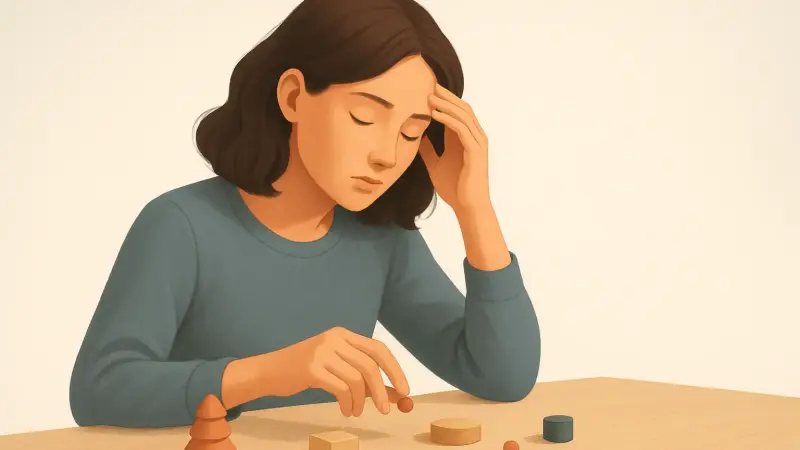
You see it in all kinds of places, not just one scene: a receptionist lining up pens at a clinic, a student nudging erasers into a straight row in a library, someone in a Tokyo café rotating a sugar packet so the logo faces the same way as the spoon. It looks small. Almost pointless. But the core mechanism is pretty direct. Anxiety pushes the brain toward scanning and uncertainty. Tiny rearrangements create a pocket of certainty. The eyes get a stable pattern. The hands get a predictable sequence. For a moment, the world becomes legible at arm’s length.
A narrow kind of control the brain can trust
An anxious mind tends to overestimate what could go wrong, especially when outcomes are unclear. Rearranging small objects is one of the few control signals that never argues back. The objects don’t have moods. They don’t change the rules midstream. That matters because anxiety often shows up as “I can’t get a clean read on anything.” With coins, paper clips, or spice jars, the read is clean. You move a thing. It stays moved. The feedback is immediate.
This is also why the action can feel more settling than thinking. Thinking about a messy day still requires prediction and interpretation. Straightening a pile of receipts doesn’t. It turns the mind from forecasting into verifying. Verify is easier to finish.
The hands set the tempo when thoughts won’t
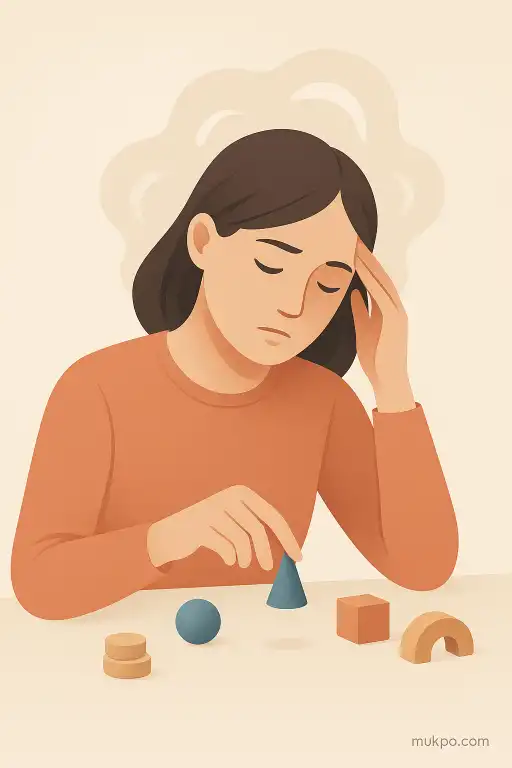
Small object arrangement is repetitive and paced. That gives the nervous system a steady rhythm without needing a big decision. When people are anxious, their attention can jump. It grabs at alerts, sounds, and “what if” scenarios. A simple motor sequence keeps attention anchored: pick up, rotate, place; pick up, rotate, place. The body is doing one thing, then one thing again.
There’s a specific overlooked detail here: the friction and sound. Felt on a desk, plastic sliding on laminate, the soft click of magnets snapping together. Those micro-sensations are not just background. They give the brain a stream of concrete input, which competes with abstract worry. People often notice the “neatness” and miss the sensory track that’s doing a lot of the work.
Order is a visual shortcut for safety
Vision is fast. The brain can read a tidy row or a symmetric layout almost instantly. That quick read matters because anxiety is partly a problem of interpretation. If the environment looks unpredictable, the mind stays on alert. When objects are aligned, grouped by size, or spaced evenly, the scene becomes easier to scan. Less scanning can mean less vigilance.
It’s not that “order equals good.” It’s that order reduces ambiguity. A scattered set of items creates unanswered questions: where is the missing piece, what’s out of place, what might be wrong? A neat arrangement answers some of those questions before they fully form. The eyes stop searching for a mismatch that isn’t there.
It turns vague worry into a solvable problem
Anxiety is often about problems with no clear edges. Rearranging small objects gives the brain a task with edges. The “problem” is defined by the surface in front of you. The constraints are real: the width of a drawer, the size of a tray, the number of binder clips. You can finish it, even if nothing else feels finishable.
A concrete example is a waiting room: someone keeps re-stacking pamphlets so the corners line up, then taps the stack twice to square it. The tapping looks like a quirk. But it’s also a finalizing gesture. It signals completion in a way anxious thoughts often can’t. The stack is done. The mind gets a small “closed loop,” which is rare during uncertainty.
Why it’s usually small objects, not big ones
Small objects are light, quiet, and low-risk. They don’t demand commitment. Rearranging furniture is slow and can trigger more evaluation: is this better, is it worth it, will someone notice? With small items, the cost of being wrong is basically nothing. That low cost keeps the brain from spiraling into second-guessing.
Small objects also allow precise correction. If a book is half a centimeter out of line, it’s easy to fix. Precision is satisfying to an anxious mind because it offers a clear “right.” You can see the improvement immediately. Even the distance between items can become the point, because spacing is one of the few things you can control down to the millimeter without needing anyone else to cooperate.
Related reads
- How tiny vortices make rainbows around waterfalls
- The pond that freezes into perfectly clear glass overnight every winter
- The lamppost used as an informal speed detector after repeat dents proved a pattern
- The bakery that insists seawater is the secret to its crackling crust
- How micro-expressions reveal thoughts before words
- The urge to double check locks even when you know you did