
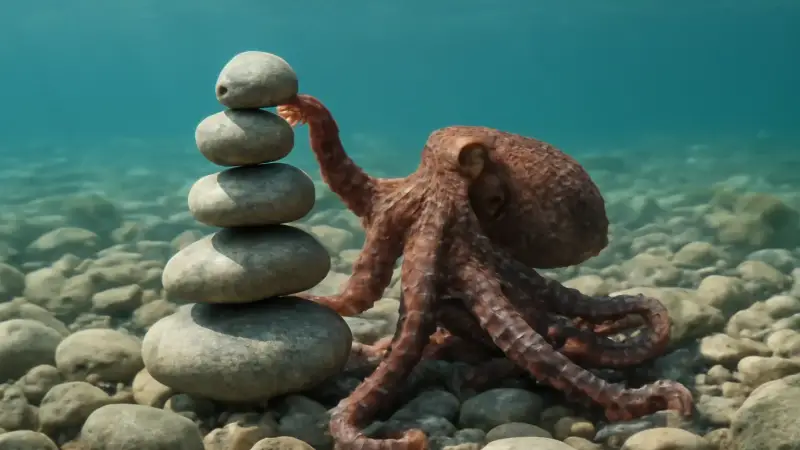
What people mean when they say “stacking stones”
If you watch a reef long enough, you sometimes see an octopus doing something that looks almost fussy. It picks up rocks, shells, or coral bits and places them around a chosen spot. This isn’t one famous incident in one place. It shows up in different regions and species, including coconut octopuses in Indonesia, gloomy octopuses around Australia, and common octopuses across the Mediterranean. The basic mechanism is simple. A soft animal without a shell needs a defensible hiding place. If the seafloor is flat or sparse, it rearranges what’s already there to make a den that works.
Why a den needs building at all
Octopuses can’t rely on speed for long and they can’t out-muscle most predators. A den gives them time. It lets them rest, digest, and wait out danger. It’s also a place to handle food without advertising themselves as much. Some dens are natural cracks or holes. But on sand, rubble, or seagrass edges, the “good” cavities can be rare. That’s when an octopus may start acting like a moving piece of construction equipment, pulling material in to make a usable entrance and a roofed-over pocket.
The overlooked detail is how specific the problem is. It’s not just “hide better.” The entrance has to be small enough to block with arms or a single rock, but large enough to squeeze through quickly. Octopuses often leave a narrow gap they can seal from inside. That gap is the difference between a den and a pile of rubble.
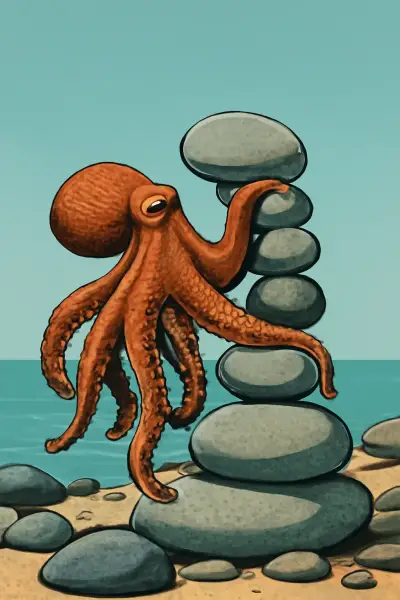
What stacking changes for predators and rivals
Adding stones changes the geometry of an attack. A moray eel or a wrasse can probe openings, but a reinforced doorway is harder to pry open and easier for an octopus to control. Some octopuses pull a “doorstone” into place when they settle in. Others build a low wall that forces an approaching animal to come from one direction. That matters because octopus arms can grip and push in a tight space, and a predator has to expose itself to get a good bite.
Stacking can also be about other octopuses. Dens are limited resources. If a site is valuable, there can be pressure to hold it. A boundary of rocks and shells makes the den’s edge clearer and makes a quick takeover harder. It doesn’t guarantee safety, but it raises the cost of getting in, which is often enough.
How they do it with arms that also have minds
To a human, it looks like deliberate masonry. The tools are suction, leverage, and patience. An octopus can test an object’s weight, rotate it, and slide it into place while staying low and partly hidden. Because octopus nervous systems are distributed, each arm can handle a lot of local sensing and control. That makes fine placement easier than you’d expect from an animal without bones. You often see quick adjustments: a rock moved two centimeters, then another nudged in, then a pause to check the fit with the tips of the arms.
Not every “stack” is stable for long. Currents, surge, and sand movement can undo it. So the behavior can look repetitive. An octopus may rebuild the same doorway again and again, especially after a night of hunting when the den has been disturbed.
When it’s shelter, and when it’s something else
Sometimes the stone work isn’t only for day-to-day hiding. During egg brooding, a female often stays in a den for weeks. A better barricade can reduce how often she has to react to intrusions while she ventilates and cleans the eggs. In other situations, the pile around a den includes leftovers: crab shells, snail shells, and fish bones. That can be an accidental effect of eating in one spot, but it can still function as extra cover and as a physical barrier.
There are also cases where the objects are portable shelters rather than a fixed den. Coconut octopuses have been observed carrying coconut shells and sometimes arranging them as a hide. That’s not the same behavior as stacking stones at a doorway, but it comes from the same pressure: the seafloor doesn’t always provide a ready-made safe space, so the octopus makes one out of whatever is available.
Related reads
If you liked this, you might also enjoy: