
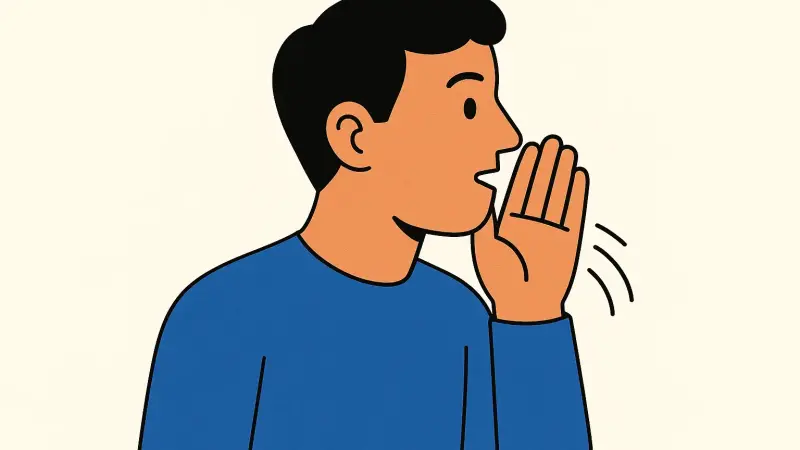
It shows up in ordinary places
You hear it at the self-checkout at Target, in a hospital hallway, or at a stoplight with the window cracked: a low, barely audible stream of directions. “Keys, phone, badge.” “Turn left, then second door.” It isn’t one single “place where it happens.” It’s a small habit that pops up wherever people have to hold a sequence in mind while doing something else. The core mechanism is simple. Speech, even whispered speech, can act like a handle for attention and memory. It makes a fuzzy plan feel more solid for a few seconds.
Whispering can work like a scratchpad for working memory

When someone whispers instructions, they’re often using sound to keep a step-by-step list from slipping away. Working memory is limited and fragile. It gets bumped by distractions, stress, or competing tasks. A whispered “first, then” turns the sequence into something you can rehearse. It’s easier to keep track of “one more step” when you can hear it, even quietly.
A specific detail people overlook is timing. The whisper often lands right at the transition between steps: hand reaches for the card, then the person murmurs “tap… receipt.” That’s not random. Transitions are where people most commonly lose their place, because the brain has to switch from planning to moving. The tiny bit of speech helps bridge that switch.
It reduces “task switching” when hands and eyes are busy
Some instructions are hard to keep purely “in the head” because the same mental resources are already occupied. If someone is assembling furniture, driving in unfamiliar streets, or charting a patient, their eyes and hands are taking priority. Whispering offloads part of the control process into the speech system. It’s not that speaking is effortless. It’s that speaking can run alongside manual actions in a way that silent planning sometimes can’t.
You can see it in quick, functional phrases rather than full sentences. “Top shelf.” “Blue wire.” “Save, then send.” They’re not trying to communicate with anyone nearby. They’re creating a narrow channel that keeps the next action from being overwritten by the current one.
It can be a form of self-cueing, not “talking to yourself” as a mood thing
People often assume whispering instructions signals anxiety or quirky personality. Sometimes stress is involved, but the behavior can be purely mechanical. It’s self-cueing: giving yourself a prompt the way a coach calls a play. Athletes do it. So do musicians counting under their breath. So do people who are trying not to forget one last item before they leave the house.
The whisper can also help with inhibition. If a person is tempted to rush, the spoken “slow” or “check” acts like a speed bump. It’s brief and specific. It doesn’t require a whole internal debate. That’s why it tends to show up when precision matters and mistakes are costly, like medication dosing, lab work, or entering numbers on a payment screen.
Why it’s often a whisper instead of normal volume
Whispering sits in a useful middle zone. It’s audible enough to reinforce the instruction, but quiet enough to avoid social consequences. People generally know that full-volume self-talk can draw attention, especially in public. A whisper keeps the benefit while signaling, “I’m not addressing you.” It can also be a privacy move. If the instruction includes sensitive info—an address, a PIN-like sequence, a patient room number—lower volume reduces the chance of being overheard.
There’s also a physical piece that varies by person: some barely move their lips, others mouth words without sound, and some whisper more clearly. The exact form depends on context, comfort, and how much reinforcement they need. What stays consistent is the function: using speech as a small external anchor when the next step matters.

Related reads
- A shop that only accepts payment in odd-numbered coins
- Seagrass meadows that trap microplastics in their blades and change sediment chemistry
- How dust grains stick together to build planets around young stars
- A microbe in Antarctic ice that eats methane without sunlight
- How cactus spines harvest fog into tiny water droplets
- How abandoned boats and tires turn into accidental reefs