

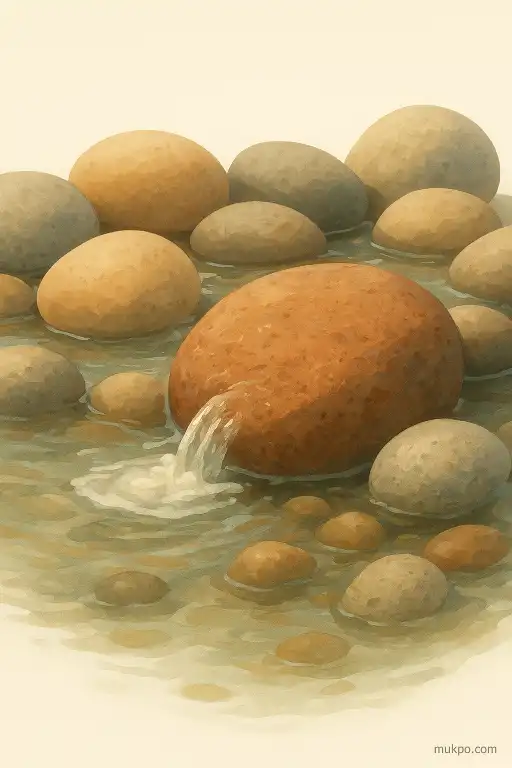
Stand near a fast riffle and you might hear a thin, glassy chirp mixed into the roar. It isn’t a bird. It can be a stone. This doesn’t happen in one famous “singing river” spot. People report it in mountain streams in the Scottish Highlands, in parts of the Rocky Mountains in Colorado, and in Japanese rivers where rounded cobbles get tumbled hard. The basic mechanism is simple: moving water makes certain stones vibrate, and those vibrations couple to the air as sound. The surprising part is how picky it is. Most rocks stay quiet, even in the same current.
What “singing” usually sounds like
The sound is usually a short squeak, a ping, or a high note that comes and goes as the flow changes. It tends to show up where water is shallow and fast, not in deep pools. It also tends to be easier to notice when the general river noise drops for a second, like between bursts of turbulence, because the “note” is narrow-band while the river is broad and noisy.
A common overlooked detail is how local the sound can be. It might come from one small patch of cobbles, not the whole bar. Move a few steps and it fades. That’s a clue that the river isn’t acting like one big instrument. It’s more like a bunch of tiny ones that only work when the current hits them in just the right way.
The role of shape, material, and hidden cavities

Not all stones can hold a clean vibration. A rounded cobble with a hard, elastic material (think dense silica-rich rock like quartzite) can “ring” more readily than a crumbly sedimentary stone that damps itself. If a stone has a thin edge, a flat face, or a small lip, water can excite it like a reed or a spring, pushing it rhythmically. A smoother stone can also slip into a steady vibration because the flow separates cleanly around it.
Some of the most effective noisemakers have something people don’t notice unless they pick one up: a small cavity, crack, or drilled-looking hole from weathering. Those features create a little chamber or a flexible wall. Water pressure changes across that opening can make the stone act like a tiny resonator. The frequency depends on the size and stiffness, so two similar-looking rocks can sound completely different.
How rushing water turns into a note
Fast water is full of instabilities. As it slides past a stone, it sheds vortices and produces pressure pulses. If those pulses line up with a natural vibration mode of the stone, the motion can build. That’s why the sound can suddenly appear at one flow speed and vanish at another. The forcing has to match the stone’s preferred rhythm closely enough to overcome damping.
Air matters too. Turbulent flow can drag air down into the gaps between stones. Those trapped air pockets compress and expand as water surges over them. That adds another springy element, which can sharpen a tone. If the bed is fully flooded with no air in the voids, the same stones may go quiet because water alone transmits and damps vibration differently than an air-water mix.
Why it happens in one spot and not the next
Riverbeds are messy. The same stream can have a silent bar and a “musical” patch because the packing is different. When cobbles wedge tightly, they can’t move enough to radiate sound. When they’re just loose enough to jitter but not so loose that they rattle chaotically, a cleaner tone can pop out. Grain size matters here. A mix of one dominant cobble size with smaller stones filling gaps often behaves differently than a bed of uniformly sized rocks.
Water depth also shifts the boundary conditions. A stone half-exposed to air can radiate sound much more efficiently than one fully submerged, because the air side “hears” the vibration better. That’s why the sound often comes from riffles where some rock surfaces are close to the surface or intermittently uncovered by waves.
Why it’s easy to miss, even when it’s happening
Human ears are good at picking out tones, but rivers are loud in the same frequency range where small stones tend to sing. Wind, nearby cascades, and even wet leaves can mask it. And the sound can be directional. A cobble vibrating against its neighbors can send more sound downstream than sideways, depending on how it’s braced and where the air gaps are.
There’s also a timing issue. A stone can sit quiet for minutes, then chirp for a few seconds when a surge changes the flow speed or when a small pebble shifts and creates a new contact point. That tiny change in how two stones touch—one new hard contact, one new gap—is sometimes all it takes to switch from dull friction noise to a clear, single note.
Related reads
- The bakery that prints miniature maps on loaves pointing to secret recipes
- Why urban pigeons harbor unusual antibiotic resistant microbes
- How whale songs bend in deep ocean layers
- Why lightning sometimes strikes the same tree dozens of times
- The vending machine that dispenses live plants with tiny adoption cards
- How tardigrade proteins stop cells from drying out