
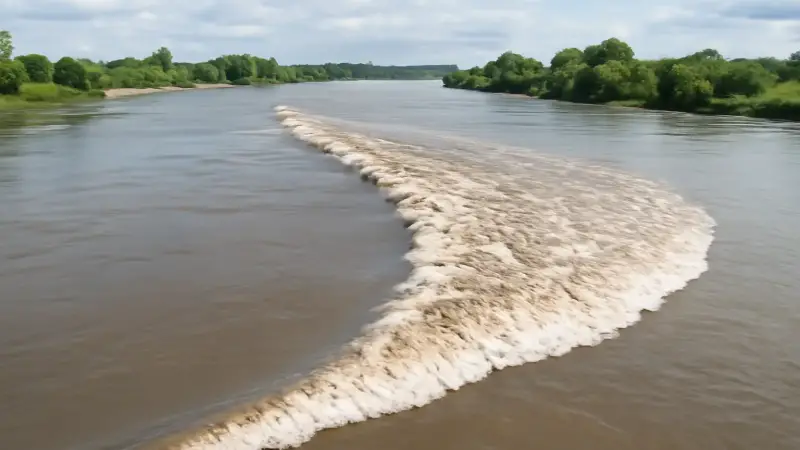
What a tidal bore looks like in real life
People picture tides as something that slides in gently. Then they see the Qiantang River in China, where a loud, fast-moving surge can run upriver like a moving wall. That’s a tidal bore. It’s not one single place or one single event. It happens in a handful of rivers and estuaries where the incoming tide gets squeezed and steepened until it becomes a wave that travels upstream. The Severn in England and Canada’s Bay of Fundy (in rivers like the Petitcodiac, depending on conditions and local changes) are other well-known examples. The basic driver is simple: the ocean is pushing in, and the river shape won’t let that push spread out quietly.
The tide has to arrive fast enough to bunch up
A bore needs a big tidal range and a strong tidal current. The water level at the mouth has to rise quickly, so the incoming flow has speed and momentum, not just height. Spring tides matter because they make the rise steeper. So do storm surges, although they can be messy and variable. If the tide is small or slow, the incoming water still moves upriver, but it stays as a gradual current and a gentle change in depth rather than a sharp front.
That “sharp front” forms when the incoming tide tries to push a lot of water into a space that can’t accept it smoothly. As the tide runs into shallower water, friction with the bed slows the lower part of the flow more than the upper part. The top keeps moving faster, so the leading edge steepens. At a certain point the flow can’t stay smooth, and it breaks into a hydraulic jump: a sudden step up in water level that moves as a wave.
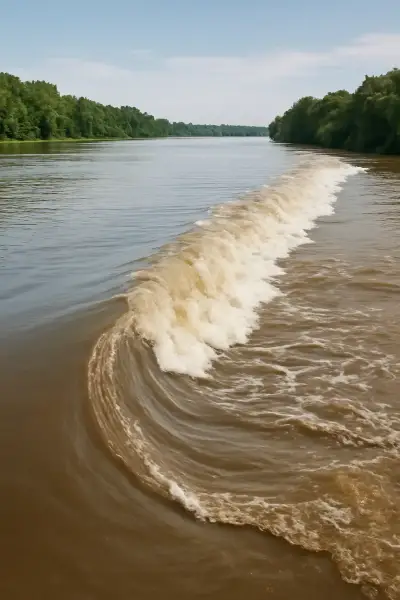
River shape is the gatekeeper
The classic setup is a funnel-shaped estuary that narrows inland. The narrowing forces the tidal flow into a smaller cross-section, which boosts current speed. Shallow depths help too, because shallow water waves travel differently than deep water waves, and they are more easily steepened by bottom friction. A straight, deep, wide estuary can have a huge tide without producing a bore, because the energy spreads out and the tidal wave stays low and long.
One overlooked detail is how quickly the channel depth changes over short distances. Sudden shallowing bars, sandbanks, and steps in the riverbed can act like ramps that help the wave face stand up. That’s why bores can shift location from year to year. A river mouth that silts up, dredges, or migrates can change whether a bore is clean and strong, weak and broken into smaller waves, or absent.
Freshwater flow decides whether the bore can fight its way in
River discharge is the other half of the contest. When the river is low, the incoming tide meets less resistance, so the bore can travel farther upstream and look more dramatic. When the river is high from rain or snowmelt, the outflow can blunt the incoming tide and flatten the wave. The same river can alternate between “bore days” and “no bore” just because the upstream flow changed.
There’s also timing. If the strongest tidal push arrives when the river is already near low tide in the channel, the incoming water has more room to accelerate and steepen. If the channel is already deep, the tide can pour in with less of a sudden step. That’s why bores often have a schedule that locals know well, but it still varies with season, weather, and the exact tide cycle.
What moves upriver is a moving jump, not a single “wave”
A bore is usually a leading surge followed by a train of standing waves and turbulent rolling water. It can sound like heavy wind. It can carry debris. The physics looks like a traveling hydraulic jump: water behind the front is deeper and slower, and the front itself is a zone of intense mixing. Salty water can be pushed upriver under or within the freshwater, depending on density layering and turbulence, so the bore is also a quick rearrangement of where salt and fresh water sit.
That turbulence is why the river surface can look oddly “boiling” behind the front, even when the weather is calm. It’s not just a surface ripple. It’s energy being dumped into chaotic motion and heat by friction and mixing. The exact height and shape can be hard to predict because small changes in channel depth, sandbars, and upstream flow can change where the jump forms and how cleanly it holds together as it runs inland.
Related reads
- How microbes dissolve concrete to access buried minerals
- Why volcanic ash plumes often produce spectacular lightning bolts
- How your brain filters out half of a crowded conversation
- When Victorian Parliament fled as the Thames reeked across London
- Why awkward silences feel physically uncomfortable
- How a beetle survives being frozen by turning its blood into antifreeze
If you liked this, you might also enjoy: