
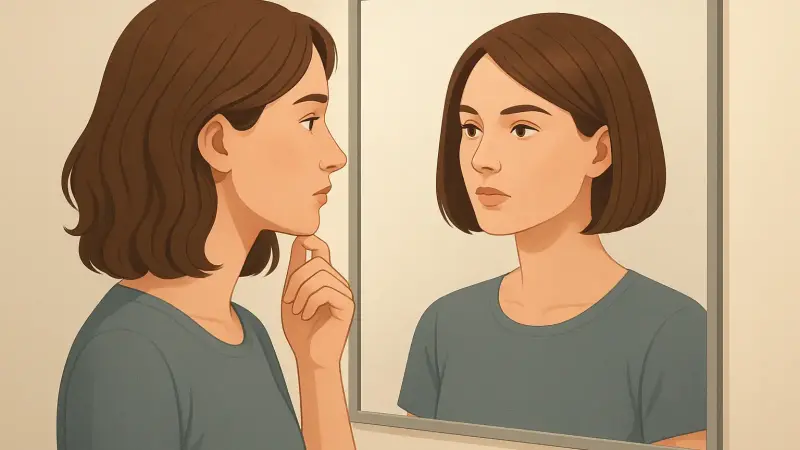
That “different person” moment is common
A lot of people have the same odd reaction after a big haircut: they catch themselves in the bathroom mirror and hesitate, like their face belongs to someone else. It isn’t tied to one place or event. You’ll hear it in a barbershop in London, a salon in Seoul, or a cramped apartment bathroom in New York. The basic mechanism is simple. Your brain doesn’t recognize “you” from scratch each time. It relies on a familiar template, and hair is a huge part of that template. When the template changes fast, the mirror image can briefly fail to match what your brain expects.
Your brain recognizes patterns, not faces in isolation
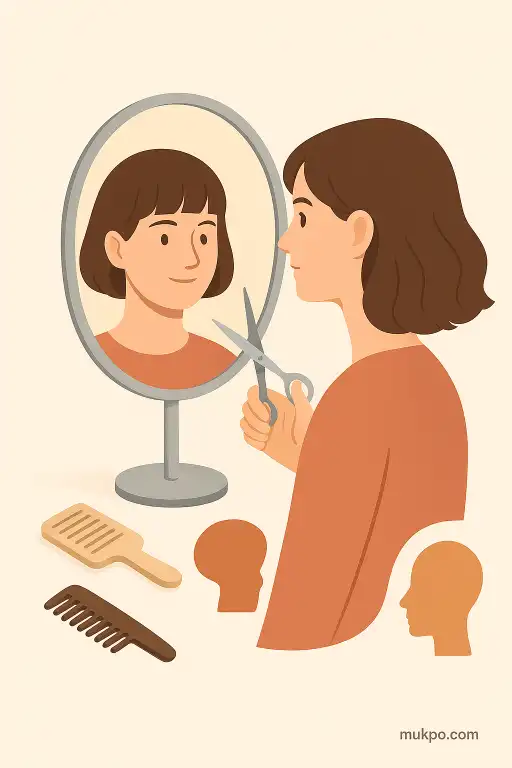
Face perception is built around quick, automatic pattern matching. The brain uses stable anchor points—eye spacing, nose shape, the mouth line—but it also leans on surrounding context. Hairline, volume, and the outline around the cheeks and jaw act like a frame. After a haircut, the frame changes, so the same internal features can “read” differently. A blunt bob can make the cheeks look wider. A fade can make the head shape look longer. None of that requires the face to change. It’s the pattern your brain has gotten used to that’s been edited.
This is also why the effect is strongest with sudden changes. Gradual hair growth gives the brain time to update its internal model. A dramatic cut forces an instant update, and for a short while your perception can lag behind the actual image.
The mirror adds its own confusion
The mirror shows a left-right reversed version of the face you see in photos. People adapt to their “mirror-self” through repetition, but it’s still a specific view you’ve learned. After a haircut, you’re comparing a new frame to an old mirrored memory. That mismatch can create a weird sense of unfamiliarity even if the cut looks objectively good.
A specific detail people overlook is the lighting angle in the place where they first notice it. Bathroom vanity lights often come from above or the sides. A new haircut exposes more forehead, ears, or neck, and those areas catch light differently. That shifts shadows under the eyes and along the jaw. The face hasn’t changed, but the shadow map has, and the brain treats shadows as meaningful structure.
Hair changes the “geometry” of your face
Hair doesn’t just sit on the head. It changes what edges are visible. Covering the temples can make the forehead seem smaller. Removing bulk near the sides can make the cheekbones stand out. Even tiny changes at the sideburns can alter how the jawline is perceived. This is why someone can feel unrecognizable after “only” taking a few inches off: the cut may have changed the silhouette that the brain uses as a shortcut for identity.
A concrete example is going from long hair that touches the shoulders to a cut above the ears. In the mirror, the neck suddenly becomes part of the visible “face package.” That extra visible skin can make the head look larger, the chin look sharper, or the eyes look higher, even though the distances between facial features are identical.
Identity is partly a memory problem, not a vanity problem
Recognizing your own face is a special case. It isn’t like recognizing a stranger. It’s tied to a long history of stored snapshots: quick glances in mirrors, a handful of favorite photos, reflections in dark windows. Hair is one of the loudest repeating cues across those snapshots. When it changes, your internal “average” of what you look like can be temporarily out of date, so the mirror image feels like it belongs to a sibling or a lookalike instead of you.
There’s also a timing issue. Right after a haircut, people often see themselves repeatedly in short bursts—mirror at the shop, mirror at home, phone camera, a reflection in a car window. Those rapid comparisons can make differences feel bigger than they are, because the brain keeps flipping between two versions of “me” that are both vivid and recent.
Related reads
- The river that briefly runs neon green after a festival dye washout
- Why we cling to useless belongings: the surprising psychology of sentimental clutter
- Why certain minerals glow under ultraviolet light
- How wood frogs survive freezing solid
- How hermit crabs choose shells using chemical cues
- How photosynthetic bacteria thrive in boiling hot springs