
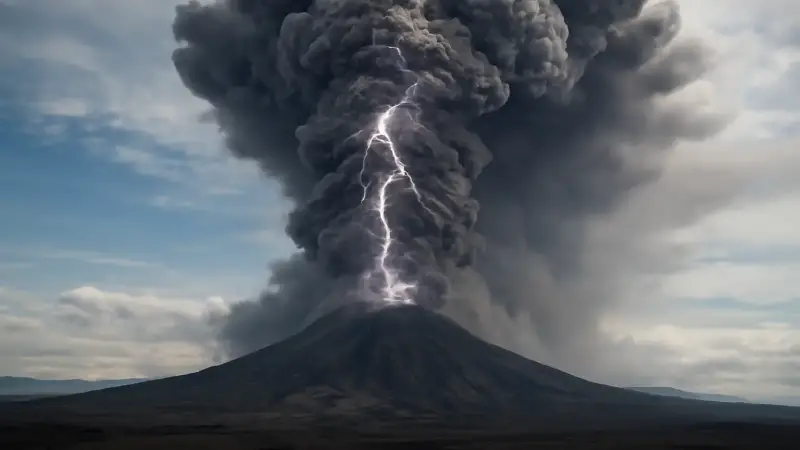
Ash clouds that act like thunderclouds
People usually expect lightning to come with rain, not with rock dust. But some eruptions throw off bolts bright enough to see through a black column. It’s not one single event. It shows up at places like Mount Redoubt in Alaska (2009), Eyjafjallajökull in Iceland (2010), and Sakurajima in Japan. The basic reason is simple: an ash plume can build up separated electric charge fast, and once the electric field gets strong enough, the air breaks down and a discharge happens.
Charging starts with collisions, not just ice
A volcanic plume is full of particles slamming into each other. Ash grains, bits of pumice, and tiny fragments of glass collide and rub. That contact can transfer electrons, a process often grouped under triboelectric charging. Which material ends up positive or negative can vary with composition, temperature, surface coatings, and humidity, so the exact “direction” of charging is not fixed from one volcano to the next. But the key point is that eruptions create constant, violent particle-to-particle contact, and that produces lots of charge quickly.
A detail people often overlook is how much the particle surface matters. Fresh ash has jagged edges and huge surface area. It is not smooth sand. Those rough surfaces can hold charge on tiny protrusions and corners, and sharp points intensify electric fields locally. That makes it easier for small discharges to start, especially close to the vent where particle concentrations are extreme.
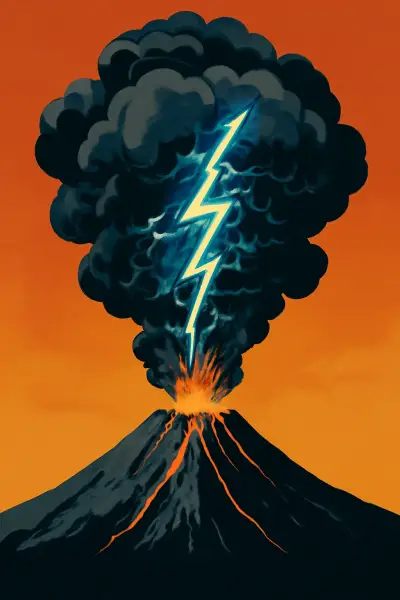
Separation happens because the plume sorts itself
Making charge is only half the story. Lightning needs separation, so opposite charges aren’t immediately neutralized. Plumes naturally sort particles by size and weight. Coarser, heavier ash tends to fall out sooner. Fine ash can stay aloft and get carried outward. Updrafts push some material higher while gravity pulls other material down. That creates layers and pockets where charge can accumulate rather than cancel out, building the electric field across distances that can range from meters to kilometers.
The way the column rises also matters. Strong, pulsing jets create repeated bursts of new charged particles and fresh separation. If an eruption becomes more ash-poor and more gas-rich, the charging efficiency can drop, and lightning can become less frequent. That shift is often visible in videos where the earliest, densest jets produce the most flashes.
Some volcanic lightning is “near-vent,” some is storm-like
Not all bolts in an eruption come from the same physics at the same distance. Close to the crater, there can be short, rapid “near-vent” discharges driven mainly by particle collisions and extreme concentrations. These can look like staccato flashes embedded in the dark column. Farther downwind, a tall ash plume can also behave more like a thunderstorm if it grows high enough to cool, condense water, and sometimes form ice. Then the familiar cloud microphysics that drives regular thunderstorms can add to the volcanic charging rather than replace it.
Whether a plume reaches that storm-like phase depends on the eruption strength and the atmosphere on that day. Moisture, temperature profiles, and wind shear all affect how tall the column gets and whether it produces convective clouds. That’s why two eruptions from the same volcano can look electrically very different.
Why the bolts can look unusually sharp and frequent
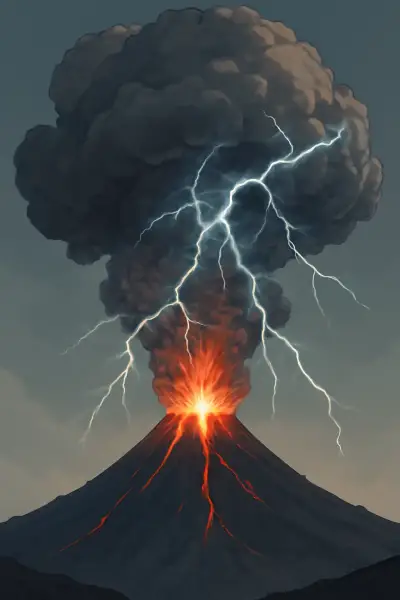
Lightning inside ash often looks crisp because the background is dark and opaque, so the channel stands out. But there is also a physical reason the activity can be intense: the plume keeps feeding the charging zone. A thundercloud charges itself more slowly as droplets and ice interact over time. An eruption can inject a continuous stream of fresh particles already colliding and separating, right where the electric fields are building. That steady supply can produce repeated discharges in the same general region.
Researchers also use that electrical activity as a clue about what the plume is doing, because lightning detection networks can “see” discharges even when the vent is hidden by weather or darkness. It doesn’t give a perfect measure of ash output, and the relationship varies by volcano and conditions, but it can reveal when the plume is vigorously particle-rich versus when it has transitioned to a more gas-dominated column.
Related reads
- How your brain filters out half of a crowded conversation
- When Victorian Parliament fled as the Thames reeked across London
- Why awkward silences feel physically uncomfortable
- How a beetle survives being frozen by turning its blood into antifreeze
- A town that kept changing clocks so shops never opened the same hour
- What hummingbird tongues reveal about fluid dynamics at tiny scales
If you liked this, you might also enjoy: