
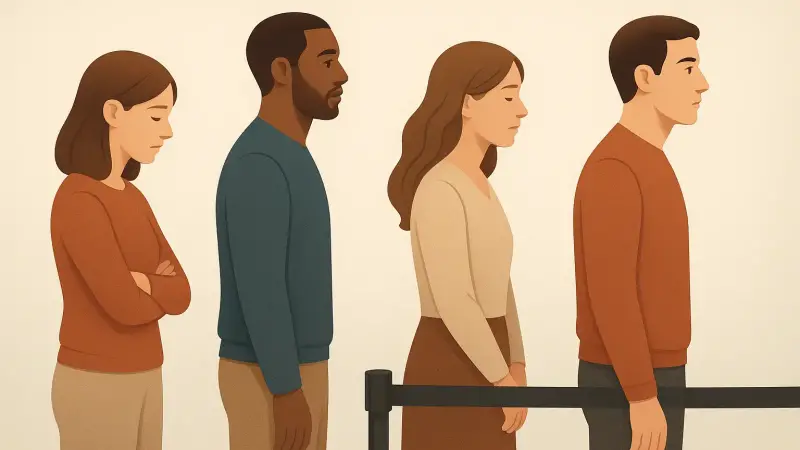
It’s not one line, it’s lots of different ones
Ten minutes on your couch can pass quietly. The same ten minutes at TSA in a U.S. airport, at Disneyland’s Space Mountain queue, or at a busy London coffee shop can feel oddly long. It isn’t one specific place or one famous event. It’s a pattern that shows up wherever people have to wait in public. The basic mechanism is that time doesn’t feel like a stopwatch reading. It feels like a mix of attention, uncertainty, and how much control you think you have over what’s happening.
A small overlooked detail is how often you check the “progress signal.” In a line, your eyes keep measuring distance to the front, the speed of the cashier, the size of the person’s cart, the movement of the rope barriers. At home, there’s often no equivalent yardstick unless you keep looking at the clock.
Attention makes time feel thicker
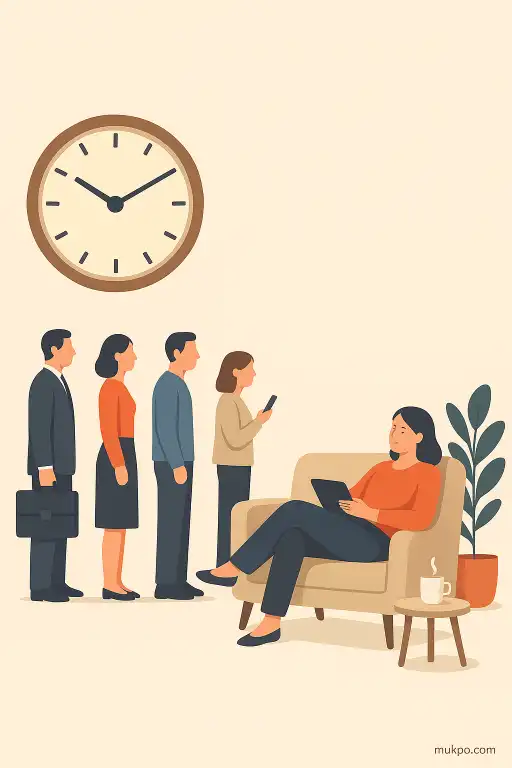
Waiting in line is hard to ignore. There’s nothing else the situation asks you to do except stand there and monitor whether it’s “moving.” That pulls attention toward time itself. Psychologists often describe this as time feeling longer when attention is aimed at the passing of time, and shorter when attention is absorbed by something else. At home, even if you’re technically waiting for the same thing—food delivery, a download, a friend to arrive—you can sink into a show, a chore, or a conversation. That shifts attention away from the wait.
Lines also provide constant micro-events that invite attention without rewarding it. A register opens, then closes. Someone fumbles with a wallet. A staff member walks by, but not to your station. Each one is a tiny “maybe this changes things” moment. You notice it, then you’re back to waiting, now more aware of every second.
Uncertainty hurts more than duration
At home, the wait often has a rough shape. A microwave says 2:00. A laundry cycle says 34 minutes. Even if those estimates aren’t perfect, the brain gets a boundary. In a physical queue, the boundary is often unclear. Two people ahead could mean two minutes or fifteen, depending on what they need, whether a manager has to approve something, or whether a machine stops working.
That uncertainty changes how time is experienced. When you can’t predict how long it will take, you keep updating your estimate. That mental updating is work. It also creates extra disappointment when your prediction is wrong, especially when the line pauses for a reason you can’t see.
Control and fairness are part of the clock
Standing in a line is a controlled situation. You can’t speed it up, and you can’t swap out the process. At home, you often can. You can start something else, switch to another task, or change the order you do things. That sense of agency matters. A wait you choose feels shorter than a wait you’re forced to accept, even when the minutes match.
There’s also the fairness monitor. In public queues, people track cutting, lane-jumping, and whether another line is moving faster. Even when nothing unfair happens, the brain keeps checking. It’s a quiet social calculation: who arrived when, who “deserves” to go next, whether the system is working. At home, that whole layer is usually missing.
Environment adds friction you don’t notice at home
Physical discomfort stretches time. Hard floors, heavy bags, tight space, bright lighting, noise, or a too-warm room all add low-grade stress. Stress changes attention and makes small delays feel bigger. Even minor hassles matter because the body is already signaling that it wants the situation to end.
Queues also have “stop-and-go” pacing, which people tend to perceive as slower than steady movement. A line that creeps forward every thirty seconds can feel worse than one that moves smoothly at the same average speed, because each stop resets your expectation. It’s especially noticeable when you reach the last few feet and the pace suddenly changes, like the awkward gap between the rope maze and the counter where you can see the finish but not reach it.
Related reads
- How two Yorkshire cousins convinced Edwardian Britain that fairies danced in their garden
- How a bark beetle epidemic transformed 20th century North American forests
- What aurora colors reveal about collisions in Earth’s upper atmosphere
- The fish with transparent teeth that glow under red light
- The pause when two people start talking at once and who yields
- The town that held an election where a dog outpolled a human candidate