
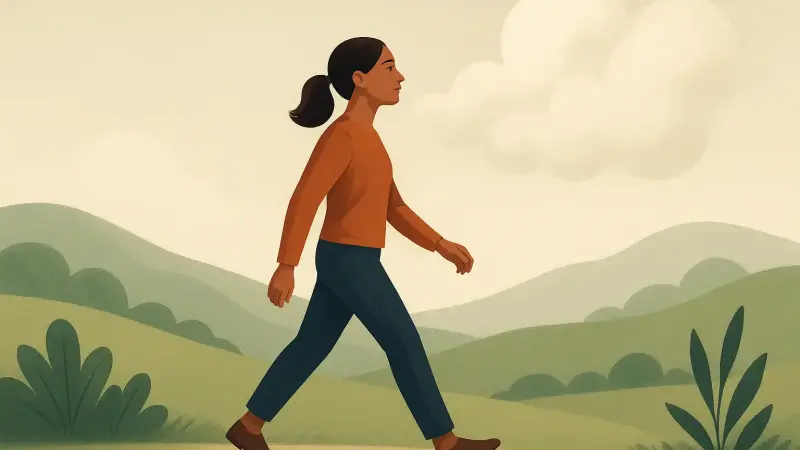
People get stuck on a problem at a desk, then come back from a short walk with the answer half-formed. It isn’t one single place or famous incident. You see it in small routines all over, from a lap around Central Park in New York to a loop along the Thames Path in London to the narrow streets of Tokyo. The core mechanism is surprisingly plain: walking changes the inputs your brain is juggling. Your body shifts into a steady rhythm, your eyes stop staring at one fixed point, and your attention loosens. That combination makes it easier for ideas to recombine without getting pinned down by the same cues.
Walking changes what your attention is doing
When someone is stuck, attention often narrows. The mind keeps checking the same details and the same internal “draft” of an answer. Walking tends to widen attention just enough to stop that loop. The visual field is moving. Sounds arrive and fade. Small choices happen automatically—step here, pass there, keep pace—without requiring deep planning. That mild, shifting demand uses attention in a different way than a screen or a page, and it can interrupt the mental rut without forcing full distraction.
One overlooked detail is eye behavior. At a desk, the eyes usually lock at a fixed distance and angle for long stretches. Outdoors or even in a hallway, the focus distance changes constantly. Near, far, near again. That continuous adjustment seems minor, but it changes the stream of sensory information feeding the brain, and it changes how tightly the mind clings to one thought.
Steady movement reduces “manual control” in the brain
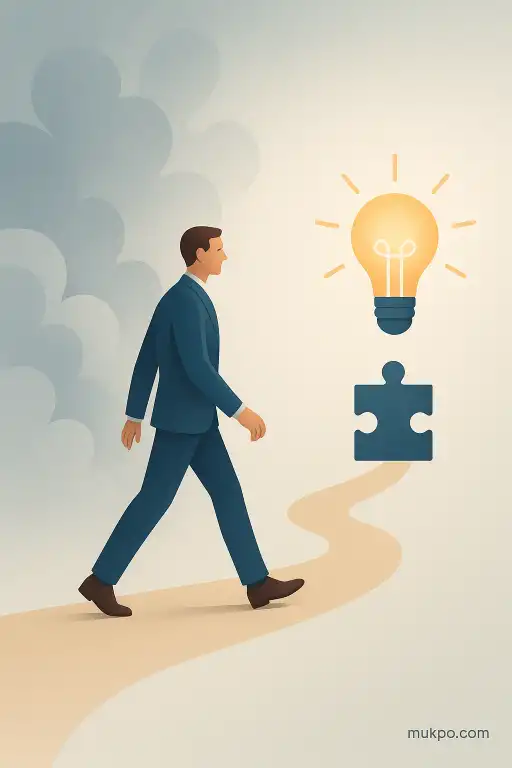
Walking is repetitive. After the first seconds, it runs on well-learned patterns: balance, stride, timing. Because it is familiar, it demands less deliberate control than many other activities. That matters because the same limited mental resources used for careful problem-solving are also used for self-monitoring and error-checking. When the body is doing something stable and predictable, there is often less need for constant internal supervision, and that frees capacity for quieter associations to surface.
This is also why the setting matters in a specific way. A crowded crossing, slippery pavement, or unfamiliar route can pull attention back into tight control. The walk becomes about not bumping into people or not getting lost. When the movement stays easy and safe, the mind can afford to drift without fully disengaging from the problem.
New cues break the grip of the original context
Problems get “stuck” partly because the context around them becomes part of the problem. The chair, the same open tabs, the same lighting, the same notifications. Those cues keep triggering the same approach. Walking removes that context and replaces it with different cues every few seconds. A delivery bike passes. A shop sign appears. The temperature changes in a patch of shade. Each cue is tiny, but together they reduce the chance that the brain keeps retrieving the exact same unhelpful framing.
A concrete example looks ordinary. Someone leaves an office building after rereading the same email draft for an hour. On the sidewalk, they notice a construction detour and have to pick a different block. Halfway down the new street, a better opening line arrives. It isn’t that the detour “inspired” the sentence. It’s that the mind stopped reloading the same context that kept producing the same draft.
Walking supports a different kind of memory search
When people try to force an answer, they often keep querying memory in the same narrow lane: the obvious facts, the recent attempts, the standard method. Walking seems to make the search less rigid. The mind is still working, but it is less insistent. That can allow more remote associations to come up—an old conversation, a half-remembered example, a phrase heard earlier—without immediately being judged and discarded. For many kinds of problems, especially wording, planning, or design, those remote fragments are exactly what’s missing at the desk.
It also changes timing. At a desk, the mind can check and re-check every second. While walking, thoughts arrive in longer waves because the environment is continuously updating. That spacing can be useful. It gives partial ideas time to unfold before the inner critic jumps in to edit them.
Stress chemistry and breathing shift in small but real ways
Fog isn’t only “mental.” It often rides with tension: tight shoulders, shallow breathing, a background sense of urgency. Walking changes physiology in modest ways. Breathing tends to deepen. Muscles warm and loosen. Heart rate rises slightly, then settles into a rhythm. Those shifts can reduce the body’s threat posture, which matters because stress pushes thinking toward short, defensive loops. When the body relaxes even a little, the mind is more willing to explore options that aren’t guaranteed.
The overlooked piece here is how quickly the body responds to micro-signals. A bright screen late in the day, a stiff chair, a cold office, a constant buzz of alerts—each can keep the nervous system on edge without anyone noticing. A walk replaces those signals with wind, ambient noise, and changing light. The brain is still doing work, but it is doing it in a different internal climate.
Related reads
- How peregrine falcons harness mountain winds to reach dive speeds
- Why your handwriting shifts when you write in a hurry
- Why a sudden noise can still make your heart jump long after the danger is gone
- Why car tires squeal on hot asphalt from rubber chemistry
- How the Donner Party’s 1846 winter stranded a wagon train and forced unimaginable choices
- How some fungi collapse their caps to launch spores like tiny cannons