
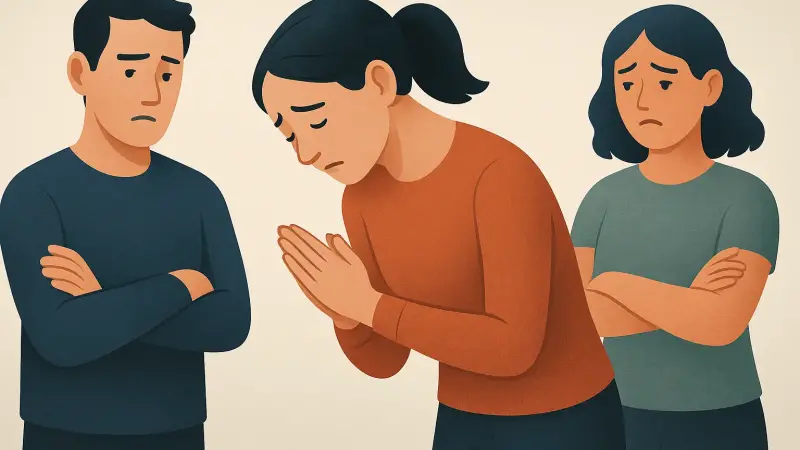
The tiny “sorry” that slips out
It isn’t one single place or moment. It shows up everywhere. In the UK, people joke that “sorry” means almost anything. In Canada, the word is so common that Ontario passed an Apology Act in 2009 saying an apology isn’t automatically an admission of legal liability. In the US, you’ll hear someone say “Sorry” while squeezing past a chair that’s already out of the way. The core mechanism is simple: the word gets used less as confession and more as social lubricant, a quick signal that someone is tracking other people’s comfort.
Sorry as a way to manage space

A lot of unnecessary apologies happen when bodies and objects share space. Someone bumps a table, drops a pen, or blocks a doorway for half a second and apologizes to a person who wasn’t actually harmed. The “offense” isn’t damage. It’s the risk of inconvenience. People often say “sorry” before anyone reacts, which makes it more like a pre-emptive cue than a response to wrongdoing.
A detail people overlook is timing. The apology often comes at the exact moment someone makes eye contact or notices they’ve been noticed. That timing tells you it’s doing interpersonal work. It’s less about the chair or the pen and more about the tiny negotiation of “I see you, I’m not trying to impose.”
Sorry as a safety check
People also use “sorry” to test how safe an interaction is. You hear it in service settings, workplaces, and crowded public spaces. Someone says, “Sorry to bother you,” before asking a normal question. The question isn’t wrong. The speaker is checking whether the other person is receptive or irritated, without forcing a confrontation.
This works because “sorry” is low-cost and flexible. It can soften the edge of an interruption and leave room for the other person to respond kindly. If the other person snaps, the speaker can retreat without escalating. If the other person is warm, the exchange stays smooth. The word becomes a quick read on mood and status, not a moral judgment.
Sorry as a stand-in for other phrases
In everyday speech, “sorry” often replaces a whole set of messages people don’t want to spell out. It can mean “excuse me,” “pardon,” “thanks for waiting,” “I didn’t mean to interrupt,” or even “I’m surprised.” The classic example is “Sorry?” meaning “Can you repeat that?” There’s no wrongdoing there. It’s just a conventional sound that keeps the conversation moving without stopping to negotiate the exact wording.
It can also be used as a gentle disagreement marker. Someone says, “Sorry, I think that’s next Tuesday,” when they could have said, “You’re wrong.” The apology doesn’t admit fault. It makes the correction feel less like a challenge. That matters in groups where harmony is valued or where directness is read as aggression.
Why some people do it more than others
Apologizing patterns vary by culture, workplace norms, family style, and personality, and the research doesn’t point to one universal rule. But there are clear pressures that push certain people toward extra “sorry”s: being lower in a hierarchy, being new in a group, working in roles where pleasing others is part of the job, or living in environments where small conflicts are costly. In those settings, a quick apology can be a way to avoid being labeled difficult.
It also increases when the “rules” are unclear. If someone isn’t sure whether a request is acceptable—asking a colleague for help, taking the last seat, speaking up in a meeting—“sorry” becomes a hedge against misreading the room. That’s why you’ll hear it spike in places like open-plan offices and crowded transit, where the line between normal use and intrusion is constantly shifting.

Related reads
- Why video calls make us miss tiny facial cues
- Why bread yeast bubbles leave honeycomb holes in dough
- How glowworms choreograph light to catch flying insects
- The rock in a backyard that turned out to be a meteorite and what it revealed
- How touch-me-not plants fling seeds with a springy snap
- How gut microbes change after a course of antibiotics