
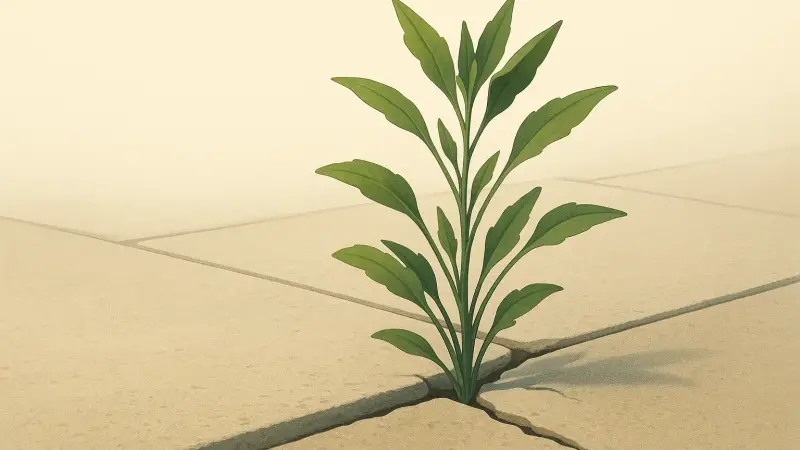
Why it happens in the first place
On almost any walk, you’ll spot it: a thin line of green pushing up between two slabs of concrete. It’s not one specific city thing. You see it in New York, London, and Tokyo, and in quieter suburbs too. The basic reason is simple. A sidewalk crack is a ready-made planting site. It’s an open seam where a seed can land, water can linger, and roots can slip into a protected space that’s hard for wind and sun to strip dry.
Concrete itself doesn’t “feed” plants, but the crack collects what plants need. Dust, grit, and tiny bits of broken pavement settle there. So do decomposing leaves and soil tracked in by shoes, bike tires, and pets. Over time that seam becomes a narrow strip of real growing medium, even if it’s only a few millimeters deep.
Cracks make a good seed trap

Most seeds don’t get a fair chance on a flat sidewalk. They blow along, get kicked, or dry out in hours. A crack changes the odds. It’s a physical trap. Seeds fall into it and stop moving. They’re shaded a little and pressed closer to moisture. If rain comes, the crack holds water longer than the slab surface, because the surface sheds water but the seam interrupts that flow.
A small detail people overlook is the role of edges. The crack has two vertical faces, and those edges slow evaporation. They also catch fine particles the way a curb catches drifting litter. That extra dust matters. It’s the start of a thin, gritty “soil” that can hold moisture and give roots something to grip.
Roots exploit tiny spaces and hidden moisture
Once a seed germinates, the first root is looking for a stable, damp path. Sidewalk seams provide that. Beneath many slabs there’s compacted base material, and sometimes actual soil beyond that. Even when the crack looks hairline from above, there are often wider voids below, created by settling, erosion, or the way the slabs were set. Roots can follow those voids and spread out under the pavement where temperatures and moisture swing less.
Water also behaves differently down there. A slab heats up in sun and cools at night, which can pull moisture up and down through pores and gaps. If a crack reaches damp sublayers, capillary action can keep the seam slightly wetter than the open surface for longer than you’d expect. That’s why a plant can stay alive in a place that looks bone-dry at noon.
Heat, salt, and stress select for certain weeds
Sidewalk cracks are harsh. They get hotter than nearby soil, and they swing temperature fast. In colder places, de-icing salts can run into seams and concentrate there. That knocks out many seedlings. The plants that keep showing up are often the ones built for stress: species that germinate quickly, grow low, and can tolerate heat, drought, compacted ground, or salty conditions.
That selection effect is why the same few “sidewalk specialists” can appear across very different neighborhoods. It’s not that cracks are perfect habitat. It’s that cracks are consistent habitat, and the plants that can handle it don’t face much competition inside that narrow strip.
The crack keeps changing, and the plant helps it change
Cracks aren’t static. Water gets in, freezes in winter in many regions, and expands, widening the gap a little at a time. Traffic vibration and settling can do the same. Once a plant is established, its roots can also exert pressure as they thicken. That doesn’t mean a tiny weed is prying up a whole sidewalk slab overnight, but root growth inside an existing weakness can help the weakness persist and slowly open.
As the seam widens, it catches more debris, holds more moisture, and supports bigger plants, which then drop more organic matter as they die back. The crack becomes a narrow, self-maintaining strip of habitat. And because seeds keep arriving—blown in, washed in, or carried on shoes—it never stays empty for long.

Related reads
- How pitcher plants dissolve insects with acid and enzymes
- Why comet tails always point away from the Sun
- How coral reefs time mass spawning with the moon
- Why pumice rafts let plants and insects colonize distant islands
- Why raindrops make different sounds on metal and wood
- The orchid that mimics a female moth down to the scent molecules