
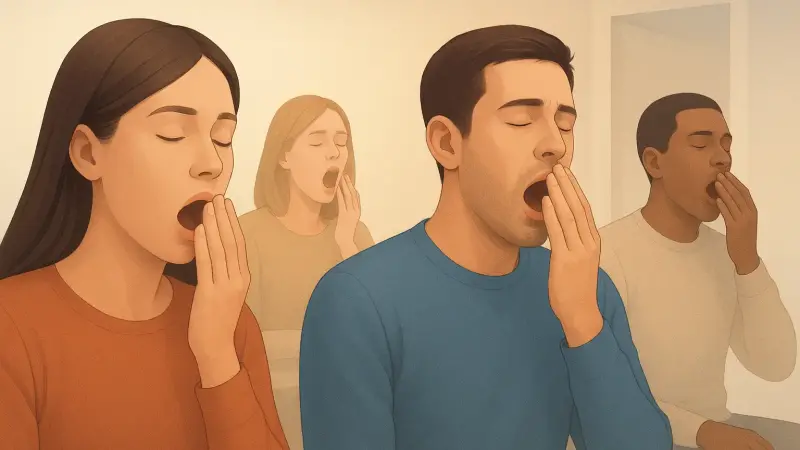
How it looks in real life
It doesn’t happen in one special place or one famous incident. It happens on a New York City subway, in a London waiting room, or in a Tokyo office meeting. One person yawns and a few seconds later someone else does, even if they never spoke. The core mechanism is simple: the brain is built to copy certain body signals automatically, and a yawn is a loud signal. It’s big in the face. It changes breathing. It lasts long enough for other people to catch it, even in peripheral vision. By the time you notice it, your own system may already be shifting toward the same pattern.
Yawning is a visible breathing cue
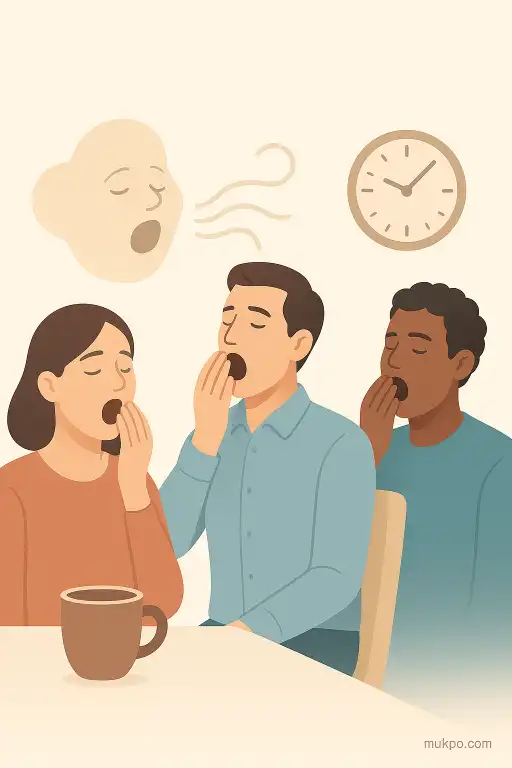
A yawn isn’t just an open mouth. It’s a specific sequence: a deep inhale, a wide jaw stretch, and a slower exhale. That matters in groups because breathing is one of the easiest rhythms to sync without trying. If a room is quiet, you can sometimes hear it too, but vision is often enough. People overlook how long a yawn lasts compared to other expressions. A blink is over fast. A yawn hangs there, giving the brain time to register it and prepare a matching response.
This is also why yawns can spread when nobody is looking directly at the yawner. The movement is high-contrast and centered on the face, which the visual system prioritizes. Even if two strangers avoid eye contact, faces still get tracked in the background. A yawn is hard to “not see” once it starts.
Automatic mimicry doesn’t require familiarity
People often tie contagious yawning to empathy, and there is research linking higher contagiousness with social closeness in some contexts. But familiarity isn’t required for the basic effect. Automatic mimicry is a normal feature of social perception. It’s the same general machinery that can make posture, speech rate, or facial tension drift toward whoever is nearby, including strangers.
With yawning, the mimicry has an extra push because it’s tied to arousal state. A yawn can signal a shift toward drowsiness, boredom, stress release, or simple fatigue. Those states are fuzzy and vary by person and situation. Still, noticing a yawn can nudge attention toward your own internal state. If your body was already close to yawning, that nudge can be enough to tip it over.
Timing, attention, and the “near-yawn” effect
Contagious yawns tend to show up with a delay. It is often a few seconds, not instant, which fits the idea that the brain is preparing a motor pattern rather than reflexively firing. The overlooked detail is how much a room’s pacing affects this. In a slow setting—waiting for a delayed flight, sitting through a long presentation—people have more spare attention to register small cues. In a fast setting, the same yawn might not spread because nobody’s processing faces long enough.
There’s also a “near-yawn” effect that’s easy to miss. People suppress yawns all the time. They close their mouth, inhale quietly, or turn away. Those half-yawns still carry enough signal—jaw movement, eye squeeze, chest expansion—to cue others. So a chain can start even when the original yawn barely looks like one.
Why a room can suddenly feel synchronized
Once one yawn happens, the room’s attention shifts. Not in a dramatic way, but in small glances and micro-checks. Humans are sensitive to signs that other people are getting tired or disengaged, especially in shared spaces like classrooms, meetings, and public transit. That shared monitoring makes the next yawn more likely to be noticed, and noticing is most of the battle.
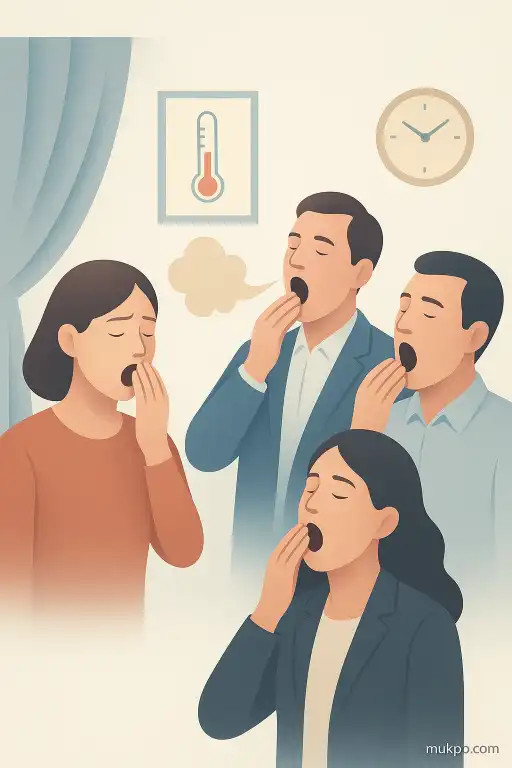
It can also cluster because many people in the same room share the same pressures on their body state: warm air, low movement, steady lighting, and a long period of sitting still. When those conditions line up, several people may be close to yawning already. One visible yawn doesn’t create the fatigue, but it can act like a starting gun for everyone who was already on the edge.
Related reads
- The sudden phantom smell that isn’t there and how memory conjures scent
- Why rehearsing arguments feels more satisfying than actually apologizing
- The house that legally owns itself in Athens, Georgia
- Why do we wake up right before the alarm
- A boutique hotel made from a 19th century prison where guests sleep in cells
- A bakery that once stamped local advertisements directly onto loaves of bread