
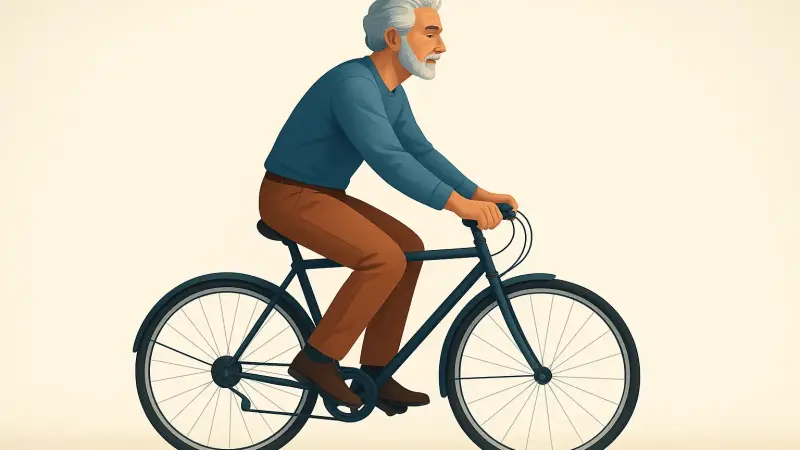
It comes back faster than it should
Someone can go a decade without touching a bike, hop on one in a park, wobble for a few seconds, and then roll away like the body remembered a private set of rules. There isn’t one single place or event tied to this. People describe it in cities and suburbs all over, like Amsterdam, Copenhagen, or Portland. The core reason is that balancing and steering a bike isn’t stored the same way a phone number is. It lives in procedural memory. That’s the brain’s “how to” system. Once it’s built, it tends to stay usable for a long time, even when the details feel rusty at first.
Procedural memory doesn’t fade like facts
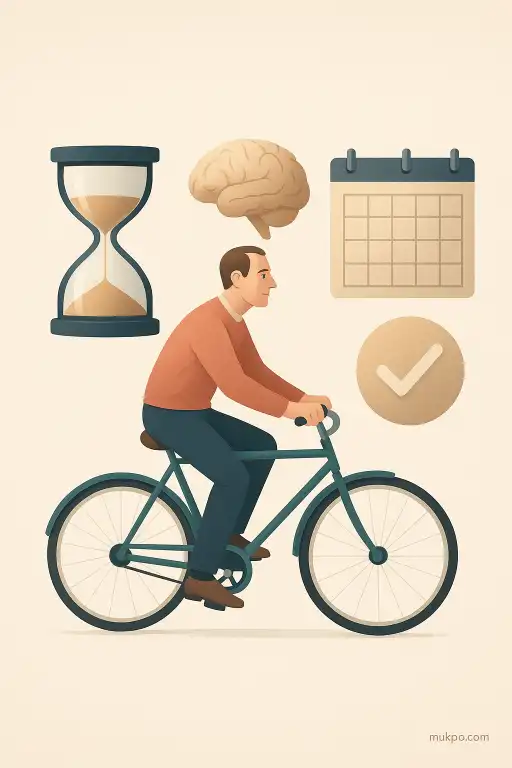
Riding relies on habits that run without conscious supervision. The brain areas involved in learned movement sequences, including circuits that help automate timing and coordination, can hold on to patterns for years. That’s different from remembering a date or a definition, which depends more on recall that can weaken without rehearsal. With a bike, the “knowledge” is mostly in the ability to generate the right corrections at the right moment. The person might not be able to explain what they’re doing. They just do it.
There’s also a practical reason it lasts: the skill is built from a small set of repeatable rules. Look where you want to go. Keep the wheels moving. Make tiny steering changes to keep the center of mass over the base of support. Those rules get baked into a routine. After years away, the routine can be slow to start, but it often doesn’t need to be rebuilt from scratch.
Balance on a bike is constant correction
A common misunderstanding is that good riders “hold balance” like a statue. They don’t. They constantly fall a little and recover a little. The bike tips, the front wheel turns slightly under the rider, and the contact patch shifts so the system catches itself. This is why speed matters so much, and it’s a detail people often overlook. When a bike is barely moving, the corrections have to be big and quick, and the steering feels twitchy. When it’s rolling, the same corrections can be smaller, and the whole process feels smoother.
This is also why people can feel surprisingly clumsy in the first seconds after a long break. Their body is re-finding the timing between lean, handlebar input, and pedaling. Once the timing clicks back in, the corrections shrink and the wobble disappears. Nothing mystical happened. The control loop just re-synchronized.
Your senses already know the signals
Riding isn’t only legs and arms. It’s vision, inner-ear balance signals, and pressure through the hands and feet. Over time, the brain learns which signals matter and which ones to ignore. A small lean detected by the vestibular system pairs with a certain feel at the handlebars and a change in what the horizon looks like. Those links become familiar. After years off a bike, the sensory inputs still make sense to the nervous system, so the right response can come back quickly.
A concrete example: someone gets on a bike path, starts rolling, and instinctively keeps their eyes ahead rather than staring at the front tire. That tends to stabilize the ride. They may not realize they’re doing it. Vision helps predict drift early. Looking down delays that information and often makes steering corrections late and bigger than necessary.
It can feel “remembered” even when it’s partly re-learned
Even when riding returns fast, the body is still updating. Muscles decondition, joints get stiffer, and reaction times can change with age, fatigue, or stress. So the first attempt after years away may involve a short phase of recalibration. The brain is comparing the old motor program with the current body and the current bike. A heavier frame, different handlebar width, or a higher seat changes the feel. Those differences can create a brief mismatch that looks like forgetting, even though the underlying skill is intact.
That’s why someone might say they “never forgot,” but still struggle with slow turns, sudden stops, or riding one-handed at first. Those are edge cases. They depend on fine control, strength, and confidence in the feedback from the bike. Once the basic loop of balance and steering is running again, those extras often return later, or not at all, depending on the person and the situation.
Related reads
- How backyard pollinator losses shrink vegetable harvests
- Why a color can suddenly trigger a craving
- Why your hands pick up complex skills before you can explain how
- The lake that turns bright pink for just a few days each year
- Why coral polyps expel algae during warming
- How subtle timing makes or breaks a joke