
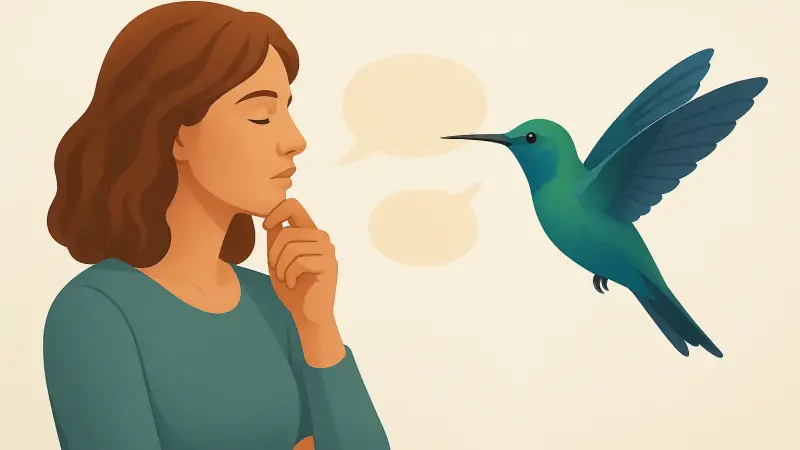
That conversation that keeps looping
People do this everywhere, so there isn’t one single place or incident behind it. It shows up in offices in London, on subways in New York, and in group chats in Seoul. A tiny moment starts it: you leave a meeting, wash a mug, and suddenly you’re replaying what you should have said. The brain is good at running “practice” without asking permission. It treats unfinished social situations like open tabs. If the outcome felt uncertain, or your status felt slightly at risk, the mind keeps the scene available. It’s not always about anxiety. It’s often about prediction.
Your brain rehearses because social mistakes are expensive
Human beings learn social rules by simulation. You run a version of an interaction, notice where it goes wrong, then adjust the next version. That’s useful if the conversation is actually going to happen. The problem is that the same machinery runs even when there’s no next meeting. Social life is full of thin evidence: a pause, a “sure,” an unread message, a coworker’s raised eyebrow. The brain tries to fill in the missing data by generating alternatives. It’s a way of reducing uncertainty, not a deliberate choice to spiral.
There’s also a status element that people undercount. A small exchange can feel like it threatens competence, likability, or fairness. Those are not abstract. They affect how others share information, invite you in, or trust you. That’s why the rehearsal often centers on a single sentence. The mind is trying to locate the exact point where the social “score” might have changed.
The loop prefers moments that never got a clear ending
Rehearsals stick to interactions that feel incomplete. A conversation ends with someone walking away, a call cuts off, or you leave before the tension resolves. The brain tags it as unfinished business, even if it’s already over in real life. People notice this after job interviews, performance reviews, or a weird hallway exchange where nobody says what they mean. The mind keeps returning to the “branch point,” the moment where a different response might have changed what came next.
A specific detail people overlook is timing. The loop often starts when attention drops: in the shower, while brushing teeth, while driving a familiar route. Those are moments when external demands are low, so internal simulation comes forward. It’s not that the shower causes it. It’s that the brain finally has spare processing room to run social scenarios that were queued up earlier.
Why the imagined version feels so real
The rehearsed conversation doesn’t feel like daydreaming. It feels like preparing. That’s because it borrows the same systems used for remembering and anticipating. You reconstruct the other person’s face, tone, and likely response. You supply lines they never said, but that match your mental model of them. If the person has power over you, the model becomes sharper. Managers, teachers, and partners often show up in these loops because their reactions matter more, and because past experiences provide plenty of material to predict from.
The mind also edits for emotional impact. It tends to generate the version that best explains the feeling you had, even if the evidence was thin. If you felt dismissed, the replay will “find” a dismissive tone. If you felt guilty, it will highlight your harshest wording. That bias can make the rehearsal persuasive, like it’s recovering facts, when it’s really constructing a coherent story from fragments.
Why you can win the argument and still keep replaying it
People assume they’re rehearsing to find the perfect line. But often the loop is trying to solve a different problem: safety. It’s checking whether you can handle the next social threat, even if there isn’t one scheduled. That’s why the imaginary dialogue keeps evolving. You land a great comeback, and the other person changes tactics. You explain yourself clearly, and the imagined response becomes colder. The brain is stress-testing outcomes, not writing a script.
A concrete example is the post-meeting replay where someone said, “Let’s circle back,” and you heard it as a brush-off. In your head, you try a firmer question, then a more diplomatic one, then an apology, then a joke. Each version is an attempt to reduce the uncertainty of what that phrase meant and what it implies about your standing. The real conversation is gone, but the prediction problem is still unsolved, so the mind keeps it running.

Related reads
- The commuter train that adopted a stray cat as its official conductor
- The winter night of 1916 when conspirators tried to poison, shoot and drown Rasputin in a St. Petersburg house
- A public bench that collected wishes carved into its underside
- How a single scent can unlock an entire afternoon from decades ago
- The muddled alertness after waking that slows decisions
- Why a stranger can feel like an old friend at first sight