

That “face” on the wall isn’t just a joke
Most people have had the moment. A car’s front end looks annoyed. A power outlet looks surprised. A stain on a ceiling seems like it’s staring back. This isn’t one single incident or place. It shows up everywhere, from sidewalks in New York to kitchens in Seoul to the front of a Toyota parked on any street. The core mechanism is that the brain treats face detection as urgent, fast, and worth a few false alarms. It will happily promote a loose pattern—two dark spots and a line—into “eyes and a mouth” before you’ve had time to think about what you’re seeing.
Face detection is built to fire early
Humans rely on faces for identity, emotion, attention, and threat. So the visual system gives faces special handling. There are brain areas that respond strongly to face-like layouts, including the fusiform face area in the temporal lobe. You don’t need a perfect face for that response to kick in. A rough arrangement can be enough, especially in peripheral vision or at a quick glance, when the brain is trying to label a scene fast.
This “early firing” is why the experience can feel automatic. You can know, immediately after, that it’s a mailbox or a rock. But the first impression still arrives as social information. A face is not just a shape to the brain. It’s a potential mind, and minds matter.
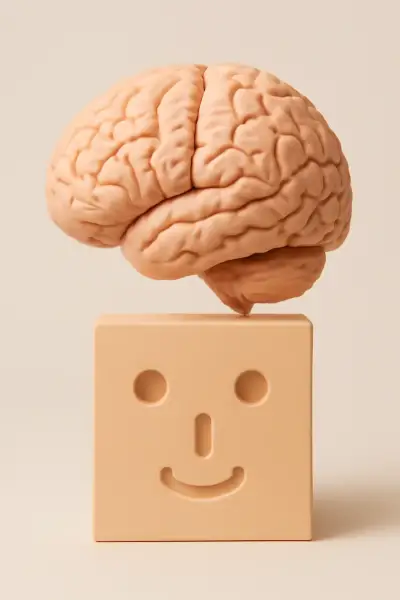
Why the simplest face pattern wins
The brain uses shortcuts. One of the strongest is a template for “two things above one thing.” That triangle-like layout matches the eyes-and-mouth structure, so it’s easy to trigger. It also explains why outlets, car grilles, and windows on a building work so well. You don’t need detail like skin texture or eyelashes. The spacing does most of the work.
A specific detail people usually overlook is contrast polarity. Dark “eyes” inside a lighter “face” read as face-like more often than the reverse. Two small shadows under a ledge can be stronger than two light marks on a dark surface. It’s one reason faces pop out in dim light, where shadows deepen and the brain’s guesswork increases.
Emotion gets pasted on top, even when nothing is there
Once the brain accepts “face,” it starts assigning expression. A downward curve becomes a frown. Headlights angled inward become anger. This is not because the object “looks like” anger in a detailed way. It’s because expression perception is also a fast system, tuned to pick up mood with limited data. The same object can look friendly or hostile depending on lighting, viewing angle, and what features stand out first.
This is why two people can disagree about what they saw. One catches the “mouth” first. Another catches the “eyes.” The brain isn’t carefully measuring. It’s settling on an interpretation that feels socially meaningful, then sticking with it for a moment.
Why it happens more at night, when you’re busy, or when you’re not looking directly
Face pareidolia shows up more when visual information is thin. Low light, fog, motion, and clutter all reduce detail. So the brain leans harder on prediction. Peripheral vision also favors coarse patterns over fine features. That’s why a “face” can appear at the edge of sight and vanish when you stare straight at it. The high-resolution center of vision checks the guess and often deletes it.
Attention matters too. When someone is walking quickly, scanning a street, or thinking about something else, the brain prefers quick labels. “Face” is one of the labels it is most prepared to offer. A moment later, the object resolves into what it is: a balcony with two dark windows, a bag with folds, or the front of a parked car catching shadows in a way that briefly looks alive.
If you liked this, you might also enjoy: