

It can happen in a meeting in London, on a first date in New York, or in a classroom in Tokyo: your cheeks heat up while your mind is still busy pretending everything is fine. That timing feels unfair. But it’s a real feature of how the body handles social threat. A flush is mostly a fast change in blood flow near the skin, driven by the autonomic nervous system. It can start before you’ve put words to the feeling, because the brain can tag something as socially risky faster than conscious thought catches up. Your face is reacting to a split-second “uh-oh” signal that arrives early.
The body reacts before the story forms
Embarrassment has a mental side—realizing you violated a norm, got judged, or made an error in public. But the physical response can start earlier because threat detection isn’t waiting for a narrated explanation. Sensory cues hit brain circuits that are built for speed. They weigh tone of voice, a pause, a laugh, a sudden silence, eyes turning toward you. If that pattern resembles “social danger,” the autonomic system begins shifting blood flow and heart activity before you consciously label it as embarrassment.
This is why someone can blush during a tiny moment that seems neutral on paper. A coworker says, “Can we circle back?” and there’s a beat too long. Or you realize you’ve been talking over someone and the room goes quiet. The body doesn’t need a full interpretation. It reacts to the change in the room.
Why the face gets picked for the signal
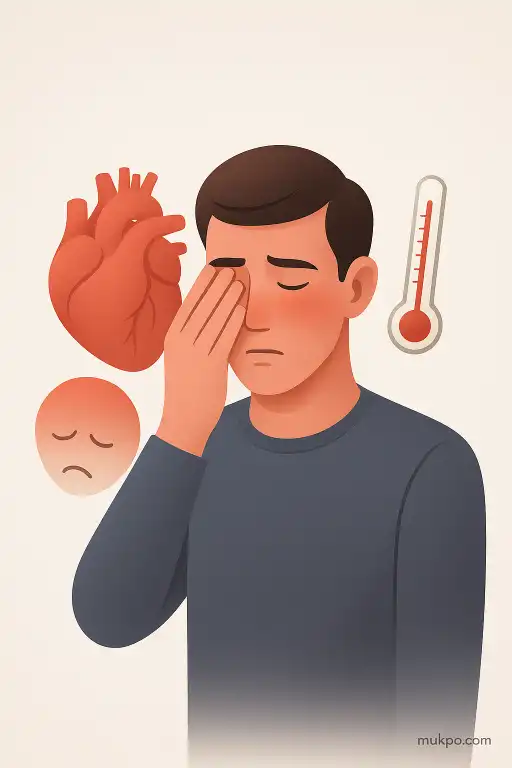
A flush is mainly vasodilation in the skin of the face, neck, and sometimes ears and upper chest. Blood vessels widen. More warm blood reaches the surface. That’s why heat and color arrive together. The face is especially noticeable because the skin is thinner in many people, it has a dense network of superficial vessels, and it’s exposed. Clothing hides the chest. Hair hides some scalp. The face is the billboard.
A specific detail people overlook is how uneven it can be. One ear can go bright red while the cheeks barely change. Or the neck goes blotchy first. That patchiness happens because different regions have different vessel density and different sensitivity to the chemical signals that control vessel tone. It’s not always a single, uniform “red face” moment.
Embarrassment is social threat, not just emotion
Embarrassment sits close to other social-threat states like shame, fear of evaluation, or sudden self-awareness. The body treats those as urgent because social standing and belonging have had survival value in groups. A flush can show up with a stammer, a swallowed breath, or a brief freeze. Those are all pieces of the same fast-response toolkit. The conscious mind might still be scanning for an explanation while the body is already broadcasting that something just mattered.
That’s also why the trigger can be surprisingly small. It doesn’t have to be a big mistake. It can be simply being seen at the wrong moment—walking into a room late, being called on unexpectedly, or hearing your name said louder than usual. The brain reads “attention on me” as a condition that can turn risky quickly, and the physiology starts moving.
Why you can’t always feel it coming
People often notice the flush after it starts because the early signals are subtle. The first changes are internal: a quick shift in heart rhythm, a tiny rush of warmth, a change in breathing. Those can be hard to detect in the moment, especially when attention is pointed outward at the conversation. By the time you register heat, blood flow may already be increasing in visible areas.
There’s also a timing mismatch between systems. Conscious labeling tends to be slower and language-dependent. Autonomic adjustments are faster and more automatic. That mismatch creates the weird experience of “I wasn’t embarrassed until my face did that.” Sometimes the mental feeling follows the physical cue, because seeing or sensing the flush adds a second layer: now you know you’re visibly reacting.
Why some people flush more, and why the situation matters
Blushing varies a lot across people, and it’s not always clear how much is genetics, learned sensitivity, skin tone visibility, and baseline autonomic reactivity. Some people have facial vessels that dilate more easily. Some notice internal sensations more. Some environments amplify it: warm rooms, alcohol, spicy food, certain medications, and hormonal shifts can all make facial flushing easier to trigger, even when the social moment is the main spark.
Context changes the threshold too. A small slip-up can feel bigger when status is on the line, when you’re speaking to a boss, or when you’re being evaluated. Picture someone presenting on a video call, then realizing their microphone was muted for the first sentence. The flush can arrive while their brain is still catching up to what happened, because the social cost gets computed quickly—often before the person has even decided whether it’s funny, harmless, or mortifying.
Related reads
- The Georgian scandal where doctors believed a woman gave birth to rabbits
- Why elevator silence twists into awkwardness as a crowd grows
- The invisible muscle memory behind sloppy versus neat handwriting
- How tiny rituals like tapping or checking unlock a sense of control
- The town that paid families to move in and brought its main street back to life
- Why yawns spread across a room even when people are strangers