
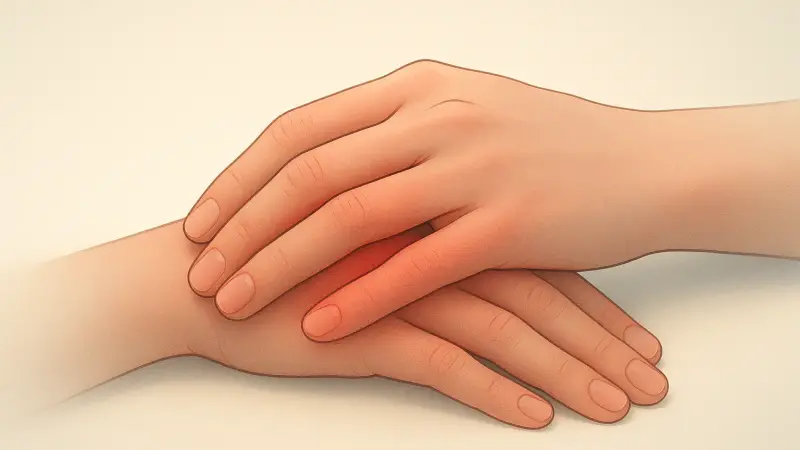
That sudden “dead hand” feeling
It happens in lots of places and situations, not one famous event. Someone falls asleep on a couch during a movie, nods off on an airplane armrest, or tucks a hand under a pillow in bed. Then they wake up and the hand feels thick, numb, or oddly useless for a moment. The core mechanism is simple: a body position can squeeze the nerves that carry touch signals and the blood vessels that feed the tissues. When those signals and that circulation get disrupted long enough, sensation fades and movement can feel delayed.
Pressure changes what nerves can transmit
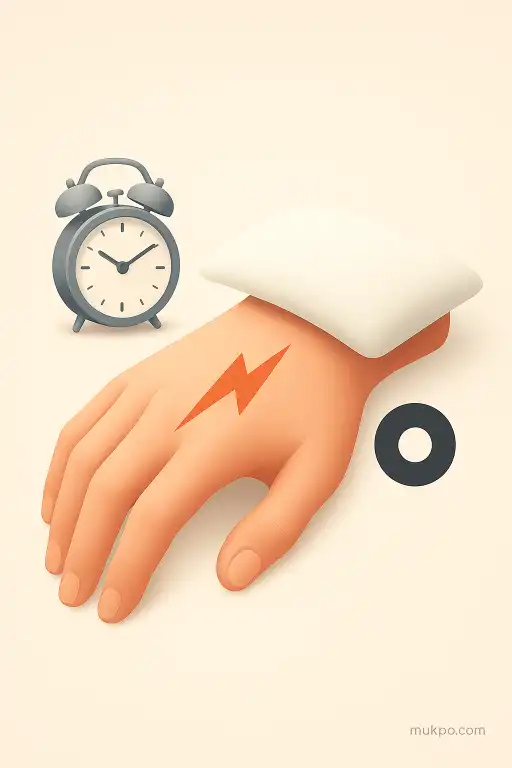
Nerves are physical cables. They conduct electrical impulses, but they also need oxygen and a steady chemical environment to keep doing it. When a nerve is compressed against a firm surface—like the edge of a mattress, a wooden armrest, or even another bone—its ability to pass signals drops. The first thing most people notice is loss of light touch or “pins and needles” rather than complete numbness. That’s because different nerve fibers shut down at different thresholds.
A detail people often overlook is how small a shift can matter. A few millimeters of change at the wrist or elbow can move a nerve from a softer area into a narrow groove. The ulnar nerve at the “funny bone” is the classic example. Leaning on the inside of the elbow can produce tingling down into the ring and little fingers, even if the hand itself isn’t being sat on.
Blood flow gets involved, but it’s not always the main driver
Pressure can also reduce blood flow. If an artery is compressed enough, oxygen delivery drops and the tissues become more irritable. That can contribute to the heavy, clumsy feeling. But a hand can feel numb even when blood flow isn’t severely blocked, because nerves are particularly sensitive to being squeezed. That’s why numbness can show up from positions that don’t leave the skin dramatically pale or cold.
When pressure is removed, the return of normal sensation is often noisy. As nerve fibers start firing again, the brain interprets uneven signals as tingling, prickling, or burning. That “waking up” phase can feel more intense than the numb phase. It’s also why the sensation can seem to travel, as different branches recover at slightly different speeds.
Why certain sleep positions target certain fingers
The pattern usually follows anatomy. The median nerve supplies much of the thumb, index, middle, and part of the ring finger. The ulnar nerve supplies much of the ring and little finger. The radial nerve is more associated with the back of the hand and wrist extension. So when someone wakes up with only the pinky side tingling, it often points to pressure around the elbow or the heel of the hand where the ulnar nerve runs. When the thumb and index are involved, pressure or sustained bending at the wrist is a common setup.
Another overlooked factor is joint angle. Nerves don’t just get squashed from the outside. When the wrist is bent sharply or the elbow is held in deep flexion for a long time, the space inside the nerve’s tunnel can narrow. That internal narrowing can irritate the nerve even without a heavy body part directly on top of it.
When it’s transient versus when it keeps showing up
For many people, this is a short-lived compression event: pressure builds, nerve signaling fades, pressure eases, and sensation returns. But repeated episodes can also be a clue that the same nerve is getting stressed night after night. Some bodies have less “spare room” around certain nerves because of swelling, prior injury, or naturally tighter anatomy, so a position that barely affects one person can strongly affect another.
That’s also why the same hand can behave differently on different nights. Temperature, fluid shifts, how deeply someone sleeps, and whether they stayed in one position for an unusually long stretch can all change how quickly numbness appears and how long it lasts after waking.
Related reads
- Why your hands warm up when you remember a pleasant moment
- Why people speed up their speech when they’re trying to impress
- Rubber ducks from a cargo spill that still wash up decades later around the world
- How your feet decide the fastest route without conscious thought
- How the Amber Room vanished from a royal palace and became WWII’s enduring mystery
- The Kentucky hamlet that keeps electing a dog as mayor