

You can watch it happen in real time. Someone starts filling out a form at a hospital reception desk, or signing a receipt in a crowded store, and their neat handwriting shrinks. Letters get cramped. Lines press harder into the paper. This isn’t one single event tied to one place. It shows up everywhere people write under pressure, from U.S. DMV counters to exam halls in the UK to job paperwork in Japan. The core mechanism is simple: stress shifts the body into a more guarded state. That state changes muscle tone, breathing, and fine motor control. The pen ends up moving differently because the hand is being driven differently.
Stress changes the way the hand is controlled
Writing is a fine motor task, but it’s not “just fingers.” The brain has to coordinate shoulder stability, wrist position, and tiny finger movements while also tracking spacing and shape. When stress rises, the nervous system tends to bias toward faster, simpler control strategies. Muscles around the forearm and hand often co-contract, meaning flexors and extensors tighten at the same time. That stiffens the joints. Stiff joints make smaller strokes feel safer and easier to control than long, loose ones.
Attention shifts too. Under stress, people often narrow their focus to the immediate goal: get the words down, don’t mess up, finish quickly. The brain spends less bandwidth on the “presentation layer” of handwriting, like consistent slant or generous spacing. The result can look like the hand “decided” to tighten, even though it’s really the whole control system changing priorities.
Grip and pressure quietly ramp up
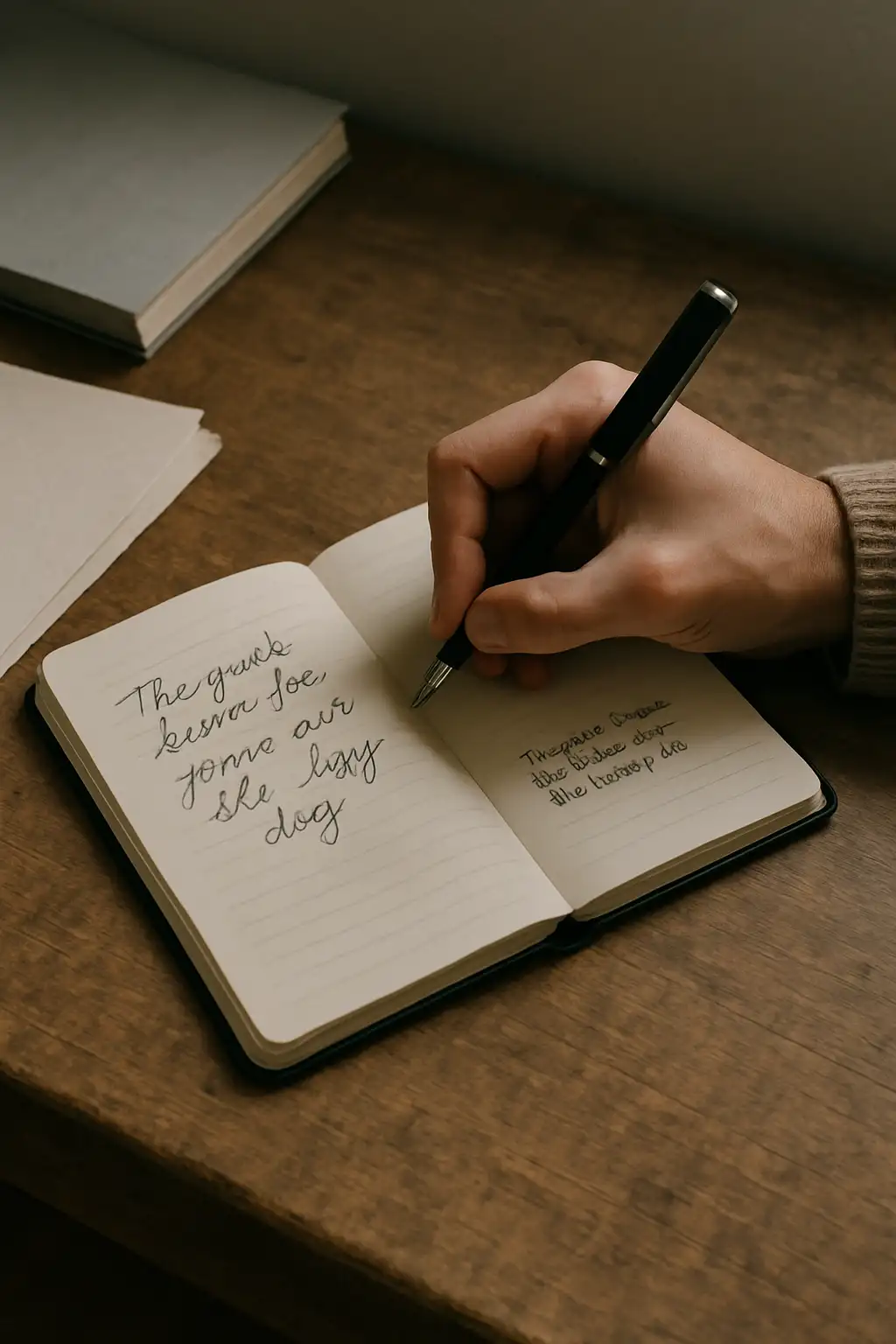
A common change is a stronger grip. The thumb and index finger pinch harder, and the pen is pressed more firmly into the page. That extra force increases friction between nib and paper. More friction makes the pen feel less slippery, which can feel reassuring when someone is keyed up. But it also makes it harder to glide. Strokes shorten. Curves become more angular. Letters start to crowd because the hand is working against the page instead of floating over it.
One overlooked detail is how the pressure shows up after the writing is finished. You can often see slight indentations on the next sheet down, or a faint “embossed” mirror of the writing on the back of the page. That’s not a style choice. It’s a physical record of increased force, which often travels with stress even if the person thinks they’re writing normally.
Breathing and posture affect spacing more than people think
Stress commonly changes breathing. People hold their breath, breathe shallowly, or speed up their inhale-exhale cycle. That matters because writing has its own rhythm, and many people unconsciously time pen strokes with small changes in breath. When breathing gets choppy, the rhythm of writing gets choppy too. Spacing between words can tighten. Descenders and ascenders (like the tails on “g” or the height of “h”) can get clipped because the hand is trying to keep up with an internal sense of urgency.
Posture adds another squeeze. At a standing counter, a cramped classroom desk, or a clipboard held in midair, the shoulder often hunches and the wrist bends more. That positioning reduces the range of motion available for smooth, larger letter shapes. The hand compensates by relying more on finger motion. Finger-only writing tends to produce smaller, tighter script than writing that uses a bit of the wrist and forearm.
Time pressure pushes toward smaller movements
Even when the stress is mainly mental, the brain treats it like a time problem. There’s an impulse to get through the task. Smaller movements are quicker to plan and execute. They also reduce the chance of overshooting a line or making a large, messy stroke. That’s why a person can start a sentence with normal-sized letters and end with a compressed scrawl, especially when someone is watching or waiting.
A concrete example is signing a credit card terminal while a line forms behind you. The surface is small, the stylus is unfamiliar, and the space for the signature is bounded. Stress doesn’t have to be dramatic. The body reads the situation as “don’t take up space, don’t take too long,” and the motor system responds with tighter, more contained movements.
Small variations depend on tools and the page
The pen itself changes what tightening looks like. A ballpoint with higher friction often reveals pressure increases as darker ink and more drag. A gel pen may glide enough that the same stress shows up less as pressure and more as tremor or uneven spacing. Paper matters too. Smooth paper can make the pen slide unexpectedly when the grip is tense, which can prompt even more pinching and smaller letters.
Line ruling and margins also shape the pattern. On unlined paper, stress-related tightening often shows up as drifting baselines and shrinking mid-word. On lined paper, it can show up as letters that start obeying the line too strictly, with reduced loops and flatter curves. It’s the same underlying state, but the page gives the hand different constraints to react to.
Related reads
- How snails rebuild cracked shells from the inside
- The Boston molasses tsunami of 1919 that swept trains and toppled buildings
- How a Habsburg envoy went out a window and sparked Prague’s uprising
- How the solar wind sculpts comet tails into bright, streaming plumes
- The smell-triggered time machine: how odors unlock buried memories
- Why some rivers form tidal bores that rush upriver as walls of water