
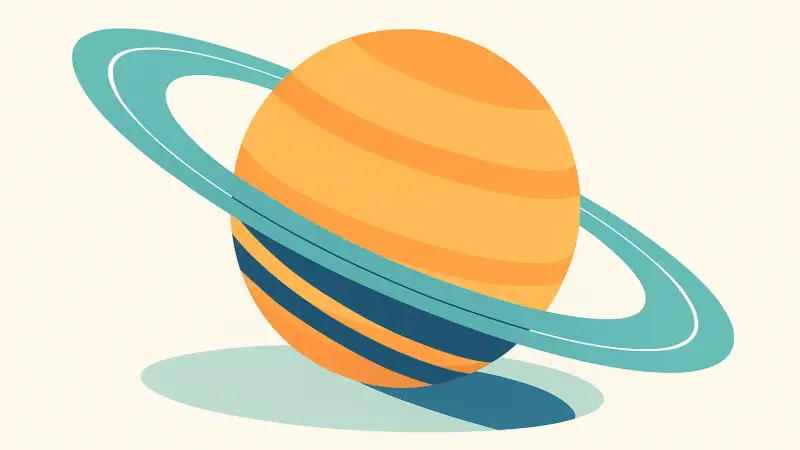
Looking up at a planet and noticing the shadow won’t sit still
On some nights, telescope observers have watched Saturn and noticed a thin, dark band on the planet that seems to drift and change shape over time. This isn’t one single event in one place. It’s a repeating geometry problem that shows up any time a ringed planet is lit from the side, including Saturn, Uranus, and Neptune. The core mechanism is simple: the rings are a wide, tilted sheet of countless particles, and the Sun’s light hits that sheet at a changing angle as the planet moves and the rings “open” and “close” to our view. The shadow you see on the cloud tops is the moving projection of that tilted, structured sheet.
The Sun angle changes, so the ring shadow slides
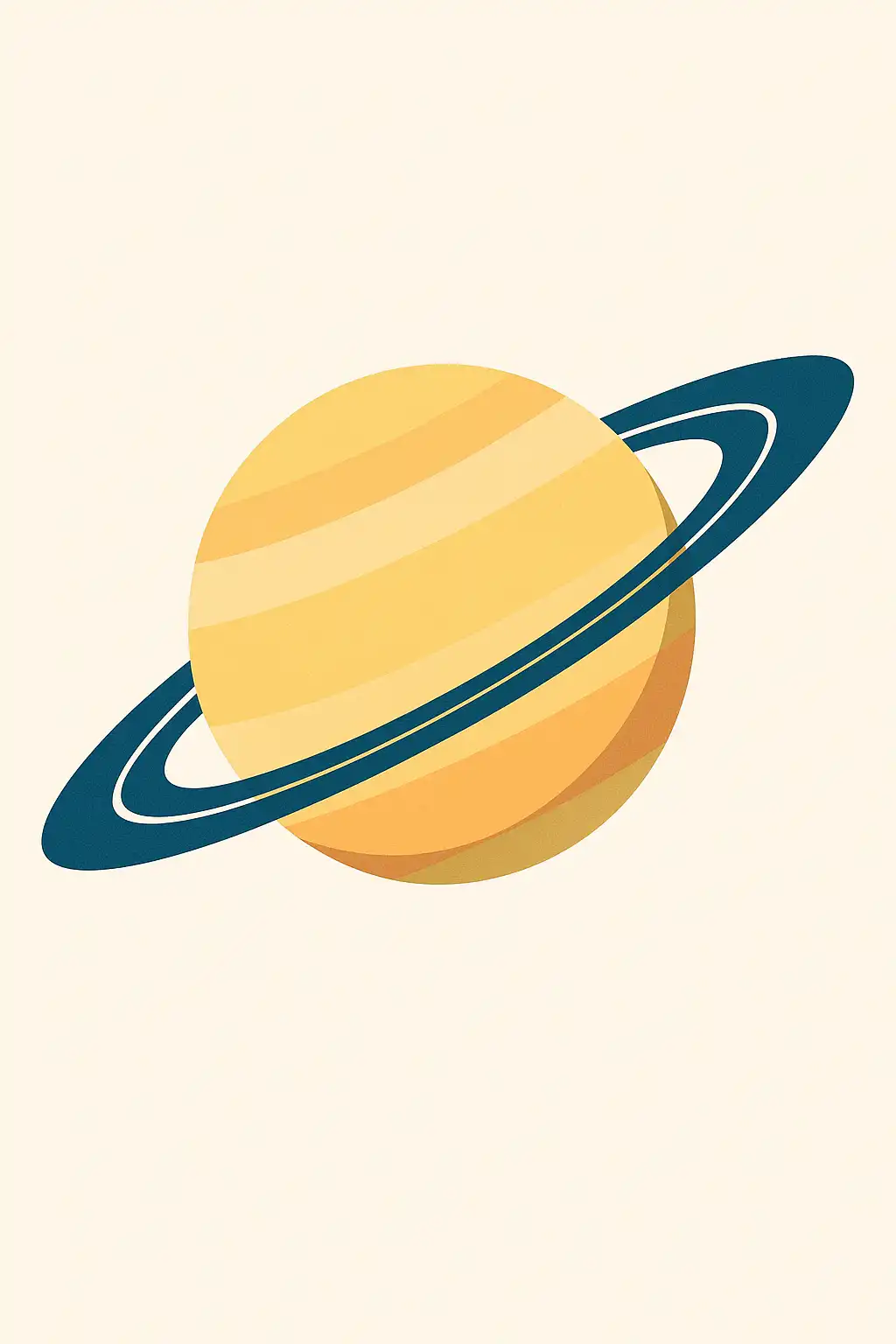
Rings don’t cast a single fixed stripe because the light source isn’t fixed relative to the ring plane. As Saturn travels around the Sun, the Sun appears to move north and south in Saturn’s sky over the course of a Saturn year. That changes the “solar elevation” above the ring plane. When the Sun is higher above the ring plane, the rings cast a narrower shadow that hugs closer to the rings’ own plane. When the Sun is lower, the shadow stretches farther across the planet’s curved atmosphere and looks wider and more dramatic.
At equinox for the ring plane, the Sun is almost exactly edge-on to the rings. The main rings then cast an extremely thin, sharp shadow line, and some parts can be hard to see because the rings themselves are also edge-on from our perspective at certain times. The shift isn’t because the rings are swinging wildly. It’s mostly the illumination geometry changing in a slow, predictable way.
The planet rotates under a shadow that isn’t painted on
There’s another motion layered on top: the planet spins quickly, while the shadow is fixed in space relative to the Sun and ring plane at that moment. Saturn’s clouds rotate in roughly 10–11 hours, depending on latitude and how you define the rotation of its atmosphere. So the same physical point on the cloud tops moves under the ring shadow and back out again. To an observer watching over a night, the band can seem to shift in texture and contrast because you aren’t looking at a static backdrop. You’re watching a changing atmosphere rotate through a steady pattern of shade.
A detail people often overlook is that the shadow isn’t falling on a solid surface. It’s falling on layers of haze and cloud at different altitudes. That changes how sharp the boundary looks. A slightly higher haze layer can brighten the shaded region by scattering light from nearby sunlit areas, softening what would otherwise be a crisp edge.
Ring structure makes the shadow look segmented and “alive”
Saturn’s rings aren’t a uniform disk. They have gaps, density waves, and sharp boundaries like the Cassini Division. When sunlight passes through or is blocked by those features, the planet receives a striped pattern of illumination. That’s why the shadow can look like several parallel bands rather than one. It’s also why the shadow can change character even if the Sun angle changes only a little: a small change in angle shifts where a narrow gap projects onto the cloud tops.
You can see this clearly in spacecraft images from NASA’s Cassini mission, where the ring shadow sometimes shows fine banding that matches ring substructure. The rings also aren’t perfectly flat. They have a small but real vertical thickness, plus localized warps and bending waves. Those tiny vertical features can make the shadow edge look slightly scalloped or uneven as the geometry changes.
Viewing angle and atmospheric scattering change what the shadow seems to do
What looks like a “moving” shadow also depends on where Earth is. As Earth and the ringed planet move in their orbits, the tilt of the rings toward us changes. When the rings are more open, you see more of the shadowed hemisphere and the band can appear broader or more offset from the rings. When the rings are closer to edge-on, the shadow can look thinner, and parts may seem to disappear because the rings and their shadow overlap visually along our line of sight.
Atmospheric scattering matters too. Gas giants brighten toward the limb in some wavelengths and darken in others. That means the same physical shadow can look high-contrast one year and subtle another, depending on wavelength, haze conditions, and how much the planet’s own clouds are changing. Under steady geometry, the atmosphere still changes, and it changes what your eyes pick out.
Related reads
- The crystal gardens that grow inside volcanic glass
- A forgotten ordinance once banned whistling in public baths
- When lakes flip: the sudden formation of toxic bottom layers
- Why your brain finishes other people’s sentences
- Why we replay awkward conversations in our heads at night
- Victorian resurrectionists who dug up graves to keep London’s anatomy theatres supplied