
What you notice first
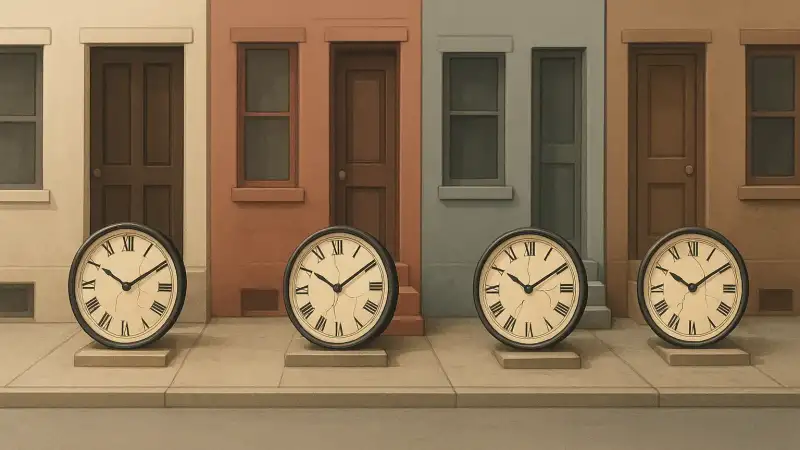
You turn into a normal residential street and then you see it. Every doorstep has a clock. Every clock is broken. And every face points to the same minute. There isn’t one famous, verified street like this that journalists can point to as “the” example, and the details would vary if it did happen. But coordinated doorstep displays are a known thing in real places. People have put identical objects on porches for street-wide art projects, and after disasters you sometimes see the same symbol repeated house to house. A row of clocks frozen to one time would work the same way: the mechanism is coordination, not coincidence.
How a whole street ends up matching
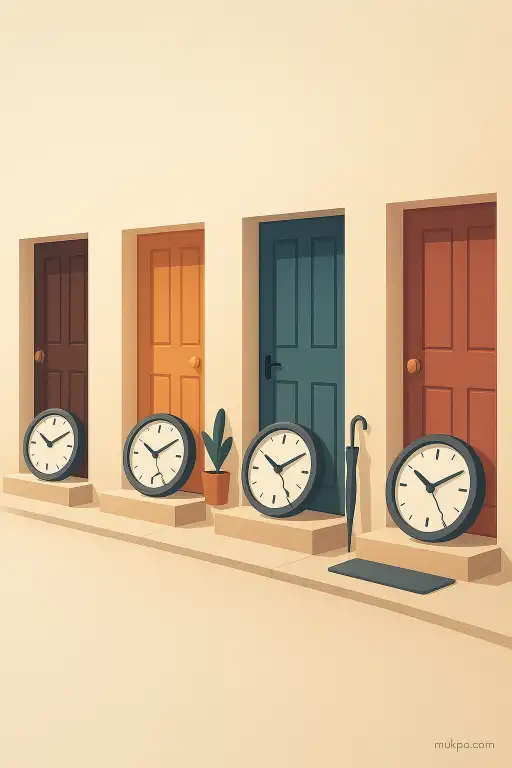
For every doorstep to match, the easiest path is a single organizer and a single source of objects. A neighborhood association orders a batch. A local artist supplies them. Or one resident starts it and others copy it because it’s simple and the rule is easy to follow. The same minute matters because it stops arguments. If the instruction is “set it to 8:17,” nobody has to pick their own time or explain it. The uniformity becomes the point.
Sometimes the coordination is social pressure without anyone saying it out loud. One porch puts out a broken clock as a joke. The next porch does it to be part of it. By the time half the street joins, not joining starts to feel like making a statement. People underestimate how fast that happens when the “cost” is small and the display sits at the boundary between private and public space.
Why the minute would be the same
The shared minute would usually be chosen for a reason, but the reason might not be legible from the sidewalk. It could be a time tied to a local event: when the power came back after a long outage, when a factory shift ended for the last time, when a school bell rang for the final day before a closure. It could also be arbitrary on purpose, picked because it looks balanced on a clock face or because it’s easy to remember. “Same minute” is a strong signal either way. It tells you it’s deliberate.
A specific detail people overlook is whether the clocks show the same minute because they were set, or because they failed that way. Cheap quartz clocks often stop with the second hand stuck between ticks after a battery leak or a fall. Mechanical clocks can stop where friction catches. If every clock is stopped at exactly the same minute, down to the angle of the hands, that points to manual setting. If the minute matches but the hands aren’t perfectly aligned, it can still be intentional, just done quickly and without measuring.
What “broken” can mean on a doorstep
“Broken” doesn’t always mean nonfunctional. Sometimes it means “not trusted.” A clock can run but be off by ten minutes, so it gets replaced and then repurposed as a prop. Sometimes the clock is intact but has no battery, which is a quieter kind of broken because it looks normal from the street. That matters here because porches are curated. People pick objects that survive weather, theft, and curious hands.
There’s also the legal-and-practical side. Putting something on a doorstep is different from mounting it on a fence or a utility pole. A porch display stays clearly on private property. It’s less likely to be treated as signage, and less likely to be removed. You’d expect the clocks to cluster near doorframes and planters, where they’re visible but hard to trip over, and where they can be brought inside fast if the street gets busy.
How it changes the street for people walking through
On a street like that, strangers slow down. Some take photos. Some look for a plaque or a flyer that explains it. If there’s no explanation, people start scanning for patterns: is the minute a date? Does it match a bus schedule? Is it the same on both sides of the street? Residents notice the micro-behaviors. People hesitate at driveways. Dogs stop to sniff longer because the handler has stopped moving. Even deliveries get affected, because drivers look at the clocks and then double-check the house number.
It also creates a boundary without a gate. A normal street feels pass-through. A street with a synchronized display feels like a place you’ve entered, even if it’s still just public sidewalk. The clocks don’t need an explanation to do that. The repetition does it on its own, and the shared minute keeps insisting that someone, somewhere on this block, decided the rule.
Related reads
- A bakery that refuses to bake any recipe printed in books
- The squid that flashes in Morse code
- A fountain that changes temperature on birthdays
- A mailbox that keeps receiving postcards from a traveler who vanished decades ago
- The cocktail party trick: how your name cuts through noise
- How glowing algae pulse in sheltered bays