
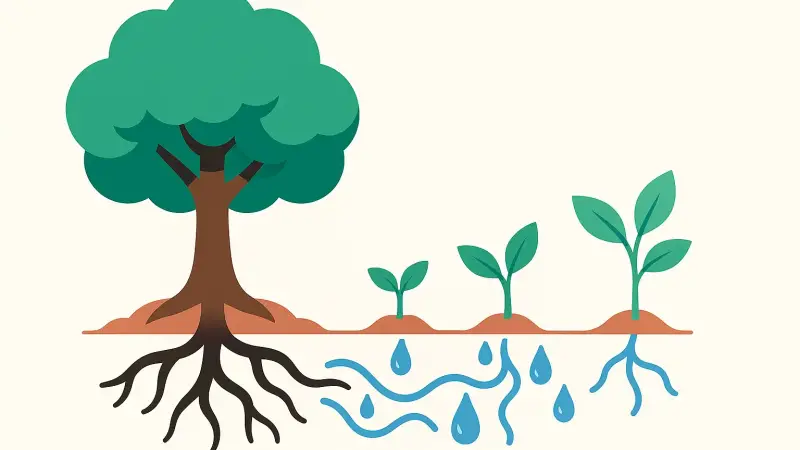
When the ground seems to “prefer” one tree
In a forest, you sometimes see a strange pattern: plenty of adult trees, but very few of their own seedlings right underneath. It isn’t one single place or event. It shows up in lots of regions, and the details vary. Researchers have documented versions of it in North American black walnut stands, in Australian eucalypt forests, and around creosote bush in the deserts of the southwestern United States. The basic mechanism is chemical. A tree leaks compounds from leaves, bark, or roots into the soil. Those compounds can slow germination, change microbes, or tie up nutrients. That soil ends up “sculpted” in a way that filters which seedlings do well nearby.
How trees get chemicals into soil
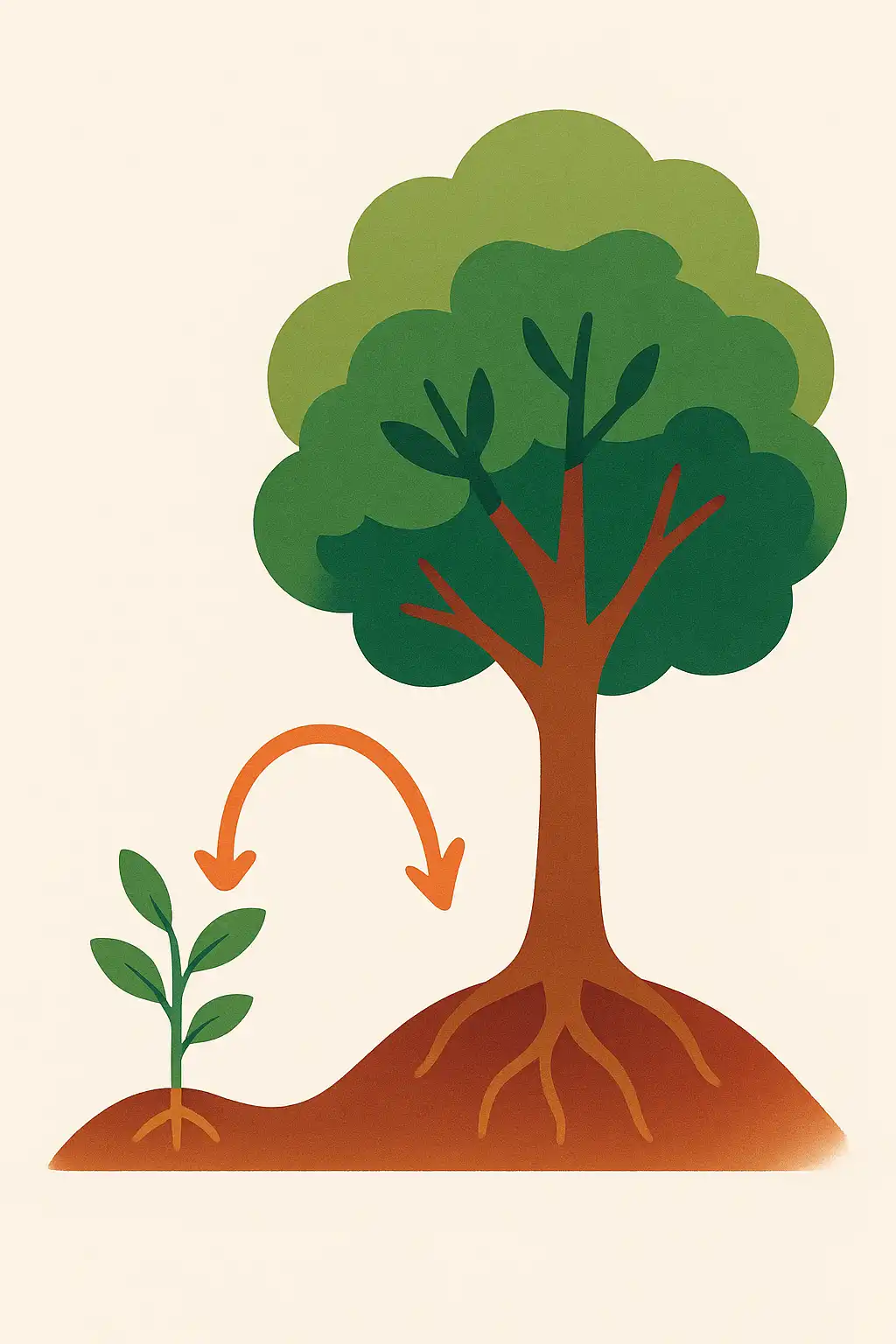
Most of it happens through ordinary mess. Leaves fall, get wet, and start to break down. Roots ooze small molecules all the time. Rain also rinses chemicals off leaves and bark and carries them down the trunk and into the ground. That route is easy to miss, but it can create a narrow ring of altered soil around the base called “stemflow” soil. It is not just leaf litter spread everywhere. It can be a concentrated drip line, delivered over years in the same spot.
The compounds don’t have to be “toxins” in a dramatic sense. They can be phenolics, terpenes, quinones, organic acids, or other metabolites that plants make for their own reasons. Once they’re in soil, they can bind to clay, stick to organic matter, or get broken down quickly. That’s why effects can be strong in one soil type and weak in another. Temperature and moisture also matter, because microbes do a lot of the breaking down.
A famous case: black walnut and juglone
Black walnut (Juglans nigra) is the example people tend to hear about first. It produces juglone, a compound that can inhibit or stress some nearby plants. Juglone shows up in different walnut tissues, and it can enter soil through decaying leaves and husks, root interactions, and water moving through the litter layer. The effect isn’t uniform. Some species tolerate it, and some soils and microbial communities seem to neutralize it faster than others.
What’s easy to overlook is timing. A seedling’s most vulnerable moment is often the first days after germination, when it’s trying to push out tiny roots and switch on its metabolism. A small chemical nudge at that stage can matter more than it would later. So the “sculpting” can look like an on/off switch even if the chemistry is subtle. You might see plenty of adult plants nearby, then a gap where certain seedlings just don’t establish.
It’s not always direct poisoning
Sometimes the chemistry works by reshaping the soil community rather than hitting seedlings directly. Root exudates can favor certain fungi and bacteria and discourage others. That changes how nutrients cycle, how pathogens build up, and how quickly organic matter decomposes. For a seedling, the difference between a friendly mycorrhizal partner and the wrong microbial neighborhood can decide survival. The tree doesn’t need to “target” its own seedlings. It just creates conditions that happen to favor some species over others.
There’s also plain nutrient chemistry. Some compounds chelate metals, shift soil pH in a micro-zone, or slow nitrification. Eucalyptus leaf litter, for example, is often discussed in terms of oils and phenolics, but another practical detail is that thick litter and certain compounds together can change moisture at the soil surface. That physical layer can amplify the chemical effect by keeping seeds from contacting mineral soil or by making the top layer dry out faster after a rain.
Why this can shape where seedlings end up
When these chemical effects are strong enough, they act like a spacing system. Seedlings that are sensitive drift outward, establishing a little farther from the parent where concentrations are lower and the microbial mix is different. That can reduce direct competition with the parent and with siblings. It also changes the plant mosaic you see on the ground, sometimes producing bare patches, sometimes favoring a short list of tolerant understory species.
It also helps explain a quiet contradiction people notice on hikes: the adult tree is thriving in its own “home” soil, but its seedlings are scarce right there. The soil right under the canopy is often the most chemically distinctive spot because it gets the most litter, the most root activity, and the most repeated stemflow. Walk a few meters away and those inputs drop, sometimes sharply, even though the light and temperature feel almost the same.
Related reads
- Why planetary rings cast shifting shadows on gas giants
- The crystal gardens that grow inside volcanic glass
- A forgotten ordinance once banned whistling in public baths
- When lakes flip: the sudden formation of toxic bottom layers
- Why your brain finishes other people’s sentences
- Why we replay awkward conversations in our heads at night