
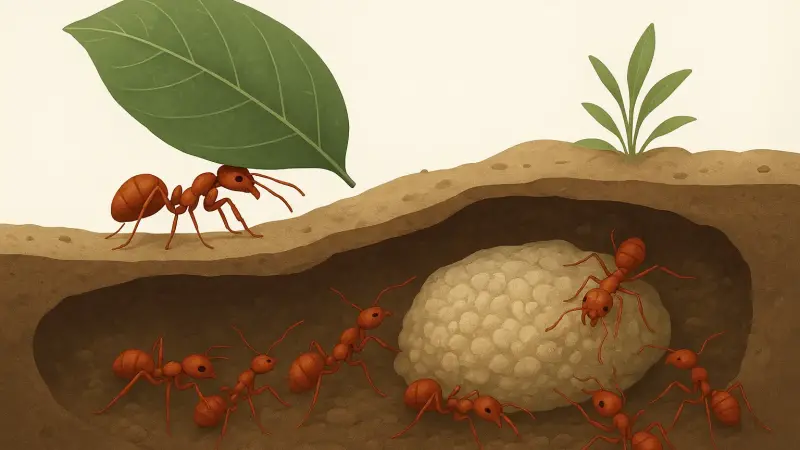
It feels like a rule: plants need sunlight, so anything that eats plants must be connected to sunlight too. Leafcutter ants break that chain. This isn’t one single place or one famous event. It happens across the American tropics, including Costa Rica, Panama, and Brazil, wherever ants like Atta and Acromyrmex can build deep nests. The ants don’t eat the leaves they carry. They use them as compost to grow a fungus underground, then eat the fungus. The garden stays in sealed chambers that never see daylight, because the crop is built for a dark, humid, carefully controlled life.
They don’t harvest leaves, they harvest fungus
A leafcutter foraging line looks like a salad parade, but the leaves are just raw material. Workers cut pieces, carry them home, and hand them off to smaller ants inside. Those smaller workers chew the leaf fragments into a pulp and tuck it into the garden as fresh substrate. On that substrate, the cultivated fungus grows new white threads, and the ants feed mostly on specialized fungal structures produced for them.
The overlooked detail is how divided the labor is. The ants that brave open air with leaf fragments are not the ones that do most of the farming. Deep in the nest, tiny workers spend their lives in the dark, tending the crop, cleaning it, and moving material around like a slow, constant conveyor belt.
The garden is kept dark on purpose
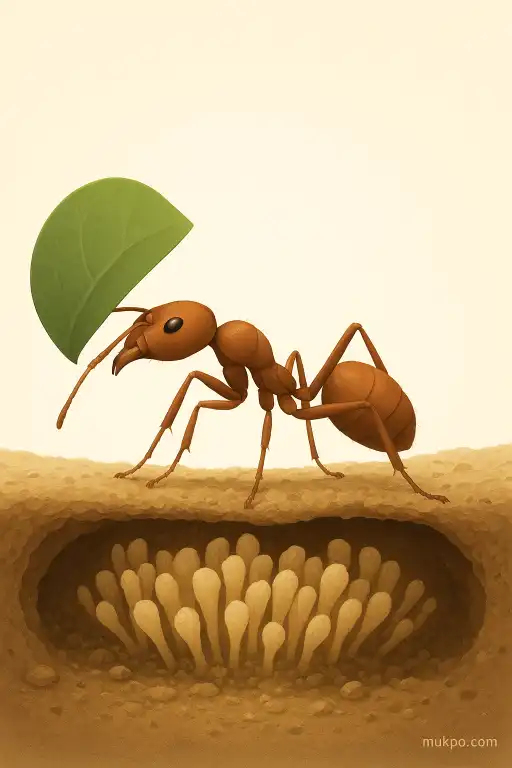
The fungus leafcutters cultivate doesn’t need light to make its own food. It gets energy by breaking down plant tissue the ants provide. Sunlight would add problems, not benefits. Light tends to dry surfaces, warm chambers unevenly, and encourage unwanted growth. A stable underground room is easier to keep humid and steady, which matters because fungal threads can stall or die if the microclimate swings too far.
Nests can be large enough that the farm chambers sit well below the surface. Fresh leaves come in through tunnels, but the crop stays in interior rooms where airflow is controlled by the nest’s architecture and by the ants’ constant opening and closing of passages. The result is a crop that lives in conditions closer to a cellar than a greenhouse.
Leaf pulp becomes a managed growth medium
Inside, leaf fragments don’t just get piled up. They get processed. Workers mix chewed leaf pulp with droplets of fecal fluid that contain enzymes from the fungus’s own digestion. That speeds up breakdown of tough plant compounds and makes nutrients more available to the fungal threads. The ants are effectively pre-treating the “compost” so the fungus can colonize it quickly.
A concrete scene you can picture: a worker arrives with a leaf piece, and within minutes it’s cut smaller, chewed, and pressed into the garden like damp crumbs. Then other ants walk over the surface, plucking out bits that look wrong, patting down loose areas, and shifting older, spent material away from the active growth zones.
Pests are constant, so hygiene becomes a survival system
A sealed, food-rich fungus farm is an invitation to parasites and molds. One of the best-known threats is Escovopsis, a specialized fungus that can invade leafcutter gardens. If it gets established, it can overgrow the crop. That pressure shapes almost everything about daily life in the nest, from grooming to waste handling.
Leafcutter ants don’t rely on one defense. They weed the garden by hand, removing contaminated bits before they spread. They also carry helpful bacteria on their bodies that produce compounds hostile to some pathogens. And they keep trash separate. Spent substrate and dead material are moved to dedicated waste chambers or external dumps so spores and rot stay away from the living crop.
The colony runs on a fragile partnership
The crop is so central that new colonies start with it. A young queen typically carries a small pellet of fungus from her birth nest when she leaves to found a colony. That pellet becomes the starter culture for the first garden chamber. Without it, she can’t simply “plant” leaves and hope the right fungus appears. The relationship is that specific.
Because the ants and fungus are tightly matched, the system has limits. The ants can only use plants that don’t poison or stall their crop, and the fungus depends on a steady flow of properly prepared substrate. When foraging conditions change, or when contaminants slip through, the ants respond fast—shifting garden material, increasing cleaning, and isolating problem areas deeper in the nest’s darkness.
Related reads
- The neighbor who returns lost keys with a typed note of thanks
- How photorespiration makes hot days harder for crops
- How backyard compost heaps generate heat and reduce food waste
- Why names disappear mid-conversation
- Why you sometimes freeze when a joke lands on you
- An old radio that plays broadcasts from distant towns at random