
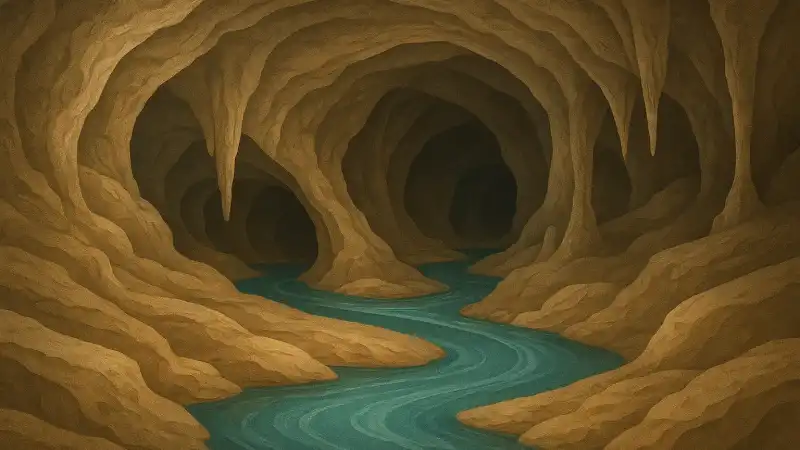
If you stand at the mouth of Mammoth Cave in Kentucky, it’s hard to picture the slow work happening under your feet. There isn’t one single place where underground rivers carve caves. It happens anywhere water can move through soluble rock. The Limestone belts of the Yucatán Peninsula, the karst country around Slovenia’s Postojna Cave, and parts of Appalachia all show the same core mechanism. Flowing water picks up carbon dioxide, becomes mildly acidic, and then reacts with minerals in the rock. Over time, that chemistry turns narrow cracks into tubes, and tubes into rooms, without any need for brute-force “cutting.”
Water gets its “bite” from air and soil
Most cave-forming chemistry starts before water ever reaches a cave. Rainwater absorbs carbon dioxide from the atmosphere. Then it picks up much more CO₂ in soil, where roots and microbes constantly release it. That extra CO₂ makes a weak carbonic acid solution. It’s not strong like laboratory acid. But it is persistent, and it is renewed with every storm and every seep through the ground.
The key reaction is simple. Carbonic acid dissolves calcite, the main mineral in limestone and marble. The rock doesn’t “melt” evenly. It dissolves fastest where water already has a path: along fractures, bedding planes, and the edges of grains. Those small differences in flow and contact time matter more than the overall acidity, which can vary a lot from place to place.
Cracks turn into conduits because flow concentrates
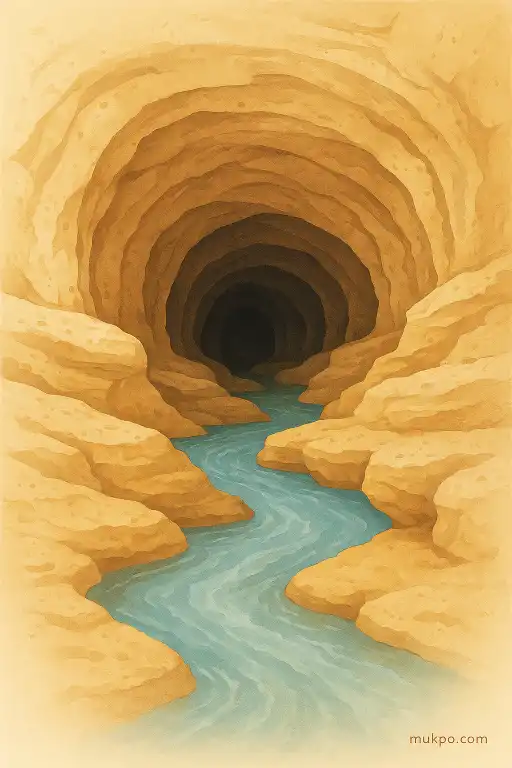
A fresh limestone bed is full of tiny openings that don’t look like much. At first, groundwater moves slowly through a network of pores and hairline cracks. Dissolution widens the easiest routes. That makes them carry more water, which dissolves them even faster. It’s a feedback loop: a slightly bigger crack steals flow from its neighbors and becomes a preferred channel.
This is why caves often follow straight lines and abrupt turns. They are tracing the rock’s existing structure rather than randomly wandering. A passage can run for long distances along a single fracture, then jog when it intersects another set of joints. The river seems like it is “choosing” a path, but the rock handed it a map.
Underground rivers don’t always start as rivers
People picture an underground stream grinding out a tunnel. Often, the first stage is more like a wet sponge. Water moves through the saturated zone below the water table, where all openings are filled. In that setting, dissolution can enlarge passages in every direction. Later, if the regional base level drops—because a surface river cuts down or the land uplifts—those passages can drain. Then a true underground river forms inside a void that chemistry helped create earlier.
You can sometimes see this history in cave levels. Higher, fossil passages may sit dry above an active stream. They are not “abandoned” because the water stopped existing. They are abandoned because the easiest drainage route shifted downward. The chemistry didn’t change as much as the plumbing did.
One overlooked detail: mixing water can dissolve rock faster
A detail that gets missed is that two waters that are each close to “full” of dissolved limestone can still dissolve more rock when they meet. This is called mixing corrosion. The chemistry of carbonate solutions is non-linear, so a blend of two nearly saturated waters can end up undersaturated. At junctions where different seepage routes combine, the rock can dissolve unexpectedly quickly even if neither input seems aggressive on its own.
That helps explain why some caves enlarge dramatically at confluences, or why big rooms can form where multiple flow paths intersect. It’s also one reason cave growth can be patchy. A passage might stay narrow for a long stretch, then open up where water sources mix, turbulence increases contact with the walls, and fresh acid is delivered to surfaces that were previously protected by slow boundary layers.
Why some underground rivers build as much as they destroy
The same reaction that dissolves limestone can reverse. If water loses CO₂—often by entering an airy cave passage—it can no longer hold as much dissolved кальcium carbonate. Calcite precipitates. That is how stalactites, stalagmites, and flowstone grow. It’s not a separate process from cave formation. It’s the same chemistry running in the opposite direction because the conditions changed.
This is why an active subterranean river can be both a hollowing agent and a builder. Deep in flooded zones it tends to enlarge cracks and conduits. In ventilated chambers above the water table, dripping water may leave mineral behind instead. A single cave system can hold both stories at once, depending on where the water is, how fast it moves, and how much CO₂ it carries when it arrives.
Related reads
- Why your mouth moves when you read silently
- A garden that sprouts coins instead of flowers every spring
- Why rushing makes tiny problems feel catastrophic
- How leafcutter ants cultivate fungal gardens that never touch sunlight
- The neighbor who returns lost keys with a typed note of thanks
- How photorespiration makes hot days harder for crops