
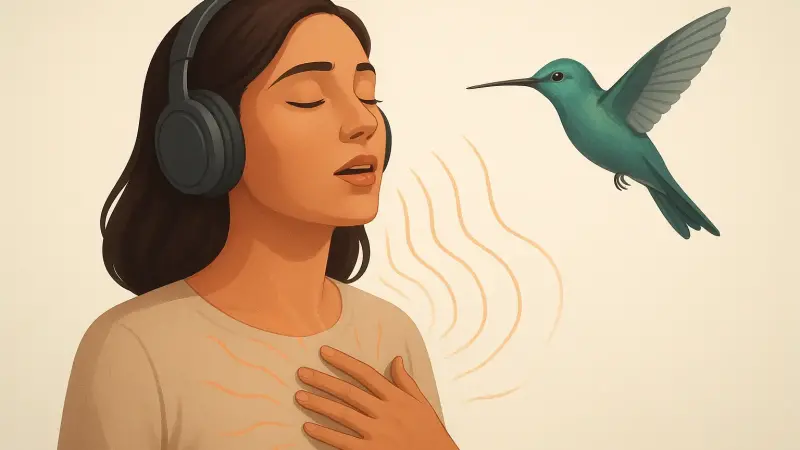
You can be sitting still and perfectly fine, then a song hits one note and your skin lifts. It’s not one single event or place. It happens in a concert hall in Vienna, in a car on the New Jersey Turnpike, or with earbuds on a subway in Tokyo. People often point to “emotion,” but the mechanism is more specific than that. Your hearing system spots a pattern it cares about, your prediction system gets surprised in a precise way, and your body treats that surprise like something important. The chills are a physical reflex. The music is just the trigger.
Chills are a body reflex, not just a feeling
Goosebumps come from tiny muscles at the base of hair follicles contracting. That reaction is controlled by the sympathetic nervous system, the same system that shifts you into alert mode. It’s related to thermoregulation and threat detection, but it also shows up in social and emotional moments. Music can tap into that circuit because the brain treats certain sounds as high-priority signals.
One overlooked detail is that people don’t always get both chills and goosebumps together. Some feel a wave down the neck with no visible skin change. Others get obvious piloerection with only mild emotion. The body response is real either way, but it’s not a single “chills switch.” It’s a bundle of responses that can separate depending on context and physiology.
Your brain is predicting the next note
Listening isn’t passive. The auditory system is constantly forecasting what comes next: the next chord, the next beat, the next phrase ending. When a song matches the prediction, it feels stable. When it violates the prediction slightly, it grabs attention. Chills tend to show up when the violation is strong enough to feel meaningful, but not so chaotic that it just feels like noise.
This is why timing matters so much. A delayed beat drop, a sudden key change, or a melody note that lands just outside what you expected can do it. The moment is often brief. The body reacts to the transition, not the entire chorus. That’s also why the same song can stop producing chills after repeated listens. The prediction error shrinks once the surprise becomes familiar, although it can return if attention, mood, or context changes.
Some sounds carry “human” importance
Music borrows features from human vocal communication. Sustained high notes, a strained voice, a sudden hush, a swelling loudness, or many voices aligning tightly can resemble signals of urgency or collective intent. A choir entering together can feel like a social moment even if you’re alone. That matters because the brain has specialized sensitivity to cues that sound like people coordinating, pleading, celebrating, or warning.
A concrete example is the first time a live audience goes silent and then erupts as a singer holds a long note. The performer’s breathing, tiny pitch wobbles, and the room’s acoustics make the sound more “alive” than a clean studio track. Those micro-variations are easy to overlook, but they can be exactly what convinces the brain this is a real, high-stakes signal rather than background audio.
Memory and meaning can be wired into one musical second
Chills often appear when a sound is linked to a personal memory, even if you don’t consciously think about that memory. A specific synth tone from a game soundtrack, the snare sound used in a particular era of pop, or the exact reverb of a song you heard during a breakup can act like a retrieval cue. The body can react before the story catches up.
Meaning can also be learned culturally. A national anthem, a religious hymn, or a protest song can carry shared associations that make certain musical moves feel loaded. The pattern itself isn’t magical. The weight comes from what the listener’s brain has been trained to attach to that pattern, which varies widely between people and regions.
The strongest chills tend to happen at specific musical moments
They cluster around entrances and shifts: when a voice comes in after an intro, when harmony thickens, when the bass finally arrives, when a melody climbs and then resolves, or when a beat drops out and returns. These moments combine attention, expectation, and a change in intensity. The body interprets that combination as significance, and it answers with a quick sympathetic surge.
They also depend on the situation. A quiet room with headphones can magnify tiny dynamic changes. A crowded venue can add social contagion, where other people’s stillness or cheering changes what your brain predicts. Even temperature matters. Cold skin goosebumps can blend with music chills, making the timing feel stronger or more confusing than it is.
Related reads
- How bioluminescent plankton make whole waves glow at night
- A park bench packed with thousands of folded notes left by strangers
- How pitcher plants use slippery surfaces and fluid flow to drown prey
- How misheard lyrics rewrite whole songs in your head
- The Victorian engineer who patented safety coffins and set London’s burial panic in motion
- The phantom buzz: why phones feel like they’re vibrating when they’re not