
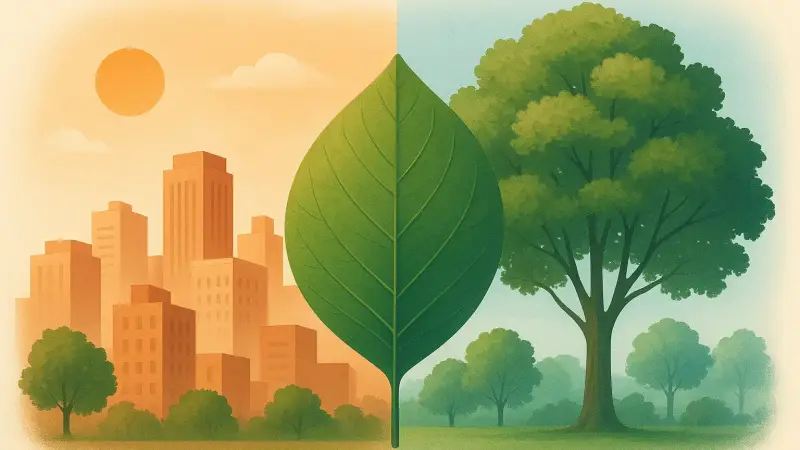
On a hot afternoon in New York City’s Central Park, it can feel a few degrees cooler under a tree than on the sidewalk a block away. This isn’t one single “city tree” story, though. The pattern shows up in places as different as Phoenix, Melbourne, and Singapore. Shade explains part of it, but leaves also change the air by how they handle water and sunlight. The chemistry inside a leaf helps decide how much it “sweats,” how much light it reflects or absorbs, and how it interacts with air pollution. Those choices are partly built into the species, and partly shaped by stress like drought, heat, and salty winter roads.
Leaves cool cities by spending energy
A leaf has two main ways to affect temperature: it blocks radiation and it moves energy into water vapor. When stomata (tiny pores) are open, water evaporates from the leaf surface. That phase change takes heat with it, so the surrounding air can cool. If stomata close to conserve water, that evaporative cooling drops and leaf surfaces can get much hotter than the air.
Leaf chemistry sits behind this because it influences how easily water moves through the plant and how the stomata behave. Hormones such as abscisic acid rise when the plant is water-stressed, which pushes stomata toward closing. The result is that the same tree can cool strongly one week and much less the next, even if it still looks green from the street.
Waxes, pigments, and hairs change how leaves handle sunlight
The outer surface of a leaf is not just “skin.” It’s a chemical layer of waxes (the cuticle) that changes how reflective the leaf is and how quickly it loses water. Some species build thicker wax layers, especially under intense sun, and that can slightly increase reflectance while also limiting evaporation. Pigments matter too. Chlorophyll absorbs strongly in red and blue light, while other pigments can shift absorption and protect the photosynthetic machinery under stress.
A detail people tend to overlook is that many urban leaves are literally coated. Dust, soot, and road grime can darken the surface and clog stomata. That changes both radiation balance and transpiration. A leaf that would normally reflect or shed some heat may instead absorb more sunlight and cool less because its pores are partly blocked.
Heat and drought push trees into a different “mode”
City heat is paired with water stress. Pavement sheds water quickly, and urban soils are often compacted, shallow, or interrupted by utilities. Under those conditions, a tree often shifts its internal chemistry toward protection: more compounds that stabilize cell membranes, changes in osmolytes (small molecules that help cells hold water), and signals that restrict stomata. Cooling drops because evaporation drops.
That’s why “more trees” does not always translate to the same temperature effect across neighborhoods or seasons. Two blocks with similar canopy cover can behave differently if one has irrigated lawns and the other has dry, sealed ground. The difference can come down to whether leaves can afford to keep stomata open on a given day.
Leaf chemistry also changes the air, which feeds back on temperature
Leaves exchange chemicals with the atmosphere. Some trees release biogenic volatile organic compounds (BVOCs) like isoprene and monoterpenes. The amount varies a lot by species and by stress level, and it is not always easy to predict on the ground. In the presence of nitrogen oxides from traffic, these compounds can contribute to ozone formation under sunny conditions.
Ozone and other pollutants can then damage leaf tissues and interfere with photosynthesis, pushing stomata behavior and water use in complicated directions. So a tree is not just reacting to temperature; it is reacting to the chemical mix of the street it lives on, and its own emissions can slightly shift that mix.
Species differences show up as temperature differences on the ground
Some species tend to be strong “evaporative coolers” because their leaves and water-transport systems support high transpiration when water is available. Others are built to be conservative, with leaf traits that resist water loss and tolerate heat, but cool less through evaporation. Evergreens can behave differently from broadleaf deciduous trees because their leaves persist through seasons and often have tougher, waxier surfaces.
On a street, this can show up in small, situational ways: the air under two neighboring trees may feel different even with similar shade, especially on dry days. The difference is not always the canopy size. It can be the leaf’s chemical and structural “settings” at that moment—how open the stomata are, how waxy the surface is, and how stressed the tree is by the specific soil, heat, and exhaust right where it’s rooted.
Related reads
- Why some cicadas emerge with transparent wings after drought
- Why frost paints fractal patterns on cold windows
- How male seahorses carry and birth dozens of babies
- How mangrove roots breathe in muddy water
- An intersection that fills with hundreds of paper boats after every downpour
- How a Victorian inventor smuggled a steam carriage into a London fair