
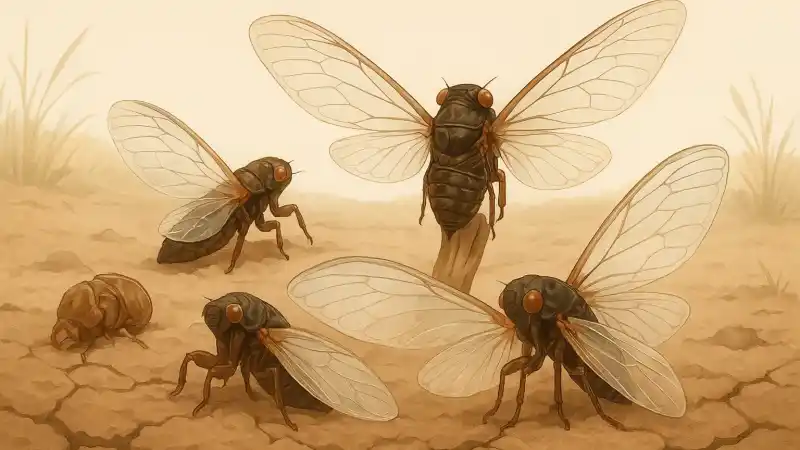
Seeing it after a dry summer
People notice it most after a hard dry spell: cicadas crawl out of the soil, climb a fence post, and the new adults look oddly glassy. This isn’t one single local event. It shows up wherever drought and cicadas overlap, like parts of Texas and Oklahoma after hot, dry summers, or in drought-stressed patches of the southeastern U.S. when annual cicadas are thick. The basic mechanism is simple. The wings start out soft, wet, and almost invisible. They only become firm and slightly tinted once the insect pumps fluid through them and the surface finishes hardening. Drought can scramble the timing and the chemistry of that process.
What “transparent” means on a fresh cicada
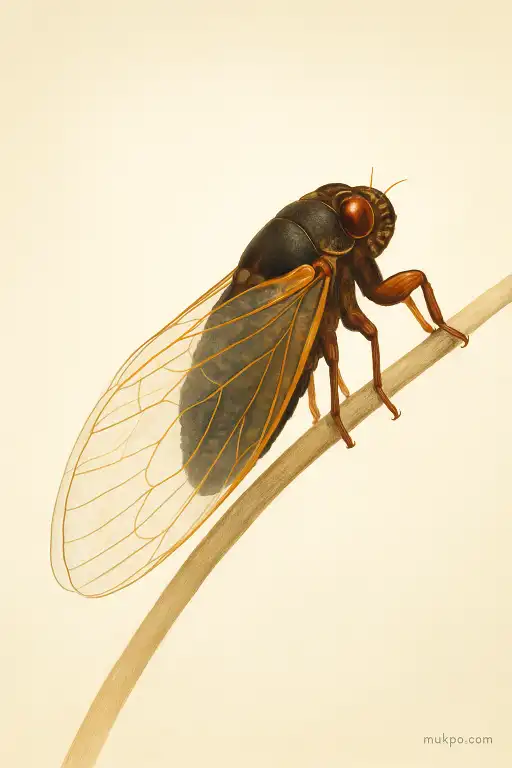
Cicada wings are always meant to be clear-ish. The difference people call “transparent” is usually that the wing stays extra colorless and glossy longer than expected, and the veins don’t stand out as strongly. Right after molting, the adult (the imago) is pale all over. The cuticle hasn’t fully sclerotized yet. That hardening step is when the wing membrane gets its final stiffness, micro-texture, and subtle amber tint. If that last part runs slow or incomplete, the wing looks like a cleaner sheet of plastic instead of a faintly smoked one.
A detail people overlook is how much of what you’re seeing is just minutes on the clock. A cicada can go from “wet tissue paper” wings to “flight-ready” in a short window, but the window varies with temperature, humidity, and the insect’s condition. If you happen to see a lot of newly molted adults at once, it can look like a new trait showing up in a population, when it’s really a lot of individuals caught at the same stage.
Why drought can change the look
Drought doesn’t just mean “no rain.” It changes the water content of the soil and the plants cicada nymphs feed on underground. Nymphs drink xylem sap from roots. Xylem is already watery and low in nutrients, and during drought it can become even harder to extract. The insect may be running on a tighter water and energy budget right when it needs to pull off the most demanding transformation of its life: leaving the ground, shedding the nymph skin, and inflating and finishing two big wings.
The wing inflation step depends on internal fluid pressure. If a newly molted adult can’t move enough hemolymph into the wings quickly, the veins may not fully expand at first. That can leave the membrane flatter, thinner in places, or just slower to settle into its final texture. Hot, dry air can also push the wing surface to dry out fast while the internal finishing chemistry is still catching up, which can change how light passes through the membrane.
The chemistry of hardening and why it can lag
Wing “hardening” is a real chemical process. After molting, insects cross-link proteins and chitin in the cuticle. They also deposit and oxidize compounds that darken and strengthen the surface, especially along the veins and edges. If the cicada is physiologically stressed from poor nutrition underground, that process can be less robust. Even small shifts can show up as lighter veins, less overall tint, or a wing that stays glossy and clear longer.
Temperature adds another twist. Warm nights can speed some reactions but also increase water loss. Cool, dry nights can slow the chemistry but still dry the surface. Either way, drought years tend to produce more “bad timing” conditions for a cicada that’s trying to inflate wings, hang still, and let everything set before it has to fly. If a cicada gets disturbed and drops before the wings are fully set, the wings can also dry in a slightly different shape and look clearer or more uneven.
What you can actually observe on the insect
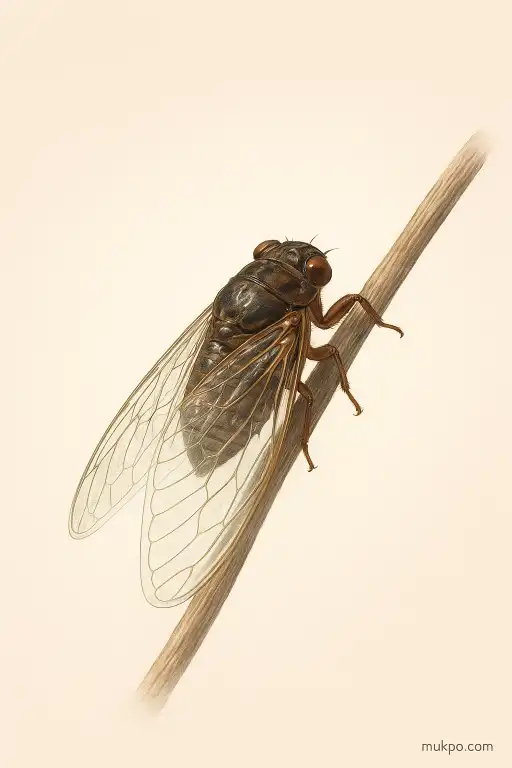
When drought is part of the story, the “transparent” look often comes with other small clues. The body may stay paler longer. The wings may feel softer if you see the insect soon after emergence. The veins can look less contrasted, almost like they haven’t “inked in” yet. Sometimes you’ll spot tiny ripples or incomplete expansion at the tips, which is easy to miss unless you look at the wing edge against the sky.
It also varies by species and by the exact conditions the night they emerged. Periodical cicadas and annual cicadas don’t all behave the same, and different soils hold moisture differently even in the same neighborhood. That’s why one yard can have cicadas that look normal while a nearby, hotter strip along a driveway produces more adults that look extra clear for a while.
Related reads
- Why frost paints fractal patterns on cold windows
- How male seahorses carry and birth dozens of babies
- How mangrove roots breathe in muddy water
- An intersection that fills with hundreds of paper boats after every downpour
- How a Victorian inventor smuggled a steam carriage into a London fair
- The Victorian surgeon whose public anatomy demonstration ignited a London street riot