
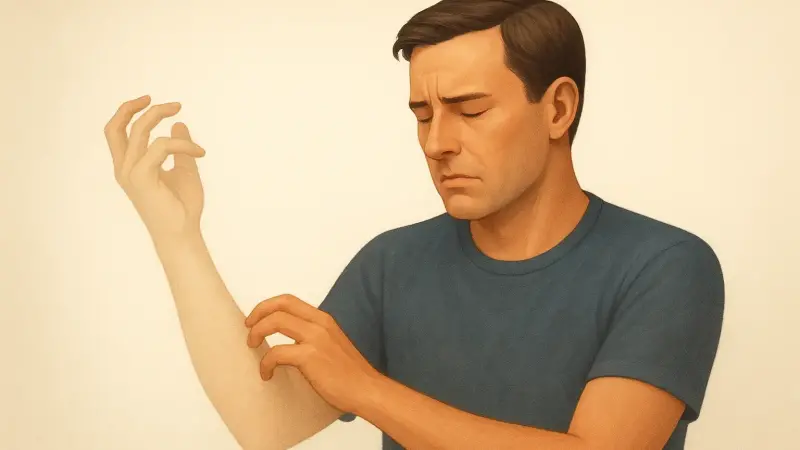
You can scratch a mosquito bite. You can rub a sore wrist. But some people feel an itch in a hand or foot that isn’t there anymore, and the urge to reach for it is automatic. This isn’t tied to one famous event or place. It shows up after amputations around the world, from U.S. military hospitals to rehab wards in the UK and India. The core mechanism is surprisingly ordinary: the brain still runs a body map that expects signals from the missing limb, and those circuits can misfire or get “filled in” by other inputs. The result can feel specific and local, like one fingertip, even when nothing can be touched.
How an itch can exist without skin
An itch is a sensation the nervous system constructs from incoming signals and expectations. Skin nerves normally send information up the spinal cord to the brain, where it gets interpreted as itch, pain, pressure, heat, and so on. After an amputation, the incoming stream changes suddenly, but the interpretation machinery doesn’t shut off on command. The brain still has a representation of the limb—often called a body map—built from years of sensory experience and movement.
That map can keep generating “best guesses” about what should be happening in the missing part. Some of those guesses are neutral. Some are uncomfortable. Itch is common because it’s a protective sensation, and the system is biased toward noticing potential irritation. A detail people overlook is how pinpoint it can be. Someone might report itching only at the “ring finger knuckle” of a hand that’s gone, not the whole hand.
The stump still talks to the brain
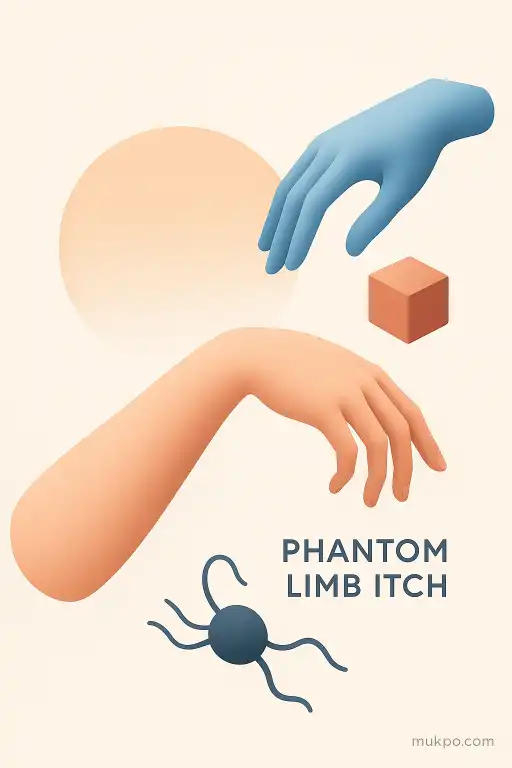
The remaining nerves at the end of the limb don’t always go quiet. They can become irritated, form neuromas, or send spontaneous bursts of activity. Those signals still travel into the spinal cord and up to the brain, but the brain may interpret them using the old address book: “this input belongs to the foot” or “this belongs to the index finger,” because that’s where those nerve pathways used to terminate in the body map.
This is one reason a very ordinary situation can trigger a very strange sensation. A sock seam rubbing the residual limb, a change in temperature, or pressure from sitting a certain way can change nerve firing. The person doesn’t feel “pressure on the stump.” They may feel “an itch under the big toenail.” The mismatch is the whole experience, and it can be immediate.
Why it can move around or change over time
Phantom sensations aren’t fixed. Early after amputation, people often report a vivid sense that the missing limb is still present, sometimes even in a specific posture. Over months or years, the quality can shift. Itch can come and go, and the “location” can drift. That variability is one clue that the sensation isn’t coming from one simple source like a single irritated nerve ending.
One factor is plasticity: the brain reorganizes when it loses input. Neighboring regions in the sensory cortex can expand and begin to activate areas that used to correspond to the missing limb. This can create odd cross-talk. Touch on one part of the body can sometimes spark a sensation that seems to belong to the absent limb. The exact pattern varies by person and by the level of amputation, and researchers still argue about how much re-mapping explains day-to-day symptoms.
Itch isn’t the same as phantom pain
People often lump phantom itch together with phantom pain, but they’re not identical. Pain and itch share some pathways and can blend into each other, yet itch has its own wiring and chemical triggers. In intact skin, histamine-driven itch is a classic example, but neuropathic itch can happen without histamine at all. Phantom itch tends to behave more like the neuropathic kind: it can be stubborn, it can feel “deep,” and scratching the residual limb doesn’t necessarily match the brain’s expected relief pattern.
A situational example shows the difference. A person might feel a sharp, burning phantom pain after bumping the stump, then later report an itch that feels like it’s between two phantom toes. The pain is tied to an obvious jolt. The itch may appear with no clear trigger. Both can be real and both can be confusing, but they don’t always rise and fall together.
Why “scratching the air” can feel so urgent
The urge to scratch is partly reflex. Itch is designed to recruit movement fast, before the thinking brain gets involved. When the missing limb is still represented as present, the motor system can generate the command to scratch it just as readily as it did before. People sometimes catch themselves reaching for a leg that isn’t there, not because they forgot the amputation, but because the body’s itch-response loop fired on old assumptions.
The other overlooked piece is attention. Itch is a sensation that pulls focus, and that focus can amplify it. When the brain can’t complete the usual “scratch → relief” cycle at the exact spot it expects, the signal may stay salient longer. That doesn’t mean the sensation is imagined. It means the nervous system is running a familiar program with missing inputs, and it can’t easily close the loop.
Related reads
- How urban trees change city temperatures with leaf chemistry
- Why some cicadas emerge with transparent wings after drought
- Why frost paints fractal patterns on cold windows
- How male seahorses carry and birth dozens of babies
- How mangrove roots breathe in muddy water
- An intersection that fills with hundreds of paper boats after every downpour