
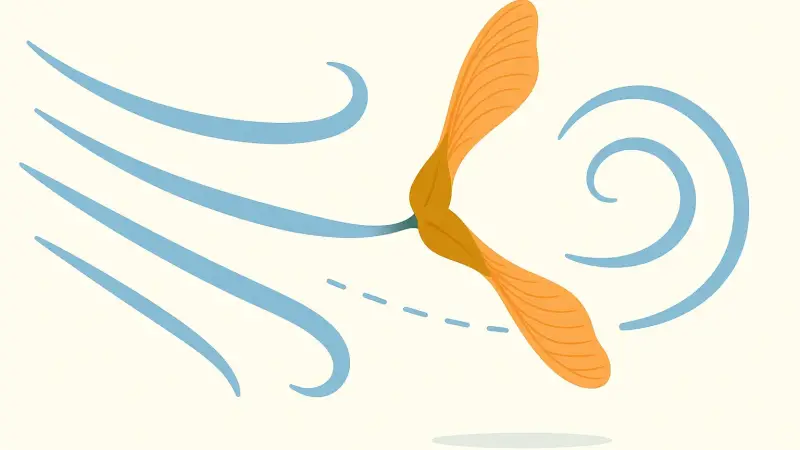
Why a “tiny helicopter” seed can go so far
On a calm sidewalk, a maple seed looks like it should land close by. It spins down, slows itself, and seems built for short hops. But this isn’t one single place or one famous event. Long-distance trips have been observed in different regions with big maples and big weather, including the Great Lakes area of North America, southern Scandinavia, and parts of Japan. The core mechanism is that the spinning seed can get caught in wind structures that don’t just push sideways. Some of those structures lift and trap objects for longer than you’d expect, and that extra time aloft is what turns a local drop into a tens-of-kilometers ride.
What the seed is doing in the air

A maple “key” (a samara) is a wing attached to a heavy seed. When it falls, it autorotates. The rotation creates a stable pattern of airflow around the wing that produces lift and drag at the same time. The lift doesn’t make it climb. It just reduces the falling speed enough that wind has time to act. Typical descent speeds vary by species and seed size, but the important point is that the seed is not a stone. It is a slow-falling object with a fairly consistent orientation, which makes it easier for moving air to “handle.”
A specific detail people often overlook is how fussy that rotation can be. The seed’s wing has a slight twist and camber, and the center of mass is off to one side. That imbalance is what keeps it spinning instead of tumbling. If the wing is damp, torn, or clumped with debris, the rotation changes and the fall speed jumps. So two seeds from the same tree can behave very differently in the same gust, simply because one is a bit heavier, wetter, or nicked.
What a wind vortex is, in plain terms
A vortex is air that’s rotating around an axis. Not all vortices look like tornadoes. Many are invisible, short-lived, and embedded inside “normal” wind. Some form along sharp changes in wind speed or direction, like where a strong breeze slides over a sheltered pocket of air. Others form when wind flows past obstacles and sheds rotating eddies. Over fields, roads, and lake shores, vortices can also pop up as the ground heats unevenly and warm air rises in narrow columns.
The key for a lightweight, slow-falling seed is vertical motion. A vortex can contain an updraft on one side and a downdraft on the other. It can also create a zone where air spirals upward for several seconds. That’s long enough for a spinning samara to be lifted higher than it could reach in a straight gust. Once it’s higher, it can meet faster winds that were not reachable near the ground, especially above treetops where the airflow is less blocked.
How a seed gets lifted, then carried for kilometers
A seed usually starts in the roughest air: the canopy layer and the cluttered space just below it. If it falls into a brief updraft or an eddy rolling off treetops, it can stall there instead of dropping cleanly. That “stall” can look like hovering or even rising a little. If a larger rotating structure is present—like a dust-devil-style thermal vortex on a warm, breezy afternoon—it can pull the seed upward in a loose spiral. The seed doesn’t need to stay centered. It just needs repeated nudges upward that offset its slow fall.
After that lift, the long trip is mostly about finding a faster airstream. Wind speed generally increases with height up to a point, because friction with the ground weakens. A seed that gets lofted above the immediate treetop layer can enter a flow that moves steadily for minutes, not seconds. From there, tens of kilometers becomes a math problem: a seed that stays aloft for, say, 30–60 minutes in a 10–15 m/s wind can travel roughly 18–54 km. The hard part isn’t the sideways push. It’s getting enough time in the air, and vortices are one of the ways that happens.
A concrete situation where it can happen
Picture the edge of a maple stand near a large open area, like farmland beside a forest, or a shoreline with trees backing onto a wide lake. Around the Great Lakes, for example, fall days can bring gusty winds and strong temperature contrasts over land and water. Trees shed seeds into turbulent air at the boundary where smooth wind over open space meets rough, swirling air over the canopy. That boundary is good at generating rolling eddies. If a thermal updraft forms over the warmer surface and tilts in the wind, it can turn into a slanted, rotating plume that lifts light debris—including samaras—above the treetops.
Once a seed reaches that higher layer, it may stop behaving like a “tree seed” and start behaving like airborne plankton. It drifts with the larger-scale flow until it meets sinking air, rain, or a calmer pocket that lets it fall out. Where it lands can be far from any maple, which is why people sometimes notice seedlings in odd places and assume animals must have carried them. For winged seeds, the trip can be mostly physics, with a short, chaotic launch provided by a vortex that existed for only a minute.

Related reads
- The fossil tooth that changed what we know about mammal diets
- The pistol shrimp that snaps bubbles louder than a gun
- Why some volcanoes make lightning during eruptions
- Why a tune loops in your head and refuses to leave
- How bioluminescent fungi light up forest floors
- Where microplastics go when dust lifts off the ocean