
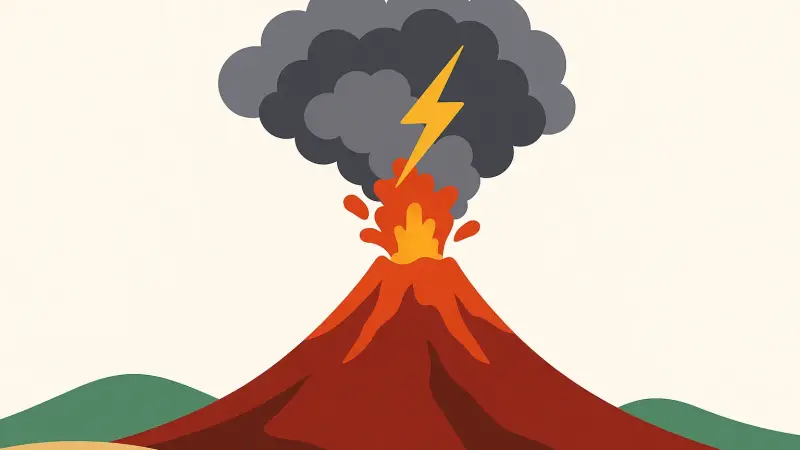
Lightning in an ash cloud looks wrong at first
A thunderstorm makes sense. A volcano feels like a different category. And yet people have watched bright lightning ripping through erupting ash at places like Eyjafjallajökull in Iceland (2010), Sakurajima in Japan, and Mount St. Helens in the United States (1980). It isn’t one single event or one special volcano. It’s a set of conditions that sometimes line up. The core mechanism is simple: an eruption can build up separated electrical charges inside the plume, and once the electric field gets strong enough, air breaks down and a discharge jumps through it.
How an eruption makes charges in the first place
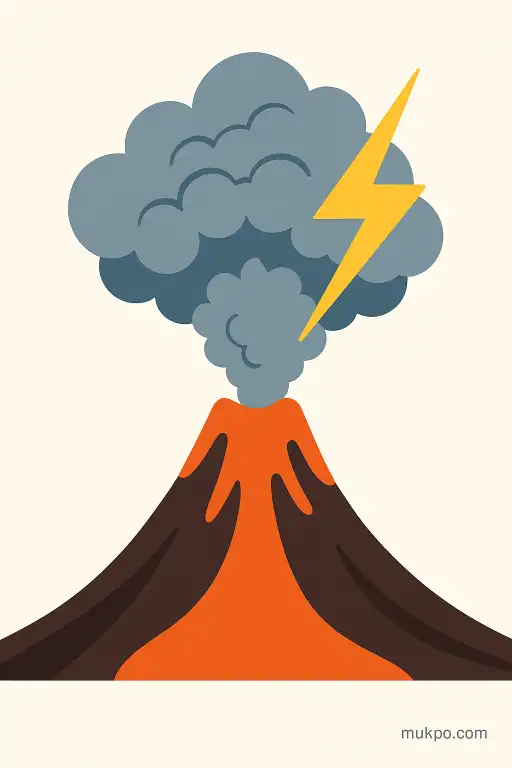
The first driver is contact and separation. Ash, pumice, and bits of rock slam into each other, grind, and bounce. That can move electrons from one surface to another, a process called triboelectric charging. Size matters here. Fine ash tends to end up with a different charge than larger, heavier clasts, so the cloud naturally sorts itself as things collide and then drift apart.
There’s also fragmentation charging. When magma shatters into fresh surfaces during an explosive eruption, it can create charge as bonds break and new surfaces form. Hot gases rushing upward help keep particles suspended long enough for separation to grow. A dense, churning plume is like a moving charge factory, even before weather gets involved.
The plume sorts itself into layers that hold opposite charge
Once particles are charged, the plume does the next step without “trying.” Gravity pulls the heavier chunks down faster. Fine ash rides the updraft and spreads outward. That sorting can leave one region of the plume more positive and another more negative, which is exactly what an electric field needs. Turbulence keeps remixing and re-separating the ash, so the field can build repeatedly rather than just once.
A detail people often overlook is that volcanic plumes are not evenly conductive. Dry ash is a decent insulator, while humid air and wet ash leak charge away faster. That means the same volcano can look wildly different from one eruption to the next, depending on how much water is in the plume and how quickly charges can “bleed off” instead of accumulating.
Why some eruptions flash constantly and others barely at all
Close to the vent, the lightning can be short, frequent, and messy. That’s “vent lightning,” driven mostly by particle collisions in a very dense ash jet. Farther up, tall eruption columns can start behaving more like storm clouds. If the plume rises high enough to cool and form ice, charge separation can be boosted by the same graupel-and-ice interactions that help power ordinary thunderstorms.
This is why some eruptions make dramatic lightning shows and others don’t. Effusive eruptions that pour lava with little ash often lack the particle traffic to charge the plume. Even explosive eruptions can be “quiet” electrically if the ash is too wet, the column is too small, or winds shred the plume before large-scale charge regions can form. Scientists can’t always predict it from volcano type alone, because the details of ash size, water content, and column height vary each time.
What lightning reveals that the eye can’t see
Lightning is a clue to what’s happening inside the plume when the vent is hidden or it’s night. Networks like the World Wide Lightning Location Network, plus local radio sensors, can detect electrical pulses from an eruption even through cloud cover. Researchers use the timing and location of flashes to infer changes in plume intensity, like a sudden surge in ash output or a jump in column height.
It also hints at the ash itself. Stronger charging is often linked to lots of fine particles and vigorous fragmentation, which can mean the eruption is producing ash that stays airborne and travels far. That’s one reason volcanic lightning gets watched carefully during events like Sakurajima’s frequent blasts: the flashes are not just spectacle. They’re a real-time signal from a plume that’s still sorting, colliding, and charging as it spreads.
Related reads
- Why a tune loops in your head and refuses to leave
- How bioluminescent fungi light up forest floors
- Where microplastics go when dust lifts off the ocean
- Why some sands fluoresce under UV light
- The Renaissance codex that baffled royal libraries — the Voynich Manuscript’s mysterious path
- The night massive brewery vats burst and flooded a Victorian London neighborhood with beer