
A beetle that uses fog like a water bottle
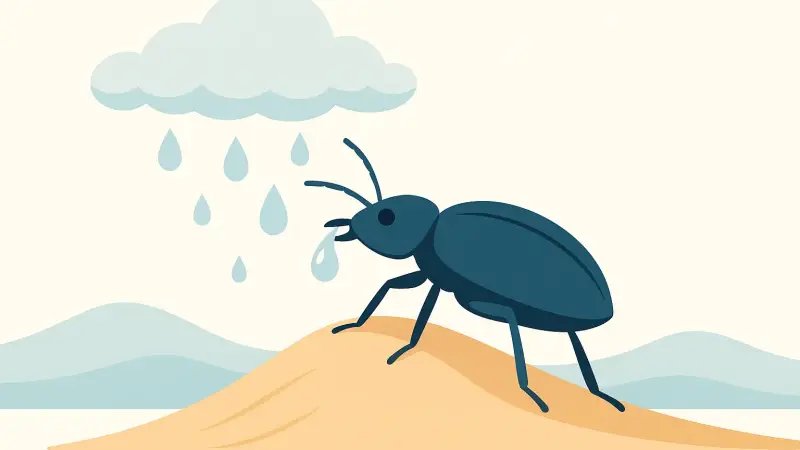
Fog looks like air that forgot how to be invisible. But for at least one desert beetle, it’s a dependable water source. This isn’t tied to one single location. It’s best known from the Namib Desert in Namibia, but fog-harvesting behavior has also been reported in other coastal deserts where cold ocean currents make regular fog, like parts of Chile’s Atacama and the Baja California region. The basic trick is simple: the beetle gets tiny droplets to stick to its body, lets them merge into bigger drops, and then guides those drops to its mouthparts before the dry air can steal them back.
Where the water comes from when there is no rain
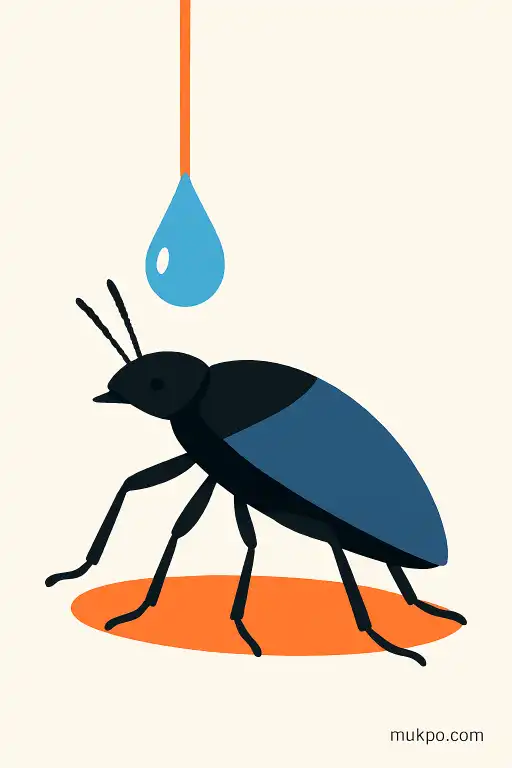
In places like the Namib, fog can arrive even when rainfall is rare or unpredictable. Cold air over the ocean meets warmer air over land, and water vapor condenses into a low cloud that rolls inland. To an animal on the ground, that can mean liquid water appears without a single puddle forming. The timing matters. Fog often shows up at night or early morning, when temperatures are lower and evaporation slows down, so droplets can survive long enough to be collected.
One overlooked detail is scale. A droplet that looks like “mist” from a human height is a heavy bead of water when you’re beetle-sized. But those droplets don’t automatically end up in a drinkable place. They land where airflow and surface texture allow them to land, then they either evaporate, get blown off, or join other droplets and start to move. The beetle’s job is to make that last option happen.
The posture that turns condensation into a sip
The behavior people usually picture is a beetle climbing a small dune and pointing its body into the wind. Researchers often describe it as a “headstand” posture: head down, rear up. The point isn’t drama. It’s gravity and flow. If droplets form on the back and wing covers, they need a slope to travel along. Tilt the body correctly and surface tension can pull drops together until they’re heavy enough to roll. Then they run toward the head, where the beetle can drink them.
In the Namib Desert, this is associated with darkling beetles (family Tenebrionidae), and the species most often mentioned in popular writing is Stenocara. Some details vary by species and study, and not every desert beetle uses the same method. But the general sequence—get into airflow, collect droplets, let them coalesce, guide them forward—shows up again and again when fog is frequent enough to be worth the effort.
Why the shell matters: bumps, wax, and droplet physics
The beetle’s back isn’t just a random surface. The outer shell has texture, and that texture changes how water behaves. Small bumps and micro-roughness can provide “starting points” where condensation is more likely to nucleate. At the same time, waxy coatings can make other areas more water-repellent, which affects whether droplets stick in place or roll. Popular descriptions often simplify this into neat “hydrophilic bumps on hydrophobic background.” Real beetle surfaces can be messier than that, and measurements differ across species and conditions, but the underlying idea holds: pattern and chemistry change the path droplets take.
Another easy-to-miss detail is the competition between droplet growth and evaporation. A droplet has to get big enough to move before dry air shrinks it away. Fog helps, but wind can also strip droplets off the surface. So the “best” surface for collecting water is not just sticky. It has to hold droplets long enough for them to merge, then release them at the right moment. That balance is why posture and surface structure work together rather than separately.
Limits, tradeoffs, and what researchers still debate
Fog drinking sounds like a superpower until you look at the constraints. It depends on regular fog, the right wind direction, and time spent exposed on open sand, which can make an insect more visible to predators. It also doesn’t solve everything. The beetle still has to manage salts, temperature swings, and moisture loss through breathing and body surfaces. Fog can be a reliable supplement, but it isn’t a free pass through the day.
There’s also ongoing discussion about how much of the water capture is due to special surface design versus behavior and environment. Some experiments suggest surface chemistry is key. Others find that body shape, posture, and local airflow do much of the work, even without exotic surface properties. It’s hard to separate those factors cleanly because fog is variable, and because a living beetle is not a static piece of material. The animal moves, heats up, cools down, and changes what “condensation-friendly” even means minute by minute.
Related reads
- The chemistry behind glass frogs’ see-through skin
- How wind vortexes carry maple seeds tens of kilometers
- The fossil tooth that changed what we know about mammal diets
- The pistol shrimp that snaps bubbles louder than a gun
- Why some volcanoes make lightning during eruptions
- Why a tune loops in your head and refuses to leave