
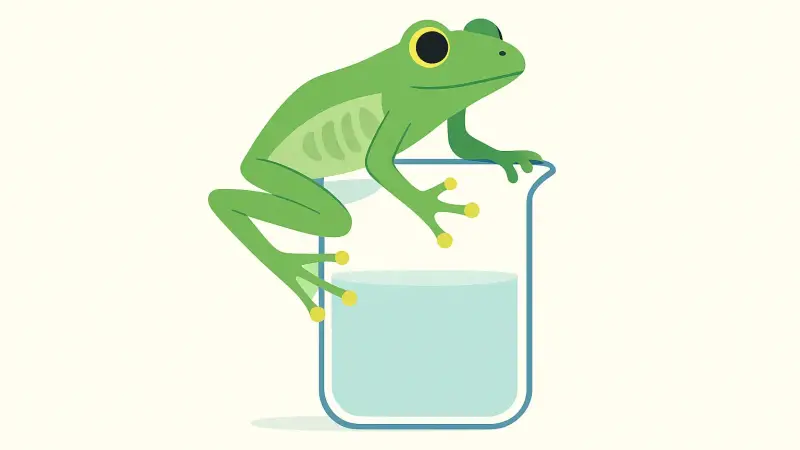
Seeing through an animal should not work
Hold a flashlight up to your hand and you can’t see your bones. Light hits blood, skin cells, and collagen, and it gets scattered. Glass frogs break that expectation. This isn’t one single “glass frog” in one place; it’s a group found across Central and South America, with well-known examples in Costa Rica and Panama. On a leaf in a humid forest, some species can look almost clear from below. The core trick is not magic skin. It’s chemistry and physics: cutting down on the number of light-bouncing boundaries inside the body, especially around blood.
Most “opacity” is just scattering

Skin is usually opaque because it’s a crowded stack of materials with different refractive indices. Keratin, collagen, cell membranes, fat droplets, and tiny air gaps all bend light differently. Each mismatch makes photons change direction. Enough mismatches and the light turns into a bright blur instead of a clean image passing through. Pigments add absorption on top of that, but scattering is the big, overlooked reason a living thing looks solid even when it isn’t very dark.
Blood is a scattering and absorption problem all by itself. Red blood cells are basically little lenses full of hemoglobin, and hemoglobin strongly absorbs some wavelengths. Even a thin layer of capillaries can ruin transparency. So the chemistry behind “see-through” often comes down to controlling where blood is, how much of it is in view, and what else sits between blood and the outside world.
Hiding blood changes the whole optical setup
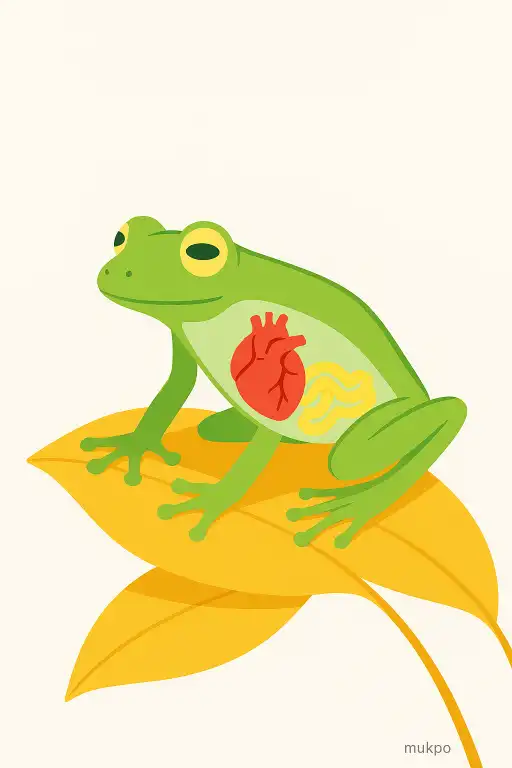
One striking feature reported for glass frogs is that, when resting, they can sequester a large fraction of their red blood cells in the liver. That means fewer red blood cells circulating in the parts you’re looking through. Plasma is still there, so the animal is not “bloodless,” but plasma is much less optically disruptive than a dense suspension of cells. Less scattering. Less absorption. The internal scene gets quieter.
The liver’s role here is easy to miss because it sounds like a circulation detail, not a skin detail. But optically it matters as much as pigment. If red blood cells are parked in one organ, the rest of the body has fewer strong scatterers. Transparency is not just about having clear tissue. It’s also about moving the worst offenders out of the light path at the right time.
Clear-looking skin still has layers with chemistry
Even with blood reduced in the periphery, tissue still needs to avoid extra scattering. That depends on how the extracellular matrix is built and hydrated. Collagen fibers, for example, can scatter strongly when they’re irregularly spaced or bundled in a messy way. If spacing is more uniform and the surrounding water-rich matrix is consistent, the refractive index changes are smaller and scattering drops. That’s chemistry at the level of proteins, salts, and water content shaping microstructure.
Another part is the pigments that remain. Many frogs have chromatophores that reflect or absorb light. Glass frogs tend to have reduced pigment on the underside, and reflective structures can be positioned so they don’t turn the belly into a mirror. The details vary by species and are not identical across the group, which is why some look dramatically transparent and others only partly so. The “see-through” effect is usually strongest in the ventral view, not all angles.
Transparency has tradeoffs your eye doesn’t notice
Parking red blood cells in the liver raises an obvious chemistry problem: clotting. Concentrating cells and changing flow conditions can make blood more prone to coagulate, especially if vessels are constricted. Glass frogs appear to avoid dangerous clot formation while doing this, which implies their clotting chemistry and blood-handling physiology are tuned in unusual ways. The exact mechanisms can vary and are still being worked out, but the constraint is real: you can’t just “store blood” without consequences.
There’s also an optical limit that’s easy to overlook. Being transparent does not mean being invisible. Water, muscle, and organs still absorb and scatter some light, and the environment matters. On a glossy leaf, reflections and shadows can hide edges. Under different lighting, the same frog can look much less clear. The chemistry builds the potential for transparency, but the final effect depends on where the animal is, what direction the light comes from, and how much blood is currently in circulation.
Related reads
- How wind vortexes carry maple seeds tens of kilometers
- The fossil tooth that changed what we know about mammal diets
- The pistol shrimp that snaps bubbles louder than a gun
- Why some volcanoes make lightning during eruptions
- Why a tune loops in your head and refuses to leave
- How bioluminescent fungi light up forest floors