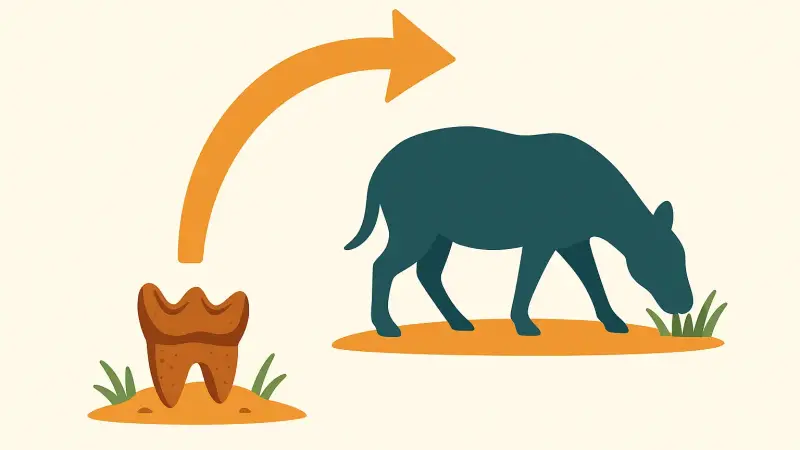
A tooth sounds like a small thing to build a big story on. But in paleontology it’s often the most talkative fossil you get. This topic isn’t tied to one single town or one single dig. It’s more like a long argument carried by tiny details from places like the Morrison Formation in the western United States, the Jehol Biota in China, and the Messel Pit in Germany. A single fossil tooth can push that argument in a new direction because tooth shape, wear, and chemistry are direct records of what an animal actually processed in its mouth, not what it merely could have eaten.
Why a single tooth can rewrite a diet
Mammal teeth are not generic. Enamel ridges line up like tools. Cusps crush or pierce. Flat basins grind. When paleontologists find a tooth that doesn’t fit the expected “menu” for a group, it forces a re-check of assumptions about that animal’s ecology, and sometimes about the whole period it lived in.
The key mechanism is that teeth are built for repeated loading. That leaves traces. A tooth that looks sharp in outline might still show heavy grinding wear, which doesn’t match a strict meat diet. Conversely, a tooth that looks suited for plants can carry fractures and pitting consistent with crunching hard items like insects with tough exoskeletons or seeds with gritty dust on them.
What scientists read in fossil tooth surfaces
The first pass is morphology: the overall shape and how it fits with other teeth. But the more diet-changing evidence often comes from the surface. Microwear analysis looks at tiny scratches and pits. Scratches tend to come from shearing and grinding. Pits often come from crushing hard objects. The pattern can suggest what the animal ate in the days or weeks before it died, not just what its lineage evolved to do.
A specific detail people usually overlook is that enamel wear can be caused by the environment, not just food type. Wind-blown grit, dust stuck to low plants, or sand in a shoreline habitat can act like sandpaper. Two animals eating “the same plant” can leave different microwear if one fed close to the ground or drank from silty water. That’s why researchers compare wear patterns across individuals and deposits instead of treating one tooth like a perfect summary.
When “herbivore” and “carnivore” stop working as labels
Some of the biggest shifts come from realizing how common mixed diets are. Early mammals and mammal relatives often had teeth that look specialized, yet their wear can point to opportunistic feeding. That matters because it changes how scientists picture food webs. If a species thought to be an insect-eater was also grinding plant matter, it isn’t just chasing prey. It’s also competing with other small animals for seasonal resources like seeds and fruits.
Even among later mammals, tooth evidence can challenge neat categories. Many primates, for example, show dental adaptations for fruit but carry wear from hard fallback foods when fruit is scarce. In the fossil record, a tooth that carries both heavy pitting and long scratches can point to that same kind of “switching,” where an animal’s teeth are built for one preferred food but regularly handle something else that is tougher or dirtier.
A concrete example: a jaw that still had its last meal
One situational example that makes tooth evidence feel less abstract comes from fossils preserved with gut contents. The Messel Pit in Germany is known for exceptionally preserved Eocene mammals. In cases where a jaw’s tooth wear suggests one thing and preserved stomach contents suggest another, researchers have to reconcile short-term behavior with long-term adaptation. A tooth can show habitual chewing forces over months or years, while stomach contents capture a single snapshot.
That mismatch is often the point. A specimen might have teeth shaped for cracking and still be found with soft food remains, or have slicing crests but show rounded wear from repeated grinding. Those combinations are exactly what prompt diet re-interpretations. They also make scientists more cautious about building an entire lifestyle from tooth shape alone.
What a “diet-changing” tooth actually changes in the bigger picture
When a fossil tooth changes a diet story, it usually changes several connected stories. It affects estimates of energy use and metabolism, because different foods require different amounts of processing. It changes how an animal might have moved through its habitat, since food distribution shapes home range. It can even change timing in evolutionary narratives, like when grinding teeth for plant-heavy diets became common, or how quickly mammals diversified after major ecosystem shifts.
And it changes the field’s habits. Teeth become less like “identity cards” and more like records that need multiple readings: shape, microwear, and sometimes chemistry such as stable isotopes when enamel preservation allows it. That’s why one small tooth, pulled from a drawer or a new layer at a site, can reopen debates that seemed settled for decades.