
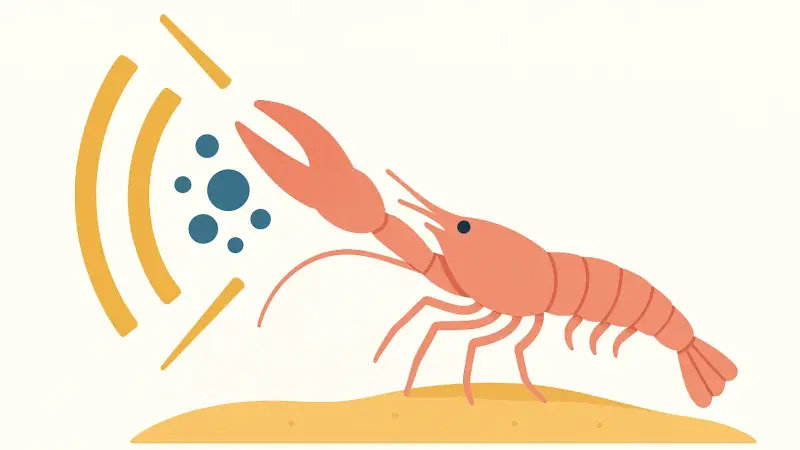
That sharp crack on a reef
If you’ve listened to recordings from coral reefs, you can hear it: a steady sprinkling of sharp clicks that sound like someone snapping twigs underwater. It isn’t one single place or one single animal doing it. You’ll hear it in the Caribbean, the Red Sea, and across the Indo-Pacific, including places like Australia’s Great Barrier Reef. A lot of those cracks come from pistol shrimps. They don’t bang their claws together. They fire a fast jet of water that creates a bubble, and the bubble collapses with a pop that can be louder than a gunshot at close range.
How a claw makes a bubble
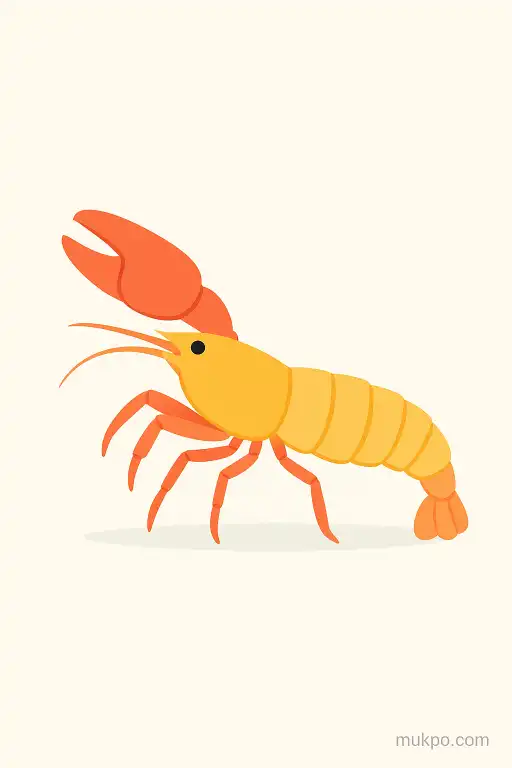
A pistol shrimp has one oversized claw with a built-in latch. The claw closes so fast that it acts like a piston. Water is forced through a narrow notch, and that tight stream shoots forward in a fraction of a second. The surprise detail people miss is that the “shot” is not the claw strike. It’s the water jet and the bubble it creates. If the claw is damaged or missing, the shrimp can sometimes regrow it, and the other claw may become the new “pistol,” which shows how specialized the mechanism is.
The bubble forms because the water pressure in the jet drops suddenly. That drop can be enough to vaporize the water locally, creating a cavity. This is cavitation, the same basic phenomenon that can pit boat propellers and pump impellers. Underwater, the cavity doesn’t last long. It collapses almost immediately, and the collapse is what produces the loud acoustic shock.
The loud part is the collapse
When the bubble collapses, it creates a very fast pressure pulse. That pulse is the “snap” people hear. Measurements vary by species, distance, and setup, but the peak sound levels reported in research can be extremely high at close range. It’s also why the sound can carry through reef habitat and show up strongly on hydrophones. To a fish or another shrimp nearby, it’s not just loud. It’s sudden, and it’s coming from a precise point right in front of the claw.
There’s another odd detail tied to that collapse: it can produce a brief flash of light, a phenomenon called sonoluminescence. It’s faint and very short-lived, and it’s easier to detect in lab conditions than by eye on a reef. The key point is that the collapse is energetic enough to create extreme local conditions for an instant, which helps explain why the snap can stun small prey.
What the shrimp uses it for
The snap is used to hunt and to defend territory. Some pistol shrimps use it to stun small fish or knock tiny crustaceans off balance, then grab them with their legs and mouthparts. Others use it mostly in disputes with neighbors. Reefs and rubble flats can be dense with burrows, so fights over a good crevice are common. The snap works as a warning and as a physical shove, because the pressure wave can be felt as well as heard.
In some species, there’s also a well-known partnership with gobies. The shrimp digs and maintains a burrow while the goby stands guard. The shrimp is often a poor swimmer and not a great lookout, so it keeps one antenna in contact with the goby’s body. That touch-based “link” is easy to overlook because the snapping claw gets all the attention, but it’s central to how the pair avoids predators near the burrow entrance.
Why reefs can sound like frying bacon
Put enough snapping shrimps together and they become a major part of the background noise of shallow seas. That crackling sound is strong enough that navies and researchers have had to account for it in underwater listening, because it can mask other signals. On some coasts, snapping shrimp noise is one of the dominant natural sounds picked up by hydrophones at night, when many animals are active and the water is calm enough for the clicks to carry.
It also means the “louder than a gun” idea depends on context. A close, peak pressure spike underwater is not the same as standing next to a firearm in air, and comparisons vary by method. But the basic reason the snap can be so intense is clear: a tiny animal is exploiting cavitation, using a mechanical latch and a nozzle-like claw to turn muscle power into a collapsing bubble that hits like a miniature shockwave.
Related reads
- Why some volcanoes make lightning during eruptions
- Why a tune loops in your head and refuses to leave
- How bioluminescent fungi light up forest floors
- Where microplastics go when dust lifts off the ocean
- Why some sands fluoresce under UV light
- The Renaissance codex that baffled royal libraries — the Voynich Manuscript’s mysterious path