
People rarely ask what made Victorian “whitening” products look so good in lamplight. The answer was often simple chemistry, and sometimes it killed. In seaside towns, a death could turn into a public lesson because the coroner’s inquest was held close to where the body was found, with local witnesses, and with a jury drawn from ordinary residents. That meant a bad batch sold over a counter could be pulled into the open quickly. The mechanism wasn’t exotic. A fashionable powder or lotion promised a paler face. It used cheap, powerful ingredients that also happened to be poisons. At an inquest, the label mattered less than what the chemist had actually mixed.
Why a coroner mattered in a resort town
Victorian coroners were not just checking a box for paperwork. They convened a jury, took sworn testimony, and asked blunt questions in public. In a holiday place with boarding houses and visitors, there was extra pressure to show the town was safe and respectable. A sudden death that looked “domestic” could still threaten trade if rumors spread. So the inquest became a kind of civic performance, but with real legal teeth.
One overlooked detail is how physical the process was. The jury might view the body. The coroner could order a post‑mortem. Objects connected to the death—bottles, paper packets, a jar from a shop—could be brought into the room and discussed in front of neighbors. That setting made it harder for a chemist to hide behind polite language like “complexion aid” or “toilet preparation.”
What “whitening” meant in Victorian consumer chemistry
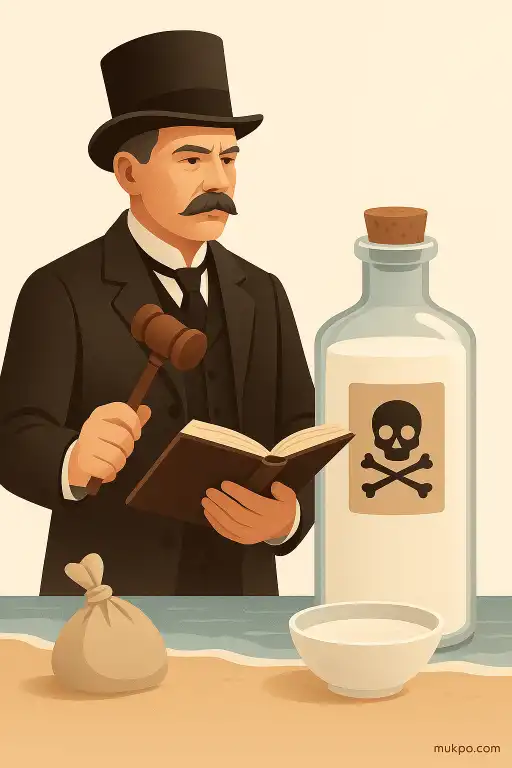
“Whitening” covered a lot of products. Face powders. Lotions. Soaps. Sometimes even washes sold for freckles or “sunburn,” which was a common complaint at the coast. The appeal was immediate and visible. A pale finish read as refinement, and powders could also hide irritation from wind and salt air. That demand created a market for quick results, not cautious formulation.
The dangerous part was that effective whiteners were often the same substances used elsewhere for industrial or vermin purposes. In the nineteenth century, arsenic compounds were used in pigments and poisons, and mercury compounds appeared in some skin preparations. Lead was used in cosmetics earlier and lingered in household knowledge. The exact ingredient in any given case can be unclear unless the inquest record or an analyst’s report survives, but the pattern is consistent: strong chemicals were sold in small quantities with big promises and weak oversight.
How an inquest could expose a shop counter to scrutiny
A death that followed a new purchase created a trail that coroners liked because it could be tested. Where was it bought. Who served the customer. Was it made on the premises or ordered in. Was the bottle labeled. Was a warning given. Those questions sound modern, but they fit the inquest format well because each answer comes from a witness under oath. A lodging-house keeper might describe when the product was first used. A friend might mention a smell or a rash. The chemist might describe a recipe, or deny having one.
It also mattered that Victorian chemists did more than dispense prescriptions. Many mixed their own “toilet” goods, and some sold patent remedies alongside ordinary medicines. That mix made the counter a blurry space. The same person weighing cough syrup could sell a whitening powder that was treated, socially, like a harmless cosmetic. An inquest forced the room to treat it like what it was: a chemical preparation with consequences.
The lethal part often wasn’t a single dramatic dose
Popular imagination likes one fatal spoonful. A lot of Victorian poisoning episodes were messier. If a whitening product contained mercury or arsenic, harm might come from repeated use, use on broken skin, or accidental ingestion after it was applied with damp fingers and then eaten with. Symptoms could look like stomach illness, “debility,” or a sudden collapse that families blamed on the sea air or bad food. That ambiguity is one reason a coroner’s questions mattered.
Another overlooked detail is packaging. Powders were sometimes sold in unmarked paper, or transferred into a household jar. Liquids could be poured into whatever bottle was at hand. When a substance changed containers, any manufacturer’s instructions vanished, and the inquest might have to reconstruct what it even was. A local analyst could be asked to test residue scraped from a stopper or the last damp clumps at the bottom, which is a tiny, practical kind of evidence that rarely features in the retelling.
What these cases reveal about responsibility and proof
When an inquest “revealed” a chemist’s dangerous brew, it usually did so by stacking small certainties. A witness saw the purchase. Someone watched the first application. A doctor described symptoms. An analyst identified a compound. The coroner then had to steer the jury toward a cause of death that could be said out loud without overreaching. That could mean naming a poison, or it could mean a careful verdict that pointed to “the effects of” a preparation without stating intent.
That public process could be uncomfortable for everyone involved. Chemists were respected tradesmen, and seaside visitors were often better-off than the locals serving them. Yet the inquest room flattened status a little. It put the recipe, the scale weights, the label, and the sales patter into the same chain of events as the body itself. And once that chain was spoken into the record, it was hard for a town to pretend the counter and the grave were unrelated.
Related reads
- Why a song suddenly gives you chills and goosebumps
- How bioluminescent plankton make whole waves glow at night
- A park bench packed with thousands of folded notes left by strangers
- How pitcher plants use slippery surfaces and fluid flow to drown prey
- How misheard lyrics rewrite whole songs in your head
- The Victorian engineer who patented safety coffins and set London’s burial panic in motion