
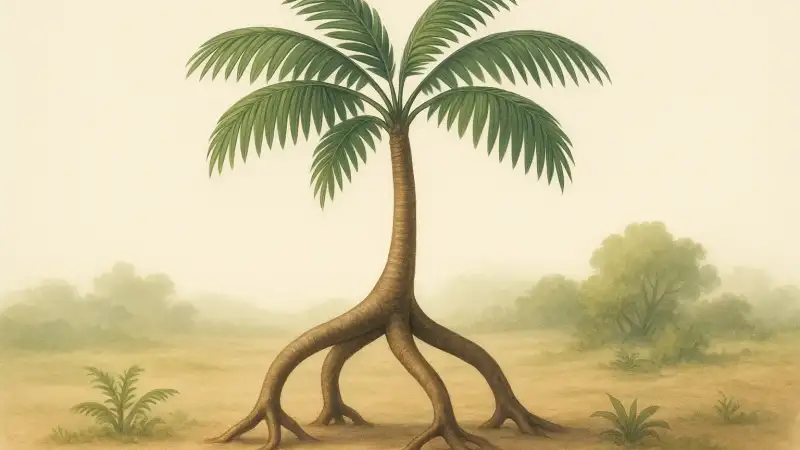
People hear about a “walking” palm and picture a tree stepping across the forest floor. That image tends to get attached to rainforests in Costa Rica, Nicaragua, and Panama, where the walking palm (often identified as Socratea exorrhiza) grows. It isn’t one single place or one documented event. The odd part is real, though: some palms look like they’ve shifted position over time. The core mechanism isn’t legs. It’s roots that are unusually visible and that can die back on one side while new ones take over on another, especially when light, soil, or stability changes around the trunk.
What people mean when they say it “moves”
The stories usually start with someone noticing a palm that seems to be “leaning away” from where it used to be, or a trunk that doesn’t line up with older photos. The species most often involved has stilt roots: thick, arched roots that rise above the ground before entering the soil. From a few steps away, those roots look like a cluster of supports that could be rearranged.
A specific situation that fuels the claim is a gap opening in the canopy after a nearby tree falls. People see the palm later angled toward the brighter patch. That can look like relocation, but what’s visible is mostly a slow change in which roots are doing the supporting, plus a trunk that can gradually re-orient as the load shifts.
Stilt roots are not a gimmick
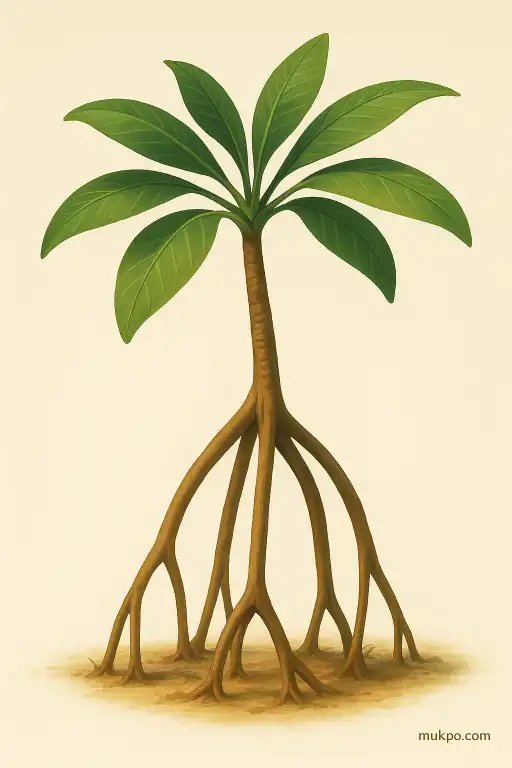
Stilt roots are an adaptation for growing in wet, uneven, or unstable ground. They spread the palm’s weight across multiple contact points. That matters in places where soil can slump, where leaf litter builds up and collapses, or where shallow roots would be exposed after heavy rain.
One overlooked detail is that those “stilts” are not a permanent scaffold in the way a wooden trestle would be. Each root is living tissue with its own growth and decay. The root cluster can look the same for years and then change fast after flooding, erosion, or damage from animals and falling debris.
The mechanics: new roots, old roots, shifting support
A palm can produce new adventitious roots from the lower trunk. If conditions favor one side—firmer soil, more moisture, or better anchoring—those roots can thicken and take more load. At the same time, roots on the opposite side can become less useful. They may be shaded out by litter, undermined by a small washout, or physically broken. Over time, that changes where the trunk is best supported.
The important constraint is that the trunk itself is not crawling forward like an animal. Palms don’t have the kind of secondary thickening and jointed structure that would allow a deliberate step. What they can do is keep adding roots and adjusting the center of support. If the “front” roots are newer and the “back” roots are dying back, the whole structure can end up slightly offset compared to where it started.
Why it often gets blamed on chasing light
Light changes fast in a rainforest. A single fallen tree can create a bright corridor, then a few years later the gap closes again. A palm that survives by staying upright and stable can end up leaning toward a better-lit direction, because that’s where growth is more vigorous and where new roots may establish more successfully in warmer, drier surface layers.
But the evidence for “walking” specifically to chase light is mixed and varies by observation. People tend to remember palms that shifted noticeably and forget the many that didn’t. And without precise measurements—marked points in the soil, repeated surveys, consistent camera angles—it’s easy to mistake a change in tilt or root dominance for the trunk base physically traveling across the ground.
What a careful look usually reveals
If you stand close to one of these palms, the base often tells a more ordinary story. You might see older stilt roots that are scarred, hollowing, or no longer well-seated in the soil. You might also see newer roots that are thicker on one side and pushing into firmer ground. Small differences like that can add up to a visible change in stance.
Another easy-to-miss detail is the ground itself. A few centimeters of erosion on the upslope side, or a small mound of sediment building on the downslope side, changes what looks like the “original” position. When the forest floor is literally moving under the palm, the palm can look like it’s the one doing the traveling.
Related reads
- The bakery oven that chimes at midnight with an impossible melody
- When uncontrollable laughter spread through Tanganyika schools in 1962
- How a Second Empire impresario tried to replace Parisian musicians with clockwork automatons
- How a vaudeville theater’s curtains seem to remember the names whispered into them
- Why people confidently defend choices they never made
- The Topkapi trial that pitted palace officials over a vanished sacred banner