
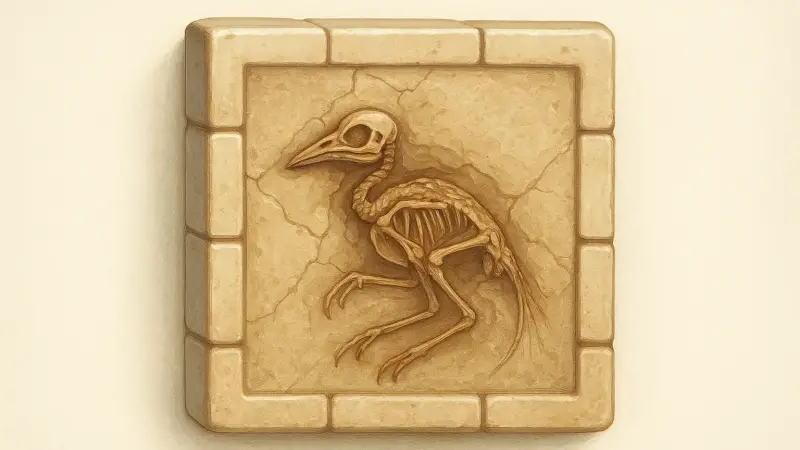
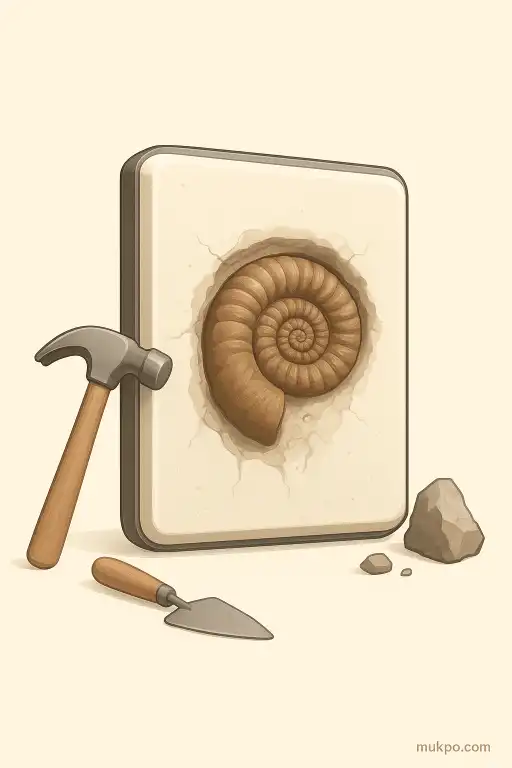
You’re waiting for a train and your eyes land on a white wall tile that isn’t quite blank. There’s a faint spiral inside it, like a pressed fern or a shell print, except it’s under the glaze. This isn’t one single station or one single find. It shows up anywhere the tile or stone came from fossil-bearing rock. People have pointed out fossils in New York City subway stations built with stone finishes, and you can see the same kind of “unexpected biology” in polished limestone walls in London Underground corridors or Paris Métro passageways. The core mechanism is boring in the best way: building materials are cut from ancient seabeds, and sometimes a fossil makes it all the way into a wall.
Why a fossil can end up in a wall tile
Most subway “tile” walls are ceramic, and ceramic doesn’t contain fossils. But stations often mix materials. There can be ceramic field tile next to limestone baseboards, marble trims, terrazzo panels, or a stone veneer behind signage. Fossils ride along in those stone pieces because limestone forms from compacted shells and sediments. When the quarry cuts a slab, it’s slicing through that history like pages in a book.
The fossil is not something that wandered in during construction. It was already locked in the rock long before the tile was manufactured. The station’s build date only matters because it fixes the moment the stone got cut, shipped, and installed. After that, the fossil just sits there behind a thin polished surface while millions of people pass it without noticing.
What people usually think they’re seeing
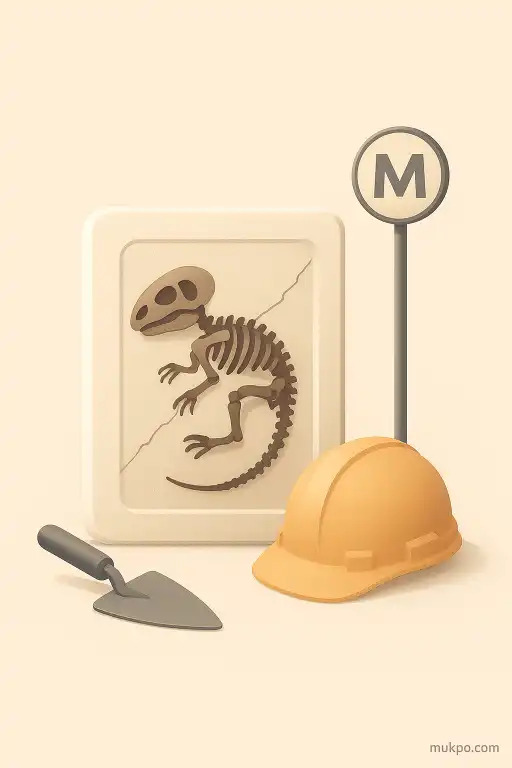
Most of these “trapped fossils” are marine. Spirals can be ammonites or snail shells, though it’s often unclear from a quick glance. Rice-grain shapes in limestone can be tiny fossil fragments, or even the cross-sections of shell pieces. Sometimes you get a honeycomb pattern that looks manufactured. That can be a coral fossil cut at an angle, so the cells look stretched.
A common confusion is mistaking a fossil for damage. A dark curve can look like a crack under the glaze. A pale oval can look like a patch job. Real fossils tend to have repeated structure. Curves that stay consistent, chambers that step outward, or a texture that’s too organized to be a random stain.
The overlooked detail: direction and slicing
One detail most people overlook is that fossils change drastically depending on how the stone was cut. A shell sliced straight through can look like a neat circle. The same shell sliced off-center turns into a comma. Coral can look like a bunch of dots, a grid, or a set of elongated tubes depending on the cut angle. Two adjacent tiles from the same slab can show totally different “pictures” even if they’re part of the same fossil body.
This also explains why the fossil sometimes appears to “continue” across grout lines. It isn’t growing. It’s just that installers often bookmatch or place sequential cuts near each other without realizing they’re aligning a pattern that started as a living organism.
How it survives a harsh subway environment
Subways are humid, gritty, and full of vibration. Fossils in stone don’t mind vibration, but the stone surface does. Polished limestone can dull over time from cleaning and abrasion. That dulling can actually make fossils easier to see because the reflective glare drops and the texture reads more clearly in flat station lighting.
What doesn’t survive as well is the crisp boundary between fossil and surrounding matrix. If water gets into tiny pores, minerals can darken along microcracks. That can outline a fossil more strongly, or blur it into the background. So the “visibility” of the fossil can vary from year to year even though nothing about the fossil itself is changing.
What a specific find in a station tends to be
A typical moment is someone spotting a spiral or a cluster of little rings while standing still, usually near a platform edge or at a mezzanine wall where there’s time to stare. In New York City, for example, there are stations with stone elements where commuters have photographed shell-like patterns in the wall panels and trim. The exact identification is often unclear from a phone photo because you need scale, lighting, and a clean view of the cut surface.
The funny part is how often the “fossil tile” is only a few feet from something designed to grab attention—maps, ads, signage—and it still gets missed. The station is built for motion. Fossils are built for stillness. So the sighting usually happens when the train is late, the crowd thins for a second, and someone’s eyes drift to a spot they’ve stood beside a hundred times.
Related reads
- The Victorian coroner whose seaside inquest revealed a chemist’s lethal whitening brew
- Why a song suddenly gives you chills and goosebumps
- How bioluminescent plankton make whole waves glow at night
- A park bench packed with thousands of folded notes left by strangers
- How pitcher plants use slippery surfaces and fluid flow to drown prey
- How misheard lyrics rewrite whole songs in your head