
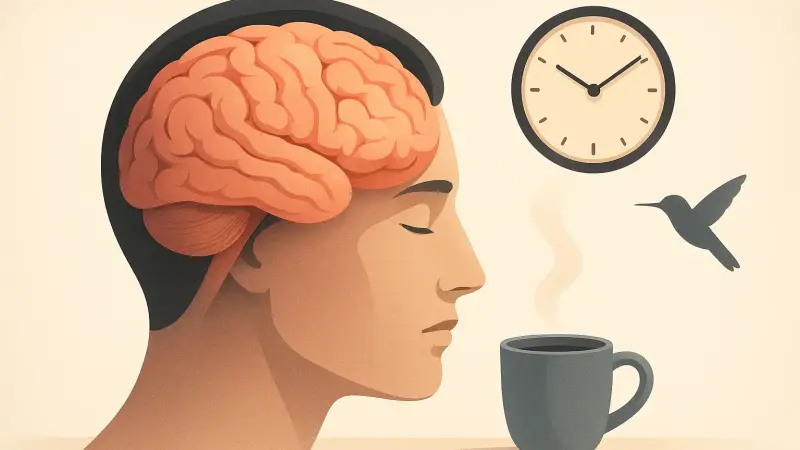
You can be sitting upright with your eyes open and still feel like your brain is running five minutes behind. It’s not one single place or event. It happens on early commuter trains in Tokyo, in hospital night-shift break rooms in London, and in dorm rooms in the U.S. The core reason is simple: waking up isn’t a switch. Different brain systems come back online at different speeds. Some circuits that keep you alert start working quickly, while others that handle attention, memory, and self-control lag behind. That lag has a name in sleep science, and it shows up even when people “slept enough.”
Waking up is a staged process
After sleep, the brain transitions through a period called sleep inertia. During it, a person can look awake but still think slowly, miss details, and feel slightly disconnected. The timing varies. It can be short, or it can stretch out much longer, especially after deep sleep.
Part of the reason is that sleep is not one uniform state. There’s REM sleep and there are non-REM stages, including slow-wave sleep. If someone wakes from slow-wave sleep, the “groggy” state tends to be stronger. That’s why two people can wake at the same clock time and feel totally different, even if they went to bed at similar hours.
Some networks stay underpowered for a while
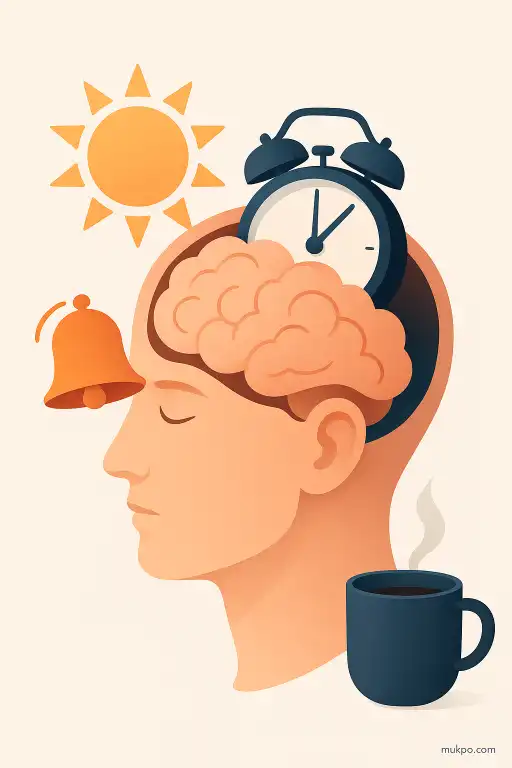
Alertness is not the same thing as full cognitive function. The brainstem and related arousal systems can push the body into wakefulness fast. But higher-order networks, especially in the frontal regions involved in planning and inhibition, often recover more slowly. That gap is why someone can walk to the kitchen and still struggle to do a simple mental calculation.
A specific detail people usually overlook is that reaction time and judgment don’t “return” together. People can regain speed for easy tasks before they regain accuracy for complex ones. So a person might feel fine answering a text but make odd mistakes reading an email, packing a bag, or interpreting something that requires context.
Chemistry has to rebalance after sleep
Sleep and wake are governed by changing levels of neuromodulators. Chemicals linked to arousal and focus, like norepinephrine and acetylcholine, rise with waking. Other pressures, like the buildup and clearance of adenosine, also shift across the night. The brain has to move from a “sleep-favoring” balance to a “wake-favoring” one, and that doesn’t happen everywhere at once.
Cortisol adds another wrinkle because it follows a daily rhythm. Many people have a rise around the time they wake, but the size and timing vary by person and schedule. If someone wakes at an unusual hour, that hormonal backdrop may not match the moment. The result can look like mental lag even when the person is technically awake.
The body is awake, but its signals can be noisy
Waking up also means the body has to re-stabilize. Blood pressure, breathing patterns, and temperature regulation shift across sleep stages. Right after waking, those systems may still be adjusting, and the brain is reading a lot of internal signals at once. That internal “noise” can make the mind feel slow or irritable even without obvious sleepiness.
A concrete example shows up in people who wake to an alarm in a cold room. The body may still be in a lower nighttime temperature state, with warm skin and cool extremities changing fast. That isn’t just comfort. Temperature is tied to alertness and performance, so the mismatch can contribute to that odd feeling of being awake but not fully online.
Timing and sleep depth can trap you in the worst moment
The strongest grogginess often happens when wake-up time collides with the deepest part of the sleep cycle. Sleep cycles aren’t perfectly predictable, and they differ across individuals and across nights. So the same alarm time can hit light sleep one day and slow-wave sleep the next. That is one reason the “I feel fine” mornings can alternate with “my brain isn’t here yet” mornings, even with similar bedtimes.
This is also why people in on-call jobs can look awake and still underperform for a while after being woken suddenly. They can speak, move, and follow simple instructions, but tasks that require integrating new information, spotting subtle changes, or making careful decisions can lag. The brain may be out of sleep, yet not fully back into its daytime mode.
Related reads
- How backyard bird feeders reshape which songbirds visit your neighborhood
- A subway tile with a fossil trapped inside it since the station was built
- The Victorian coroner whose seaside inquest revealed a chemist’s lethal whitening brew
- Why a song suddenly gives you chills and goosebumps
- How bioluminescent plankton make whole waves glow at night
- A park bench packed with thousands of folded notes left by strangers