
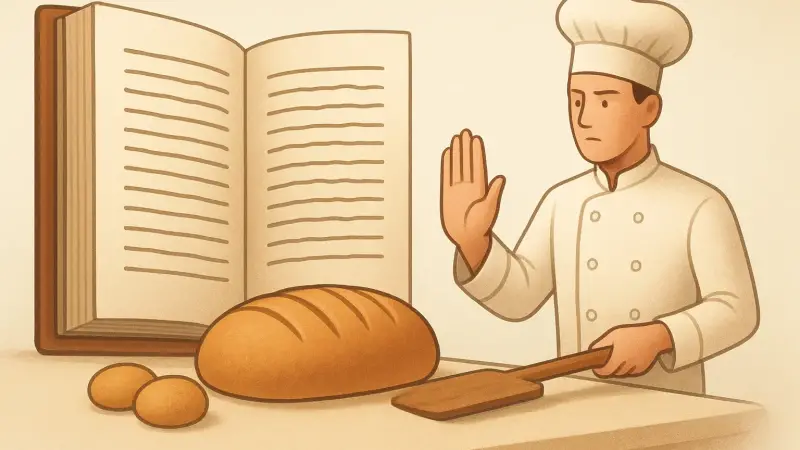
You walk into a bakery with a dog-eared cookbook in your hand, point to a photo, and expect a nod. Instead you get a polite refusal. Not because the recipe is “too hard,” or because they don’t have lemon curd today. The line is stranger than that: they won’t bake anything that’s printed in a book. This isn’t one famous shop with a sign on the door, either. You hear versions of it in different places for different reasons—an independent bakery in New York might frame it as policy, while a small shop in London or Sydney might explain it as “we can’t touch that.” The details vary, but the mechanism is usually the same.
What “no book recipes” usually means
The refusal rarely applies to the finished product. Nobody is saying croissants are off-limits because a book has a croissant recipe. The “no” is about copying a particular written expression. A customer brings in a page. The bakery would be reproducing that exact set of instructions, quantities, and sometimes the branded identity around it. If the request is “make this cake like the one in Joy of Cooking,” staff often treat the physical page as the problem, even if they already know how to make a similar cake.
There’s also a practical communication issue that gets overlooked. When a bakery accepts a recipe from a book, they inherit the book’s assumptions: pan sizes, oven quirks, ingredient brands, even regional words like “caster sugar.” If the result doesn’t match the photo, the complaint tends to land on the bakery, not the author or the publisher. Saying “we don’t work from books” is a clean boundary that avoids that whole argument.
The copyright fear behind the counter
Most of the anxiety comes from copyright, even when nobody in the shop uses that word. In the US and UK, the basic idea is that a list of ingredients is usually treated like a set of facts, while the creative text around it can be protected. But bakeries don’t want to play lawyer in real time. If a customer asks for an item “exactly like the recipe on page 112,” the staff may hear: copy this publisher’s work for money. The safest move is a blanket rule, even if the actual legal risk is smaller than it feels.
The overlooked detail is that cookbooks often include more than the recipe. They can include a distinctive name, a story, a signature decoration, and a photo that sets an expectation. Even if the ingredients are ordinary, the overall “presentation” can be tied to a brand. A bakery might be fine making a chocolate layer cake, but not fine making “Momofuku Milk Bar Birthday Cake” under that name, because the name itself is doing work.
Recipes aren’t factory instructions in a professional kitchen
Another reason is workflow. A bakery’s production recipes are written for their own equipment, batch sizes, and timing. A home recipe printed in a book usually assumes a single oven, a single mixer, and a person hovering over it. Scaling isn’t just multiplying by ten. Yeast behaves differently, fillings set differently, and bake times shift with pan depth and airflow. If a shop agrees to “just do what the book says,” they’re agreeing to an experiment during a workday that’s already scheduled in trays and timers.
This is why you’ll sometimes see a compromise offered without calling it a compromise. The bakery won’t “bake the book recipe,” but they’ll make something in the same family: a lemon tart with a similar look, or a spice cake with similar frosting. That keeps the request in the bakery’s system. It also keeps responsibility where the bakery can control it.
Customer-supplied pages create awkward proof problems
Handing over a photocopied page creates a kind of paper trail, and people underestimate how that changes the conversation. If the bakery takes the page, they now possess a copy. If they text it to a baker in the back, they’ve made another copy. If they pin it to a board for tomorrow’s shift, it’s still there. None of that feels dramatic, but it’s exactly the kind of situation businesses try to avoid: a tangible artifact that looks like “we knowingly reproduced this.” Even if nobody would ever complain, the shop has to consider what happens if someone does.
It can also be unclear who owns what the moment money enters. A customer may think they’re paying for labor. The bakery may think they’re being asked to sell a product that’s tied to somebody else’s published work. That uncertainty is enough for a hard rule, especially in small businesses where the owner is also the person frosting cakes.
How the rule plays out in real orders
The most common flashpoint is a celebration cake. Someone brings a cookbook photo and wants “this exact one,” including the name and the look. The bakery may refuse the book-based request but accept a description: flavors, number of servings, style of decoration, allergies, and a reference like “semi-naked frosting” or “buttercream flowers.” The same end result might be close, but the order is framed as the bakery’s own build, not an execution of a printed blueprint.
And then there are the quiet cases where the bakery says yes without saying yes. A customer mentions a well-known author or a trendy book, and the staff recognizes the flavor combo. They make their version from memory or from their own formulas. The line they’re protecting isn’t taste. It’s the explicit act of reproducing the book on request, with the page sitting on the counter between you.
Related reads
- The squid that flashes in Morse code
- A fountain that changes temperature on birthdays
- A mailbox that keeps receiving postcards from a traveler who vanished decades ago
- The cocktail party trick: how your name cuts through noise
- How glowing algae pulse in sheltered bays
- Why your gut feeling can be alarmingly persuasive