
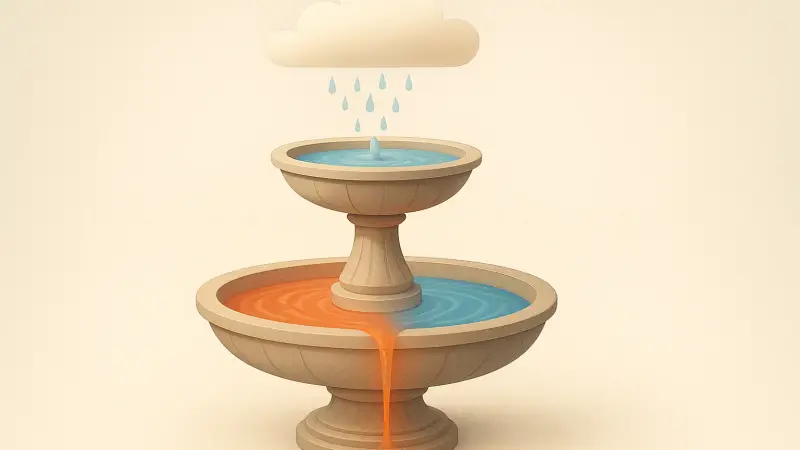
What people mean by a “birthday temperature” fountain
People notice the water feels different on certain days and assume it’s doing something personal. There isn’t one famous, confirmed public fountain known for literally sensing birthdays. It’s usually a story attached to a particular plaza feature or hotel courtyard. You’ll hear versions around big tourist fountains like the Bellagio Fountains in Las Vegas, or older city fountains in places like Rome, where visitors already expect little “signs” to happen. The core mechanism, when there is one, is not mystical: it’s scheduled control. Someone sets the fountain’s water temperature, spray pattern, or timing to match a calendar date connected to a person, an event, or a promotion.
That can still feel uncanny because temperature is intimate. You don’t see it the way you see lights. You only notice it when your hand gets wet, or when the mist hits your face. If the date happens to be your birthday, it’s easy to believe the fountain “knew.”
The simple machinery behind changing water temperature

Most decorative fountains recirculate water through pumps and a filtration system. If they can change temperature on command, it’s usually because a heat exchanger or inline water heater is added to the loop. The control system can be as basic as a thermostat and timer, or as complex as a building-automation panel that schedules different “modes” by date and hour. The water doesn’t need to be heated much to feel different. A few degrees can register on skin, especially if the air is cool.
One overlooked detail is how quickly the loop responds. A large basin holds a lot of thermal mass. It takes time to warm up or cool down. So a fountain that “changes” on a specific date tends to start drifting hours earlier than people expect, or it stays warm long after the programmed window. That lag can make the change feel less like a switch and more like a strange, gradual effect you only notice once you touch it.
How it gets tied to birthdays in the first place
The birthday part usually comes from people, not hardware. A property manager might schedule a warm-water day for an owner’s birthday, an anniversary, or an opening date. A hotel might do it for a VIP guest, because a staff member entered a note and the fountain’s controller already supports special-event presets. In public spaces, it can also be a local tradition: a municipal crew adjusts a valve or heater setting for a mayor’s birthday, a founder’s birthday, or a holiday that locals treat like a birthday for the town.
It also spreads because it’s hard to verify. Most people don’t visit the same fountain every day of the year. A visitor arrives on one day, feels warm mist, and hears a story from someone nearby. The story sticks, but the “control day” might actually be a maintenance schedule, a seasonal setting, or an event booked in the adjacent venue.
Why temperature feels “personal” even when it isn’t
Skin is a sensitive thermometer, but it’s not a precise one. Wind, humidity, and how long you’ve been in the sun changes what “warm” feels like. Fountain spray makes it trickier, because evaporation cools water as it turns into mist. So the exact same fountain setting can feel warm on a still day and cold on a breezy one. That’s part of why two people can stand in the same splash zone and disagree about the temperature.
Another overlooked detail is where you touch it. Water at the surface of a basin can be noticeably warmer than water drawn from the bottom and shot through nozzles, especially if the basin sits in sun. If a person dips a hand in the pool one moment and catches mist the next, it can feel like the fountain is “changing” in real time. It’s just two parts of the system experiencing heat differently.
What a real “birthday mode” would look like up close
If a fountain truly changes temperature for a specific date each year, it usually leaves practical fingerprints. Staff will mention a “special program” because someone has to maintain it. You’d expect consistent timing year to year, because automation is repeatable. You might also notice other coordinated changes that are easier to schedule than heat, like lighting colors, music cues, or a different nozzle pattern.
The giveaway is often not the water, but the equipment. Heating water in an open, outdoor fountain is energy-intensive, especially if it’s windy or cold. So systems that do it tend to do it briefly, in a narrow window, or only for a small feature—one jet line or a mist ring—rather than the entire basin. People remember the moment they felt it on their birthday, but the engineering usually favors the smallest, quickest part of the fountain that can convincingly feel different.

Related reads
- A mailbox that keeps receiving postcards from a traveler who vanished decades ago
- The cocktail party trick: how your name cuts through noise
- How glowing algae pulse in sheltered bays
- Why your gut feeling can be alarmingly persuasive
- The mushroom that wires forests with electricity
- Why rain smells earthy: the bacteria behind petrichor