

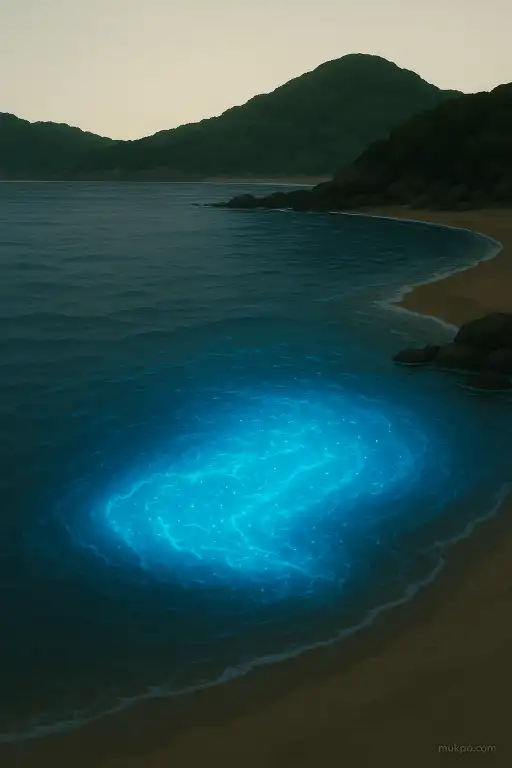
If you’ve ever seen a kayak paddle flash electric blue in the dark, it can feel like the water is “turning on.” This isn’t tied to one single bay. People report it in places like Mosquito Bay in Vieques, Puerto Rico, in parts of California’s coast, and around some sheltered coves in the Maldives. The core mechanism is small: single-celled algae called dinoflagellates get jostled by motion, and they respond with a brief burst of light. When conditions are right in a protected bay, those bursts can look like a pulse moving through the water.
Who is glowing, and what triggers it
The usual glow-makers are dinoflagellates such as Pyrodinium bahamense (a common species in some famous bioluminescent lagoons) or Noctiluca scintillans (often seen in coastal blooms). They aren’t glowing all the time. They glow when something disturbs them: a wave breaking, a fish turning, a hand moving through the surface. The trigger is mechanical stress on the cell membrane. That stress sets off an electrical and chemical chain reaction inside the cell.
The light comes from a reaction between luciferin (a light-emitting molecule) and luciferase (an enzyme). It happens in tiny compartments inside the cell and lasts a fraction of a second. One overlooked detail is that the “spark” is not a continuous lamp. Each cell is more like a camera flash. A bright streak on the water is thousands or millions of these flashes happening nearly at once.
Why sheltered bays make the glow easier to see

Protected bays and lagoons are good at holding onto things. Water exchange with the open ocean can be slower, so dinoflagellates can accumulate instead of getting diluted. Calm water also matters for visibility. Less wind means fewer random ripples producing constant faint flashes. When the surface is mostly quiet, one paddle stroke or one small wave stands out as a clear burst.
Sheltered water can also form layers. Fresh rainwater can sit on top of denser salty water. Temperature differences can do the same thing. These layers reduce mixing and can keep plankton concentrated in a thin band near the surface. If the glowing organisms are packed into that surface layer, a disturbance can look like a sharp, defined line of light rather than a scattered shimmer.
What “pulsing” looks like in the water
The pulsing effect is usually about timing and movement, not the algae coordinating like a school of fish. A small wave train enters a cove and repeatedly stresses the surface layer. Each crest triggers flashes as it passes. To an observer, the bright line seems to travel, then fade, then reappear with the next crest. Boat wakes do the same thing. They create a pattern of alternating compression and shear, and the light follows that pattern.
There’s also a biological limit that shapes the pulse. Individual cells can’t flash continuously. After a flash, they need a short recovery period while the chemistry resets. So the water can’t stay bright under constant agitation. It tends to flicker in bursts, especially when the disturbance comes in waves or strokes spaced a second or two apart.
Why it happens some nights and not others
Glowing depends on how many dinoflagellates are present, and that changes fast. Nutrients, temperature, salinity, and recent weather all matter. Heavy rain can dilute surface salinity and shift the layers. Strong wind can mix the bay and spread organisms out. Tides can either bring in new water or flush the bay, depending on the shape of the inlet. Even when the organisms are there, the glow can be hard to notice when there’s bright moonlight or nearby artificial lighting.
Different species also behave differently. Some migrate up and down in the water column over a day-night cycle. Others bloom suddenly and then crash. That’s why two visits to the same sheltered bay can look completely different, even a week apart.
The small defensive reason they make light at all
The best-supported idea is that the flash is part of a defense system. A sudden burst of light may startle small grazers. It may also act like an alarm that makes predators of those grazers more likely to notice them. Either way, the flash is tied to being touched or disturbed, which fits what people see: the water stays dark until something moves through it.
In a sheltered bay, that defensive flash becomes a visible pattern because the organisms are concentrated and the water surface is calm enough to show the timing of each disturbance. A single fish turning near the top can leave a brief glowing comma, then the water goes dark again as if nothing happened.
Related reads
- Why your gut feeling can be alarmingly persuasive
- The mushroom that wires forests with electricity
- Why rain smells earthy: the bacteria behind petrichor
- Traffic lights that flash seemingly random colors but predict storms
- The confident memory that never happened: how false memories form
- Why yawns spread: what contagious yawning says about empathy