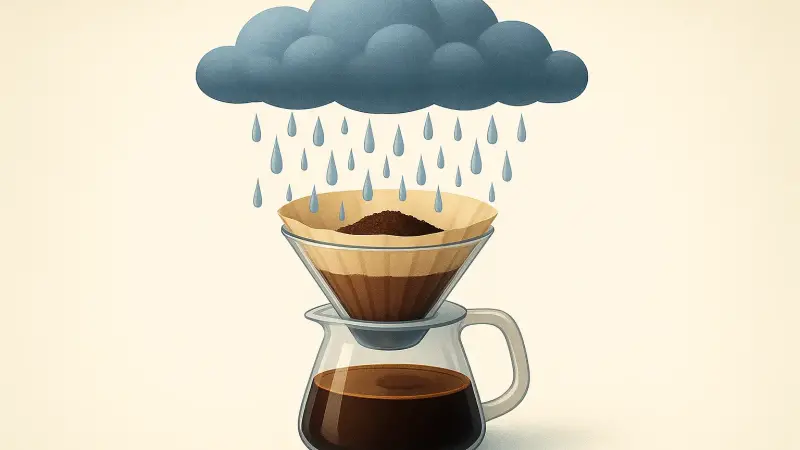
You can taste it when water changes. Even before anyone mentions minerals, the cup can feel flatter or sharper. There isn’t one single café that does this, and some shops only do it seasonally. But rainwater-only brewing is a real idea that shows up in different places, from Amsterdam (where “rainproof” projects have pushed people to think about rain as a resource) to parts of Australia and California that already collect rainwater for household use. The mechanism is simple: capture rain from a clean surface, store it, filter it, and brew with it instead of municipal water. Everything else becomes a detail you can’t ignore.
What “rainwater-only” actually means in a café
Rainwater starts as distilled water. Then it picks up whatever it touches. In a café, the “only rainwater” claim usually means the brewing water comes from collected rainfall, not the tap. It does not automatically mean it’s used for handwashing, dishwashing, toilets, or ice. Those uses trigger stricter plumbing rules in many places, and the shop may still be connected to mains water for everything except the espresso machine and kettles.
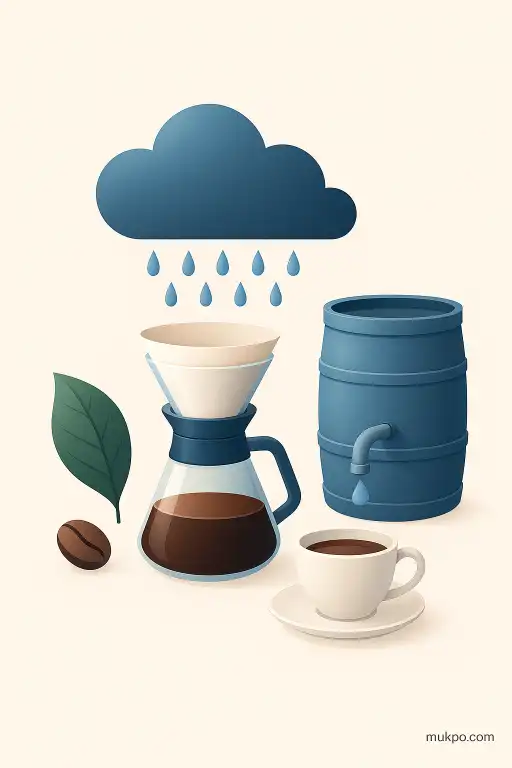
The practical setup is fairly consistent. Roof catchment goes to a tank, then through sediment filtration and a carbon stage. If the café is serious, there’s disinfection, often UV, and then a final “polishing” filter right before the coffee equipment. The overlooked detail is that the tank is part of the taste. Storage time, temperature swings, and biofilm on tank walls can change smell and flavor even if the water tests fine.
The water chemistry problem coffee people can’t avoid
Most rainwater is too soft for brewing coffee as-is. It has very low hardness and alkalinity, so it doesn’t buffer acids well. That can make coffee taste thin, sour, or oddly hollow. Espresso can also become inconsistent because extraction depends on dissolved minerals interacting with coffee compounds.
So rainwater-only cafés almost always end up doing a second step people don’t expect: remineralization. That might be a blending valve, a cartridge that adds calcium and magnesium, or a measured dose of mineral concentrate. It can still be “only rainwater” in the sense that the base water is rain, but it’s no longer chemically “just rain.” That line—what counts as “only”—varies by who’s telling the story and what regulations allow.
How they keep it safe (and what makes it hard)
Rainwater is not automatically cleaner than tap water. Rooftops collect dust, soot, pollen, bird droppings, and whatever the wind brings. First-flush diverters are a common safeguard. They dump the initial runoff from a rain event, which tends to carry the highest contamination load, before allowing water into the storage tank.
Then there’s the equipment side. Coffee machines don’t like variability. If the mineral level swings week to week, scaling risk and corrosion risk both go up, just at different times. That’s why some cafés treat rainwater like a lab input: they test conductivity or hardness regularly and adjust. It’s mundane work, and it’s easy to miss because the marketing tends to focus on the romance of “rain,” not the routine of calibration and logs.
A concrete example of what a rain day changes
Imagine a small shop that collects water from a metal roof into a 5,000–10,000 liter tank. A long dry stretch leaves dust on the roof. The first heavy storm hits. If the first-flush system is undersized or stuck, the tank can end up with water that smells slightly musty. The barista might notice it first as a muted aroma in filter coffee, not as “bad water.” It’s the kind of sensory change people blame on the beans.
On the flip side, after several days of steady rain, the same tank can fill with relatively low-mineral water. If the café’s remineralization setup is manual, the day’s espresso might run faster and taste more acidic until someone checks. That is the operational reality: weather becomes part of the brew recipe, even when the coffee dose and grinder settings don’t change.
Why a café would bother, even when it complicates everything
The appeal is partly practical. Some regions have water restrictions, expensive water rates, or unreliable infrastructure. Capturing rainfall can reduce dependence on municipal supply, at least for brewing volumes. It can also be a way to control water more tightly than whatever comes out of the tap that week, especially in places where seasonal source changes shift mineral content.
The other appeal is that it turns something invisible into something measurable. Customers can see the tank, the gutters, the filtration rack. They can ask what happened after last night’s storm. And the shop has to answer with real details—filter changes, UV bulb replacements, mineral targets—because the cup won’t let them hide it.