
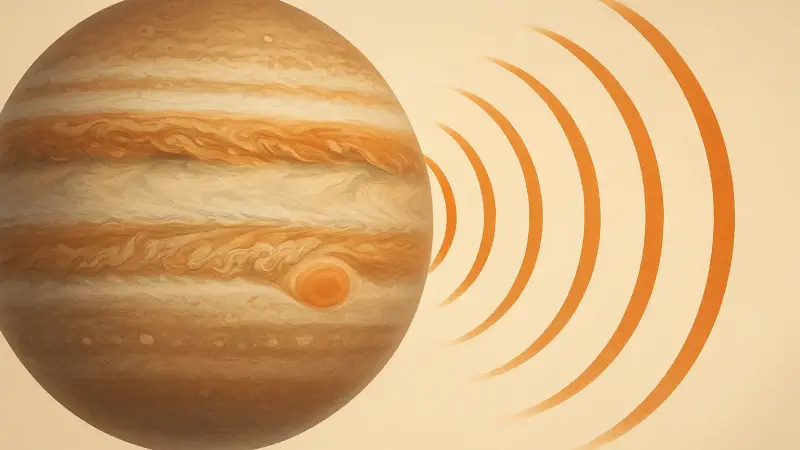
If you point a radio telescope at Jupiter, you don’t get a steady hum. You can get sharp squeals, bursts, and crackles. That isn’t one single “Jupiter storm” doing one single thing. It shows up in different observations and settings, including NASA’s Juno mission at Jupiter, earlier flybys like Voyager, and ground-based radio telescopes on Earth. The core mechanism is electrical: charged particles get accelerated and then dump energy into Jupiter’s upper atmosphere and magnetosphere in a way that naturally produces radio waves. The overlooked detail is that the “storm” people picture—cloud tops and lightning—is often not the direct radio source. A lot of the loudest squeals come from far above the clouds.
Jupiter makes its own radio station
Jupiter has the strongest planetary magnetic field in the Solar System. It also spins fast, about once every 10 hours, which helps whip its magnetosphere into an energetic, rotating system. That combination turns the space around Jupiter into a particle accelerator. Electrons and ions get trapped on magnetic field lines and can be pushed around, energized, and redirected.
The radio “squeals” are a known class of emissions, especially in the decameter and hectometer ranges. Those names are just shorthand for wavelength and frequency bands. The important point is that these emissions are not thermal “glow.” They’re coherent radio waves, which means a lot of particles are acting in a coordinated way, so the signal can be intense and spiky.
Storms connect to the magnetosphere, but not like a weather report
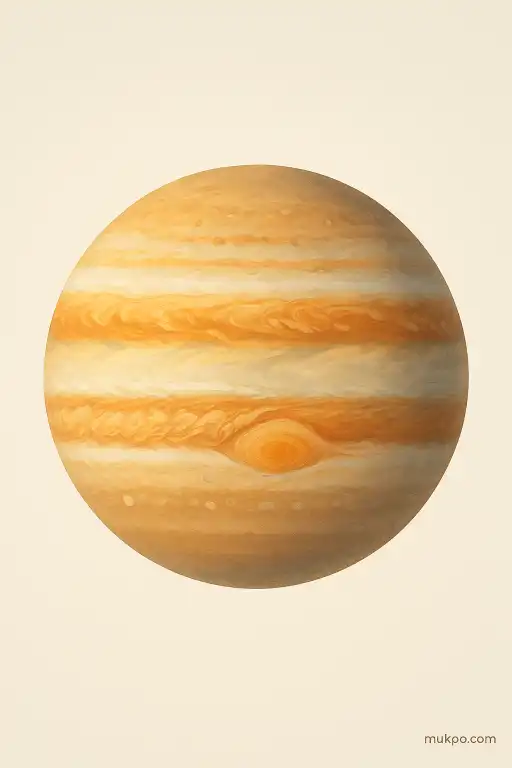
Jupiter’s visible storms—like the Great Red Spot and the many belts and zones—tell you the atmosphere is turbulent and electrically active. Lightning exists there, and it does make radio noise. But the squeal-like emissions people talk about are often tied more to auroral processes than to lightning flashes.
The link is that storms and atmospheric convection can feed energy upward. They can help move charged particles and change electric fields in the ionosphere, the layer where the atmosphere is partly ionized. That matters because Jupiter’s magnetosphere couples to its ionosphere through magnetic field lines. When that coupling changes, the auroral regions respond, and that’s where some of the strongest radio emissions are generated.
The squeal comes from a specific kind of electron motion
A leading mechanism for Jupiter’s intense radio bursts is the cyclotron maser instability. It sounds abstract, but the idea is simple. Electrons spiral around magnetic field lines. If the electrons have the right kind of “lopsided” velocity distribution—more energy sideways than along the field—they can transfer energy into radio waves very efficiently.
That mechanism naturally produces narrowband emissions near the local electron cyclotron frequency, which depends directly on magnetic field strength. Since Jupiter’s magnetic field strength changes with location, the frequency can drift as the source region moves along field lines. That drift is one reason the signal can sound like a rising or falling squeal when converted to audio.
Io can trigger the loudest bursts, and it’s easy to miss why
One concrete example: Jupiter’s decametric radio emissions are famously modulated by Io, Jupiter’s volcanically active moon. Io isn’t just “nearby.” It moves through Jupiter’s magnetic field and plasma environment and acts like a generator. The motion sets up currents along the magnetic field lines that connect Io to Jupiter’s atmosphere, creating an electrodynamic interaction that can light up auroral footprints and trigger radio bursts.
The overlooked detail is that this is not a simple on/off effect. Whether Earth can detect an Io-triggered burst depends on geometry. The emission is beamed, not broadcast equally in all directions. So an observer might see intense squeals at certain Io orbital phases and Jovian longitudes, and almost nothing at other times, even if the underlying activity is still happening.
What a “squeal” really is in the data
Scientists don’t start with sound. They start with a spectrum: intensity versus frequency versus time, often displayed as a dynamic spectrum. A squeal-like event is a bright, structured trace that can curve or drift as conditions change. Converting it into audio just maps frequency to pitch and intensity to loudness, which makes the structure easier for humans to notice.
Those structures carry clues about where the emission happened. Because the emission frequency tracks magnetic field strength, the pattern can hint at altitude and magnetic latitude. It can also show how the source region evolved, like electrons being accelerated in bursts rather than steadily. That’s why a noisy, almost musical chirp can be treated as a measurement of plasma physics happening tens of thousands of kilometers above Jupiter’s cloud tops.
Related reads
- How tiny phytoplankton shape global clouds
- How supersonic winds turn rock into glass on hot exoplanets
- How waterspouts lift fish into sudden rains
- Why you suddenly forget a familiar word mid-sentence
- The village that changes its postal codes as a superstition
- An office building whose plants only thrive when given live music