
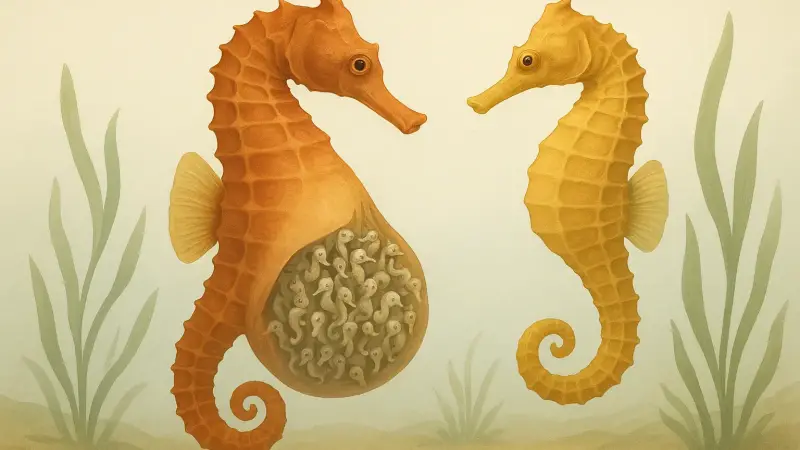
People hear “male pregnancy” and assume it’s a slogan, not a literal body plan. But with seahorses, the core mechanism is simple: the male has a brood pouch, the female places her eggs inside it, and he carries them until they’re ready to come out. This isn’t one single event in one place. It’s how seahorses live across a lot of coastlines, from Australia’s leafy seadragon-and-seahorse waters to the Mediterranean, to eelgrass beds along parts of North America. If you watched a pair in an aquarium, you’d see the handoff happen fast, then the male’s belly area slowly round out as the embryos develop.
The pouch is not just a pocket
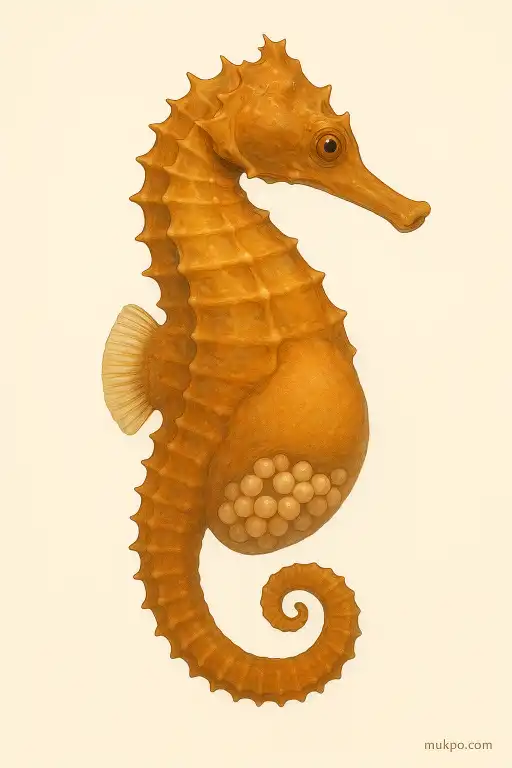
The brood pouch sits on the male’s front side, near the tail. In many species it seals shut after the eggs are transferred. That seal matters. It turns an exposed bundle of eggs into something more like an internal nursery, where the embryos aren’t constantly hit with changes in the surrounding water.
People often overlook that the pouch has living tissue with blood vessels. It isn’t dead skin holding marbles. The lining can exchange gases and manage fluids. That’s a big reason the embryos can develop there for days or weeks, depending on the species and water temperature, instead of needing to be glued to a rock or carried in the open.
How the eggs get in there
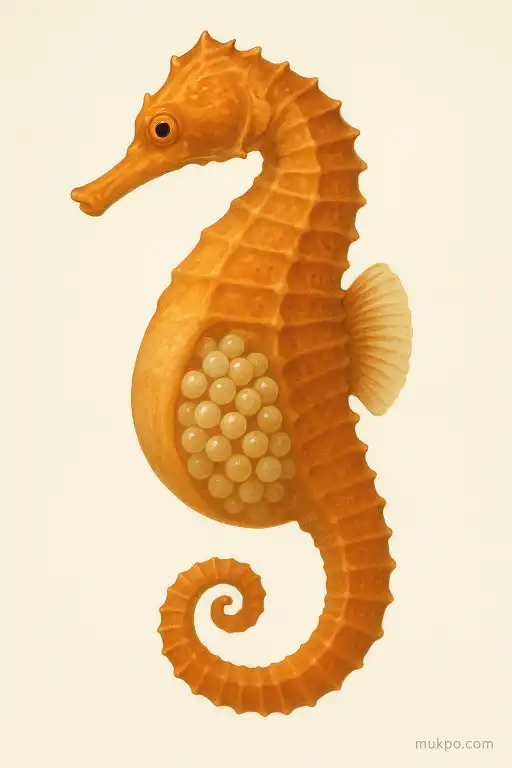
Before the transfer, pairs usually go through a courtship routine. It can look like synchronized swimming, color changes, or repeated approaches. The point is coordination. The female has to line up her ovipositor with the opening of the male’s pouch, and the timing has to be right because eggs don’t stay viable forever once they’re ready.
A concrete example is what aquarists often report: the pair rises in the water column together, the female presses in, and she deposits a batch of eggs in a short burst. “Dozens” is common for smaller species, but the number varies a lot by species and body size. Some seahorses produce far more than that. It’s not a fixed count, and sources don’t always agree because broods change with age, season, and health.
What the male does during pregnancy
Once the pouch closes, the male’s job is active, not passive. The pouch environment shifts as the embryos develop. Water and salt balance have to be managed so the embryos don’t shrivel or swell. Oxygen has to reach them, and waste has to be moved out. The pouch lining helps do that work.
One specific detail people miss is that the pouch can change its internal chemistry over time. Early on, the embryos are adapting to a protected, controlled space. Later, conditions can shift to better match the outside seawater, which makes the final transition easier when the young are released. It’s less like carrying eggs in a bag and more like maintaining a small, adjustable incubator attached to your body.
Birth looks rough because it is
When it’s time, the male goes through strong muscular contractions. In an aquarium, keepers sometimes describe the male gripping a plant or tank decor with his tail and pumping his body. That isn’t dramatics. It’s how he forces the fully formed young out of the pouch opening.
The newborns come out as tiny seahorse-shaped fry. They aren’t larvae that need more time attached to a parent. Once they’re expelled, they’re on their own. There’s no ongoing feeding from the father. The “pregnancy” part is about development and protection, not parental care afterward.
Why evolution ended up here
Seahorses are slow swimmers, and their habitats can be turbulent or full of egg-eaters. A protected pouch changes the odds for the embryos. It also shifts how reproduction is divided between the sexes. The female invests heavily in making eggs, then can begin preparing another batch while the male carries the current one.
That can shape behavior in ways people don’t expect. In some species, pairs are relatively faithful over a breeding season, and coordination becomes valuable because missed transfers waste eggs. In others, the pattern is less stable. The setup isn’t a moral statement or a simple role swap. It’s a workable solution for an animal that can’t guard a nest, can’t hide eggs easily, and still needs a decent number of young to survive the odds waiting outside the pouch.
Related reads
- How mangrove roots breathe in muddy water
- An intersection that fills with hundreds of paper boats after every downpour
- How a Victorian inventor smuggled a steam carriage into a London fair
- The Victorian surgeon whose public anatomy demonstration ignited a London street riot
- A supermarket aisle that keeps smelling like citrus, year after year
- How a Florentine guild in the 14th century outlawed laughter on market days