
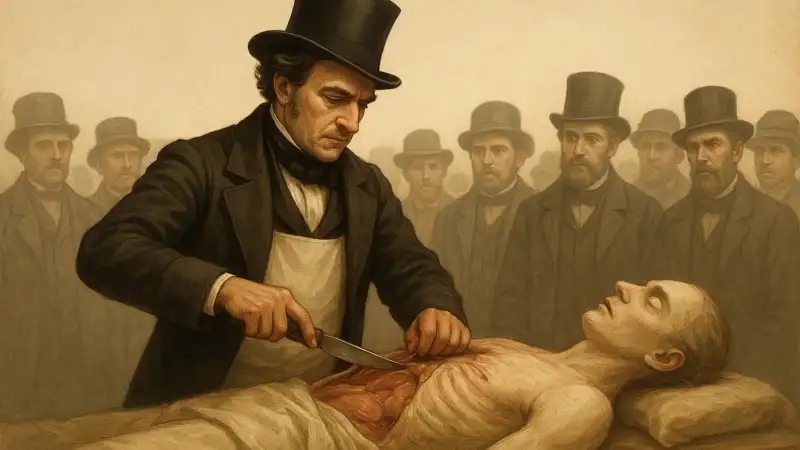
A lecture theatre can feel like a street
People picture Victorian surgery as something hidden away. But in London it was often public, loud, and commercial. One of the best-known flashpoints centered on Robert Knox, an anatomist teaching in Edinburgh in 1828, when crowds fixated on where bodies came from and what surgeons were doing with them. London had its own versions of that tension. When an anatomy demonstration spilled into public anger, it wasn’t usually the scalpels that triggered it. It was the suspicion that someone nearby had been turned into a specimen, without permission, and that the medical men in the room were protected by money and status.
Why dissections made people furious
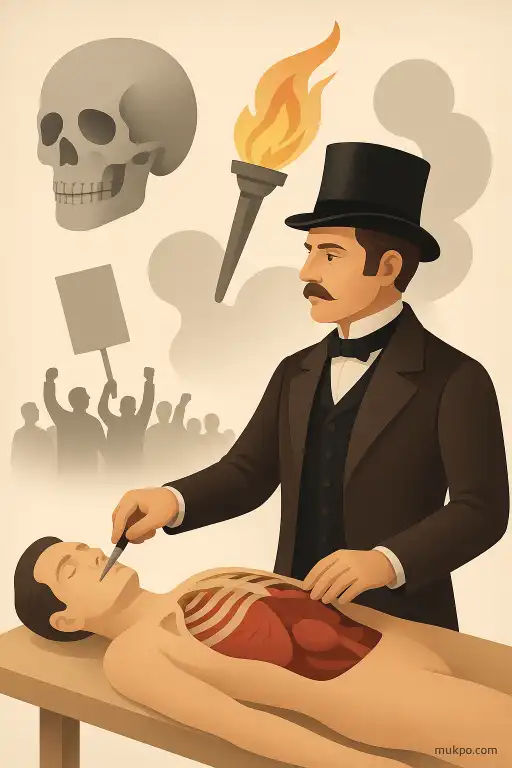
Anatomy teaching needed bodies. Before the Anatomy Act of 1832, the legal supply in Britain largely came from executed criminals. That was never enough. The gap got filled by grave robbing and by a shadow market of “resurrection men” who stole fresh corpses. Londoners knew this wasn’t a rumor. Cemeteries hired night watchmen. Iron cages called mortsafes appeared in some places. Families kept vigil over new graves because they didn’t trust the ground to stay closed.
The overlooked detail is how practical the fear was. A body taken quickly was worth more to a dissecting room because the tissues were still usable for teaching. That meant the danger felt highest right after a funeral, not months later. So a public demonstration, or even the sight of students heading toward an anatomy school, could connect instantly to very recent grief on the same street.
What a public anatomy demonstration looked like
These weren’t always quiet, respectful lessons. Some were ticketed. Some were effectively performances, staged in tiers so paying observers could see. A surgeon might lecture while assistants held limbs in view, or while students clustered close enough to smell the preservatives. If the room was attached to a hospital, there could be a steady traffic of bodies, instruments, aprons, and buckets moving through doors that opened onto public courtyards.
Even when nothing illegal was happening, the setup invited assumptions. A covered cart arriving at an odd hour looked like a corpse delivery. A shuttered window suggested secrecy. The audience itself could make things worse. Students were often young men with a reputation for rowdiness, and their joking could be heard outside. That kind of sound carries, especially in a tight London lane.
How a demonstration turns into a riot
The ignition tends to be social, not surgical. Someone in the crowd claims recognition: a missing neighbor, a pauper from a workhouse, a sailor who never came home. The claim doesn’t have to be true. It just has to feel plausible in a city where poor people could die anonymously and be buried quickly. Once that story lands, the demonstration stops being a lesson and becomes an accusation, aimed at whoever represents the anatomy room.
Then the street does what streets do. People gather because something is happening. Windows fill with faces. The crowd swells past the point where anyone can check facts. If constables arrive, their presence can confirm the worst suspicions: that the surgeon is being protected. Objects start flying because they’re at hand—stones, lumps of mud, bits of broken pavement. The surgeon, students, and staff may barricade doors, and the building becomes the target even if the original anger was about a single body.
What changed after 1832, and what didn’t
The Anatomy Act of 1832 was meant to cut the link between anatomy schools and grave robbing by allowing unclaimed bodies from workhouses and hospitals to be used for dissection. That reduced some kinds of theft. It also moved the fear. Now the worry wasn’t only about cemeteries. It was about dying poor and unattended, and being taken because nobody with influence claimed you in time.
So the conditions for street anger didn’t vanish. Public demonstrations still carried the same basic risk: they made a private, taboo process visible, and they did it in a city where class and power already felt lopsided. When a crowd decided a surgeon had crossed a line, the argument wasn’t about education. It was about whether ordinary Londoners had any control over what happened to their bodies, even after death.
Related reads
- A supermarket aisle that keeps smelling like citrus, year after year
- How a Florentine guild in the 14th century outlawed laughter on market days
- The speeding years illusion: how perception compresses with age
- When a solar storm painted auroras across low latitudes
- How squid see and signal with polarized light
- Smell triggers that pull up entire childhood scenes instantly