
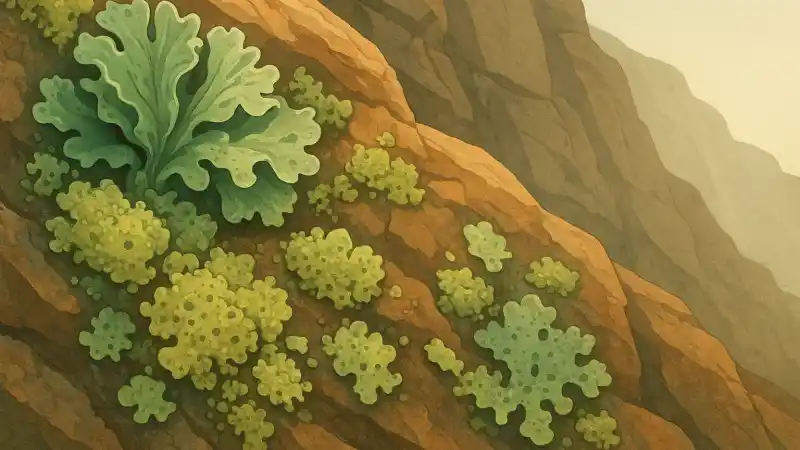
A quiet chemistry on bare stone
People walk past a rock face and read it as solid and finished. But if it has a crust of lichen, that surface is being worked on all the time. This isn’t one single place or event. It happens on sea cliffs in Scotland, on granite in Yosemite National Park, and on lava fields in Iceland, among countless others. The core trick is simple: a lichen’s fungal partner releases acids and other compounds right where it touches the mineral grains. Those “living acids” don’t melt rock like a movie, but they do loosen atoms, open tiny cracks, and slowly change the chemistry of the surface.
What a lichen is actually doing there
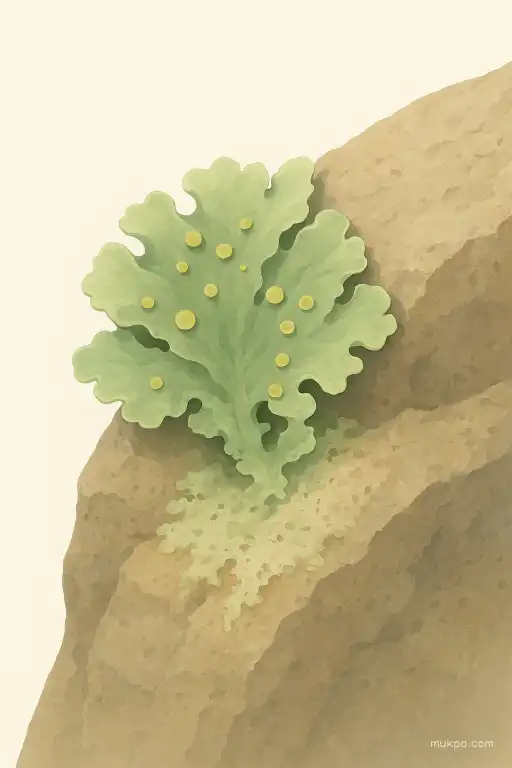
A lichen isn’t one organism. It’s a partnership, usually a fungus with a photosynthetic partner (an alga or cyanobacterium). The fungus builds most of the structure and presses it tight to the rock. That close contact matters. It keeps moisture from drying out too fast, traps dust, and creates a thin, persistent film of water when conditions are damp. That film is where a lot of the chemistry happens, because ions can move through it even when the surrounding air feels dry.
The lichen isn’t “eating” the rock for calories. It’s trying to get scarce nutrients like potassium, calcium, magnesium, iron, and phosphorus. A bare mineral surface can hold those elements, but they’re locked into a crystal lattice. The fungal side is good at bargaining with minerals. It exudes compounds that either donate protons (acids) or bind metals (chelators), and both routes help pull useful ions into solution.
The acids and the slow release of minerals
One overlooked detail is how localized the attack is. The strongest effects are often right under the lichen’s tiny anchoring structures (rhizines) and at the edges where the thallus meets bare rock. Those spots stay wetter longer and collect more dissolved material. Lichens can produce organic acids such as oxalic acid, along with a wide mix of secondary metabolites that vary by species. The exact cocktail is not fixed. It changes with the lichen, the rock type, and the environment.
Acids help in two main ways. They lower pH at the rock surface, which speeds up chemical weathering reactions. And their molecules can latch onto metal ions, which nudges minerals to dissolve so those ions can be carried away in the water film. On calcium-rich rocks, oxalic acid can precipitate calcium oxalate crystals. That sounds like it would protect the rock, and sometimes it does form a crust. But it can also be part of a cycle: dissolve, re-precipitate, and keep the interface chemically active.
Physical leverage: prying, swelling, and micro-cracks
It isn’t only chemistry. The fungal filaments can push into microscopic pores, mineral boundaries, and existing cracks. The expansion and contraction that comes with wetting and drying can widen those openings. In cold places, the lichen’s moisture can freeze and thaw in place, which adds another kind of mechanical stress. The result tends to be tiny grains loosening from the surface and a rougher texture that holds even more water and dust the next time it rains or fog rolls in.
There’s also a timing advantage that’s easy to miss. Lichens can photosynthesize and hydrate quickly after brief wet periods, including dew and sea spray. That means their weathering work can happen in short pulses, not just during obvious rainfall. A rock face that looks dry for most of the day may still have repeated micro-wet events at the lichen-rock boundary, where the acids and dissolved ions keep interacting.
From mined rock to the first hints of soil
As minerals are loosened and organic material accumulates, the surface starts to behave less like bare rock and more like a thin, primitive soil. Dust sticks. Dead lichen fragments add carbon. Cyanobacterial partners can contribute biologically available nitrogen in some lichens, which is a big deal on new or nutrient-poor surfaces. Over long periods, that thin layer can support mosses and small plants, especially in places like Iceland’s young volcanic landscapes where there wasn’t much to start with.
None of this runs on a predictable schedule. Rates vary widely with rock type, climate, exposure, and the particular lichen community. Granite, basalt, and limestone each respond differently because their minerals dissolve at different speeds and produce different byproducts. But the pattern is consistent to observe up close: where a lichen sits, the rock underneath is not just stained. It’s being chemically negotiated, grain by grain, through a living contact zone.
Related reads
- The cliffside that coughs up bottles after every high tide
- Why the perfect word finally pops into your head hours later
- How whale carcasses create island ecosystems on the seafloor
- The law that once listed house cats as livestock
- How background chatter quietly drains your focus
- Australia’s 1932 emu war where soldiers and machine guns were outmaneuvered by birds