
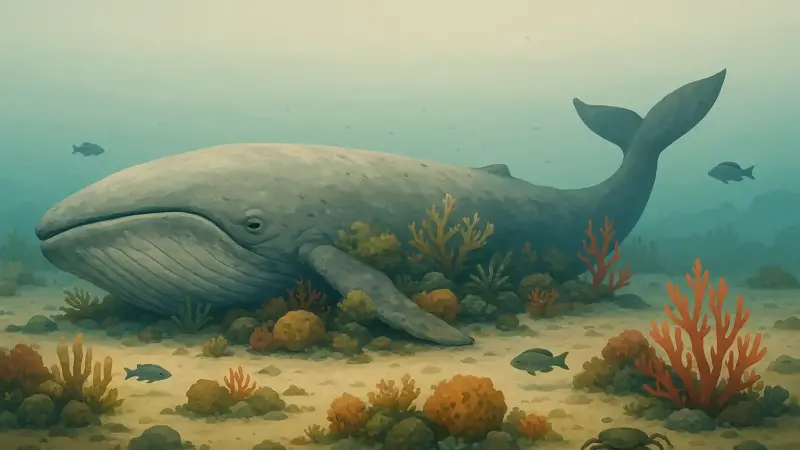
Finding an “island” where there is no land
It’s a quiet contradiction: in the deep ocean, where food is scarce and the seafloor can look empty for long stretches, a dead whale can turn into a busy neighborhood. This isn’t one single place or event. It’s been documented off California, in Monterey Canyon, and on the abyssal plains of the Northeast Pacific, among other regions. The basic mechanism is simple. A huge package of organic matter drops to the bottom. It stays put. Then microbes, scavengers, and specialized animals arrive in waves, each using what the last group left behind.
The fall: a sudden food drop that doesn’t drift away
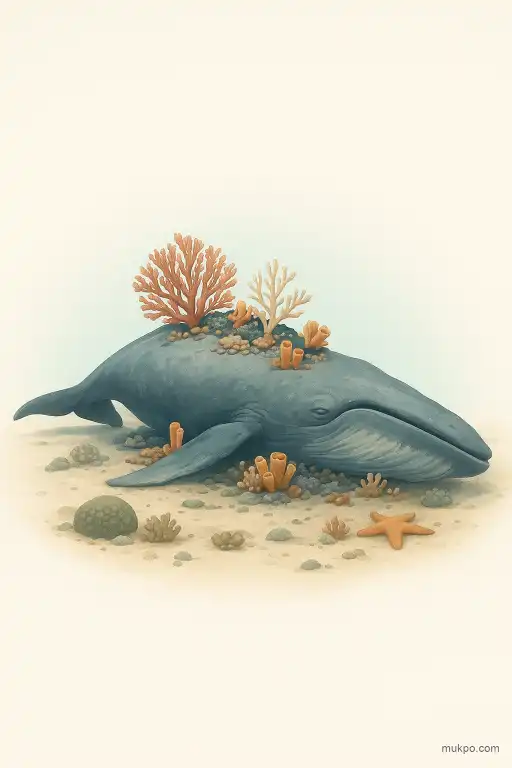
When a whale sinks, it delivers tens of tons of tissue and bone to a single spot. On the surface, that much food would be torn apart and spread out quickly. On the seafloor, currents are often weaker and there’s nothing to drag the carcass away. Location matters. A fall onto soft sediment can partly bury the body and slow access at first. A fall onto rock can leave it more exposed. Either way, the concentration is the point: it’s a rare meal that stays localized for months to decades.
One detail people overlook is how much of the long-term value sits in the skeleton, not the flesh. Blubber and muscle can be stripped fast by mobile scavengers, but the bones are packed with lipids. Those fats can persist and leak out slowly, like a stored fuel source. That’s why the site doesn’t just flare up and vanish. It keeps feeding things long after the obvious meat is gone.
The first wave: scavengers and the “cleanup crew”
The earliest arrivals tend to be animals that can detect a large food source from far away. Deep-sea sharks, hagfish, and large amphipods are often reported at whale falls, though which species show up varies by depth and region. They do the fast work. They open the carcass, remove soft tissue, and leave scraps behind. That activity also stirs up sediment and releases fluids, which changes the chemistry in the immediate area.
As the big pieces disappear, smaller opportunists take over. Crustaceans, worms, and snails move in to graze on leftover tissue, skin, and microbial films. The seafloor around the carcass can become enriched with organic particles. That can support animals that don’t eat the whale directly, but benefit from the spillover. It’s one reason the footprint of a whale fall can extend beyond the bones themselves.
The chemistry phase: a sulfide-powered habitat
After the easy meat is gone, the site can shift into something more like a chemosynthetic system. As microbes break down remaining tissues and bone lipids in oxygen-poor pockets, they can produce hydrogen sulfide. That sulfide becomes the energy source for bacteria that don’t rely on sunlight. Those bacteria can live as mats on nearby surfaces or inside the bodies of certain animals, forming partnerships that turn chemical energy into biomass.
This is where whale falls start to resemble places like hydrothermal vents and cold seeps, at least in function. Clams, mussels, and tube worms associated with sulfide-rich habitats have been found at some whale falls, depending on depth and local conditions. The community isn’t identical everywhere. The intensity and duration of sulfide production can vary, and some carcasses may never develop a strong chemosynthetic stage if decomposition proceeds differently or oxygen stays relatively available.
Bone specialists and the long afterlife of a skeleton
Even when the seafloor looks “finished,” the skeleton can keep creating habitat. A famous example is Osedax, sometimes called bone-eating worms. They’ve been documented in Monterey Canyon and other deep sites. They don’t have a typical digestive tract. Instead, they bore into bone and use bacteria associated with their tissues to help extract nutrients. That lets them exploit a resource most animals can’t use.
The bones also become hard structure in a place that may otherwise be mostly mud. That alone matters. It creates surfaces for sponges, anemones, and other animals to attach to, and it changes local water flow in small ways that can influence where larvae settle. Over time, pieces break, get buried, or get scattered, and the “island” shrinks and fragments. But for a while, it’s a rare, stable patch of food and structure sitting in the dark.
Related reads
- The law that once listed house cats as livestock
- How background chatter quietly drains your focus
- Australia’s 1932 emu war where soldiers and machine guns were outmaneuvered by birds
- The town where the river runs backward once a year
- Why tiny awkward pauses make us assume the worst
- How spiders use zigzag silk bands in their webs