
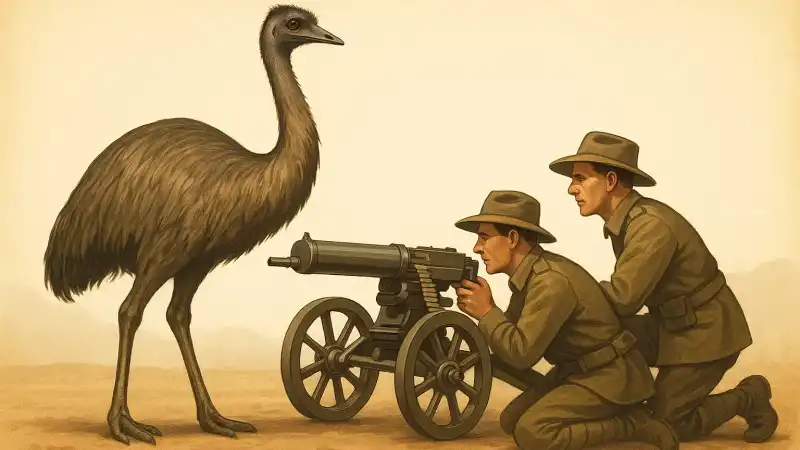
How a “war” with birds even starts
It sounds like a joke until you hit the details: in 1932, in Western Australia, the military was asked to help deal with emus tearing through farms around the Campion district. After World War I, many returned soldiers had been given land to farm, and a bad run of economics and weather made any crop loss feel intolerable. Then thousands of emus moved in from inland areas, drawn by water and food, and fences that were built for livestock didn’t mean much to a tall, fast bird. The mechanism was simple. Big birds ate and trampled grain, and the state tried a tool it understood: guns and uniformed men.
Why farmers wanted soldiers, not just more fencing
Emus weren’t “invading” in a military sense. They were following seasonal patterns and exploiting a new buffet created by agriculture. But on a wheat farm, the difference between nuisance and crisis is often a few bad weeks. Contemporary accounts describe emus breaking fences, opening gaps that also let rabbits in, which made the damage feel multiplied. There was also politics. Farmers had been lobbying for help, and the government faced pressure to be seen acting, especially with soldier-settlers struggling. It’s easy to overlook that this wasn’t purely pest control. It was also public reassurance, staged in the language of response and order.
Machine guns meet a target that won’t behave
The operation used Lewis guns, a light machine gun familiar from the previous war. On paper, that sounds decisive. In practice, the landscape and the animal didn’t cooperate. Emus don’t move like a herd of cattle. They split, scatter, and run in jagged lines, often at speeds a person doesn’t expect from a bird. Shooters also had to deal with range, dust, heat shimmer, and the simple fact that even “large” wild animals present a small, bouncing target. One overlooked detail is how quickly the gun itself became a limiting factor. Reports mention jams and the difficulty of mounting the weapon securely on a moving vehicle over rough ground, which turned “firepower” into bursts that arrived late or not at all.
There were successes. Emus were killed, and some flocks were disrupted. But the mismatch stayed. When birds spread out, a machine gun loses the advantage it has against clustered targets. When they funnel through scrub or low cover, sightlines vanish. Even when a group was lined up, the first shots often turned a tidy target into a chaos of bodies sprinting in different directions. The military approach assumed the birds would present repeated, predictable chances. Instead, each engagement tended to be a one-off, with the survivors learning the shape of danger and choosing routes that made the next attempt harder.
So what does “outmaneuvered” really mean here?
It doesn’t mean emus were clever in a human strategy sense. It means the system couldn’t force an outcome. The birds were spread across wide country, they didn’t need to defend a spot, and they could leave the moment pressure appeared. Soldiers needed road access, ammunition, workable firing positions, and time. Emus needed only space. That asymmetry mattered. So did reproduction and numbers. Even a “good” day of shooting didn’t change the basic fact that more birds could arrive, and the remaining ones could keep doing damage. When people retell the story, they sometimes treat the comedy as the point. But the more interesting part is how quickly certainty collapses when the target is mobile, decentralized, and not trying to “win” anything.
What actually reduced emu damage afterward
The military effort ended, and the label stuck: an “emu war” that Australia “lost.” But the longer-term controls were quieter and more bureaucratic. Bounties and organized culls continued in various forms, and farmers kept pushing for stronger fencing and better pest management. Over time, improved exclusion fencing did more than gunfire to protect particular paddocks, because it didn’t require finding the birds at the right moment. The episode also left a mark on how governments talked about pest control. Calling in soldiers made for headlines, but it also made failure visible in a way routine programs don’t. Out in the wheat belt, though, the daily issue stayed the same as it was in 1932: when water and grain are concentrated in one place, wildlife will notice first.
Related reads
- The town where the river runs backward once a year
- Why tiny awkward pauses make us assume the worst
- How spiders use zigzag silk bands in their webs
- Why confident speakers change our beliefs even without evidence
- How repeating a word until it sounds meaningless tricks your brain
- The hotel room guests say rearranges itself at night