
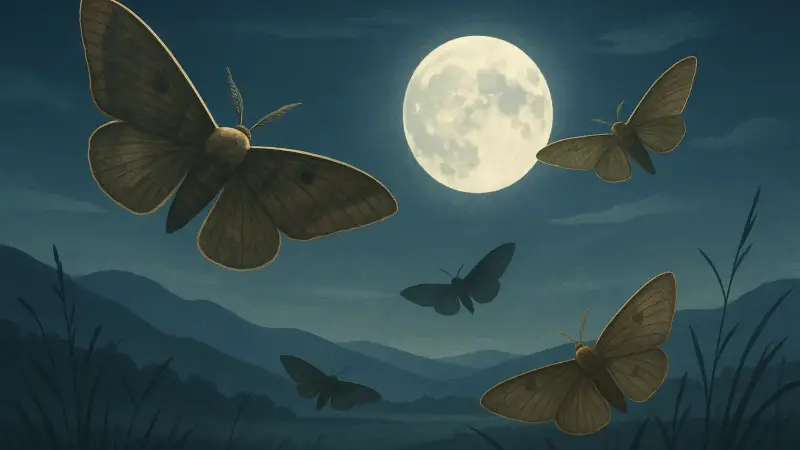
Walk past a porch light on a clear night and you might see it: a moth that seems to “orbit” the bulb in tight loops. Out in the dark, that same animal can fly for kilometers without doing anything like that. This isn’t one single place or event. People notice it in rural England, the U.S. Midwest, and around streetlights in places like Tokyo. The core mechanism is simple and a little fragile. Many nocturnal moths keep a steady flight path by holding a constant angle to a faraway light source, often the Moon. When the light is close, that rule breaks, and the flight path curves.
The “keep a steady angle” trick
For an animal with a tiny brain, the Moon is a useful reference. If a moth keeps the Moon at, say, 30 degrees off its body axis, it can travel in a roughly straight line. The geometry works because moonlight arrives almost parallel across the landscape. The Moon is so far away that “constant angle” and “constant direction” end up being nearly the same thing.
This kind of navigation doesn’t require a map. It’s more like a stabilizer. It also doesn’t have to be perfect to be useful. Even brief glances at a stable cue can reduce drifting when a moth is weaving through trees, hedges, or tall grass.
Why porch lights cause spirals
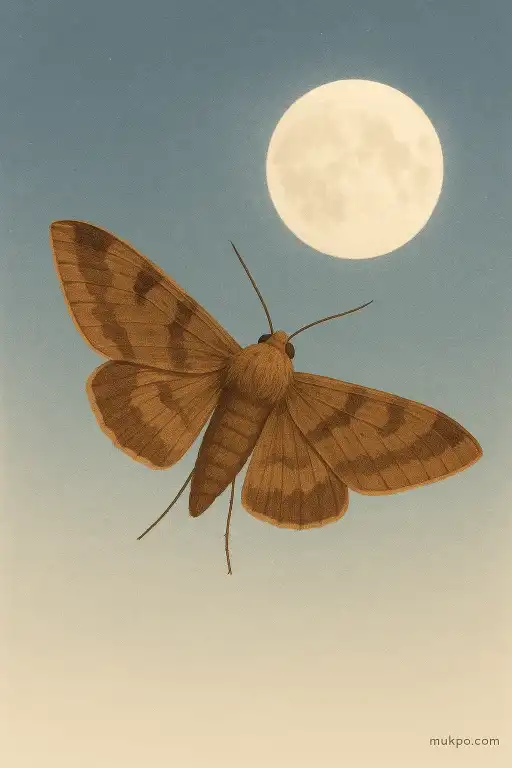
Put a bright lamp where the Moon “should” be and the same rule produces a different path. A nearby bulb isn’t at optical infinity. Its rays spread out. If the moth tries to keep a constant angle to that light while moving, the only way to do it is to curve inward. That’s how a spiral or looping “orbit” can happen.
The overlooked detail is that the loop size depends on distance and height. A moth circling a wall sconce is reacting to a light that sits above and to the side. The same moth near a low garden lamp may spiral differently because the angle it tries to hold forces a sharper turn closer to the ground.
The Moon is helpful, but it’s not the only cue
Moonlit navigation isn’t a single “moon compass” that runs all night. Moths also use the horizon, contrast edges, wind direction, and the texture of optic flow as the ground moves beneath them. If the wind shifts, a moth can correct without ever needing to “know” where it is, just by balancing how fast the world slides across its eyes.
Odor plumes matter too. Many nocturnal moths track scent by flying upwind when they smell it and casting crosswind when they lose it. Under a bright light, that odor-tracking can get disrupted because the insect keeps reorienting to the light source instead of committing to the wind-and-smell pattern.
What moonlight looks like to a moth
Moth eyes are tuned for dim conditions. They can be very sensitive to small changes in brightness, and they can respond quickly to flicker and motion. That sensitivity helps with night flight, but it also makes artificial lighting unusually “loud” information. A single LED can dominate the visual field in a way moonlight rarely does, even when the Moon is full.
Color and polarization can enter the picture, but it varies by species and conditions. Moonlight is partially polarized, and some insects can use polarization patterns in the sky as a compass. It’s not always clear how much any given moth relies on that on a typical night, especially under cloud cover or near urban skyglow that washes the pattern out.
Moonlit landscapes change night to night
The Moon isn’t a fixed beacon. It rises, moves across the sky, and sets. A moth using it as a reference has to update the angle over time or combine it with other cues. Clouds can remove the cue entirely for minutes, then reveal it again. Tree canopies can turn moonlight into moving patches that don’t behave like a stable point source.
Then there’s the human layer. Streetlights, illuminated signs, and even lit windows add multiple bright “moons” at different heights and distances. A moth flying along a hedgerow can pass through alternating zones of darkness and glare, switching guidance strategies mid-flight, and that’s when the path starts to look jagged or indecisive even on an otherwise calm, clear night.
Related reads
- Why time seems to slow down during a sudden scare
- How lichens mine rock faces with living acids
- The cliffside that coughs up bottles after every high tide
- Why the perfect word finally pops into your head hours later
- How whale carcasses create island ecosystems on the seafloor
- The law that once listed house cats as livestock