
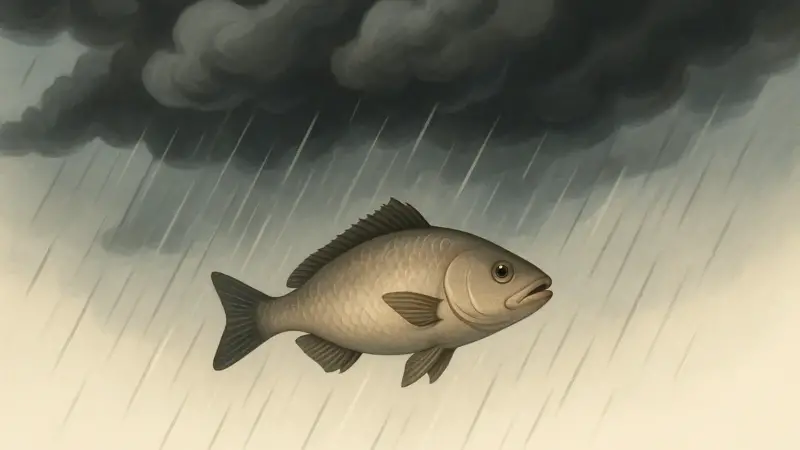
How fish end up in the air in the first place
People talk about it like it’s a tall tale, but it isn’t tied to one single town or one single storm. It’s been reported in places as far apart as Yoro, Honduras (where residents have a long-running “rain of fish” tradition), Marksville, Louisiana (1947), and parts of Australia. The basic mechanism is straightforward. A violent storm can lift small animals out of shallow water, carry them, and then drop them somewhere else when the winds change or the storm weakens. It sounds impossible mostly because we imagine fish as heavy. Many of the ones that fall are small, light, and already near the surface.
The overlooked detail is how selective the “catch” can be. Reports often mention one kind of fish, or fish without many leaves, sticks, or lake muck mixed in. That isn’t proof of anything paranormal. It’s a hint about where the water came from and how the storm grabbed it.
What kind of storm can do it
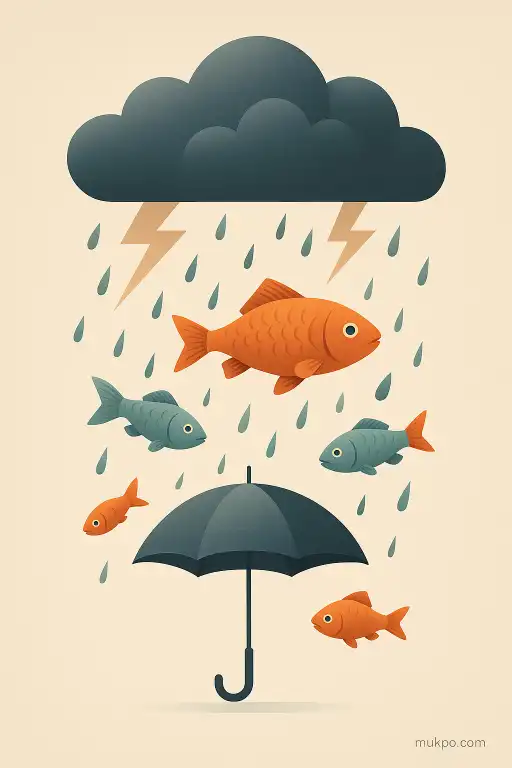
The usual suspect is a waterspout, which is basically a tornado over water. You don’t need a monster tornado that tears up towns. A narrower vortex over a lake, a flooded field, or a coastal inlet can be enough to loft small fish or tadpoles. Strong updrafts in severe thunderstorms can also lift spray and light debris, but the neat “animals only” stories tend to fit a rotating column of air better than a chaotic gust front.
Another overlooked point is timing. The storm has to hit water at the right moment. Shallow water after heavy rain, seasonal flooding, or a shoreline packed with baitfish makes it easier. A deep, calm lake with big fish isn’t as good a source as a ditch, a pond edge, or a flooded pasture where small fish are concentrated near the surface.
What the “fish fall” looks like on the ground
Accounts that sound most plausible tend to be oddly specific: fish scattered across a small area, sometimes alongside frogs or small crustaceans, with no obvious sign of a nearby flood washing them in. The Marksville, Louisiana case in 1947 is often cited because it wasn’t described as a single pile of fish. It was a spread-out drop, noticed after a storm passed. That distribution matches the idea of animals falling out of a weakening circulation rather than being dumped like a bucket.
People also overlook how far a storm can shift between “pickup” and “drop.” A waterspout can travel, dissipate, or reform. So a neighborhood can get fish even if the nearest obvious body of water is not right next door. That gap is what makes the story feel impossible to anyone who didn’t watch the storm’s full path.
Why it’s often one species, and why some fish survive
When a storm scoops from a small, uniform source, it tends to pull up what’s easiest to lift. That usually means the same size range and the same species that were schooling near the surface. If the source is a shallow pond with mostly one kind of small fish, that’s what falls. A mixed bag is more likely if the vortex crosses different water patches or churns up a more varied shoreline.
Survival is less mysterious than it sounds. A small fish falling onto wet grass, mud, or a puddled street has a better chance than one landing on hot pavement. Some reports mention fish that were still flopping, which can happen if the trip wasn’t long, the air was cool, and the landing surface was soft. Others describe fish already dead or injured, which also makes sense because the ride involves tumbling, pressure changes, and impacts with rain or debris.
What makes these reports hard to pin down
Even when something real happened, the documentation is usually thin. People notice the fish after the storm, not during it. That means the critical details—wind direction, storm track, proximity to shallow water—are reconstructed from memory. It’s also easy for separate events to blur together. A local legend like the one in Yoro, Honduras is part weather story and part community tradition, so the boundary between repeated reports and repeated retellings isn’t always clear.
Another complication is that “fish from the sky” competes with more ordinary explanations that can look similar at a glance. A flash flood can strand fish when water retreats. A bird can drop a fish. A truck can spill bait. Those don’t explain every report, but they explain enough that each case has to be read like a small scene, not like a single category. The cases that keep attention are the ones where the fish are fresh, widespread, and appear without the other signs you’d expect from flooding.

Related reads
- How biological soil crusts glue desert sand into living mats
- Why spinning ice slabs can flip and launch during a thaw
- Why speaking feelings out loud can calm the body
- Why sidewalk puddles vanish faster under leafy trees
- The rainforest fungus that secretes tiny antibiotic molecules
- How confident voices make doubtful facts feel true