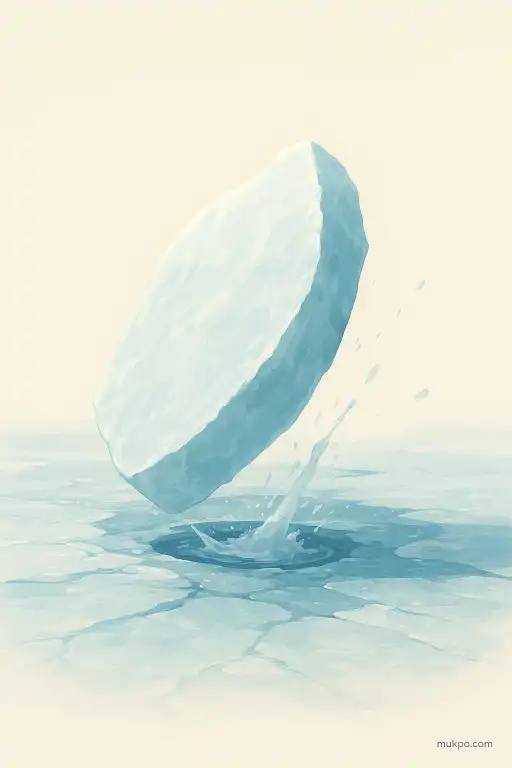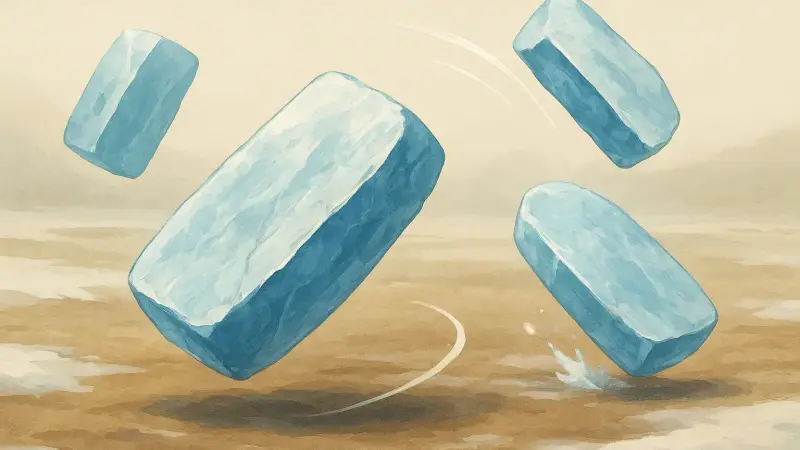
People sometimes catch a weird moment on a river during spring thaw: a flat slab of ice starts spinning, then it suddenly tips up like a hinged door and snaps out of the water. It’s not one famous incident in one town. It gets reported wherever big river ice breaks up, like the Yukon River in Alaska, the Red River along Minnesota and Manitoba, and Finland’s lake and river shorelines. The basic mechanism is plain but easy to miss. A floating slab can be held down on one edge, pushed by current, and “loaded” by water pressure underneath. When that hold releases, the slab doesn’t just drift. It can flip and launch.
What has to be true for a slab to act like a lever
Ice has to stop being a free floater. One edge needs to be pinned. That pin can be a gravel bar, shoreline ice, a log, a bridge pier, or even another ice floe wedged against it. Once one edge can’t rise easily, the slab becomes a lever with a pivot. The rest of the plate is still buoyant, so it wants to pop up, but it can’t do it smoothly.
The slab also has to stay stiff enough to act like a single piece. Late-season ice can be honeycombed and weak, which makes it crumble instead of flipping. The “launch” moments tend to involve slabs that are still coherent, even if the surface is wet and rotten. Thickness varies a lot by river and season, so the exact feel of it is hard to generalize, but the lever setup is the common requirement.
Water pressure can build under the ice without looking dramatic
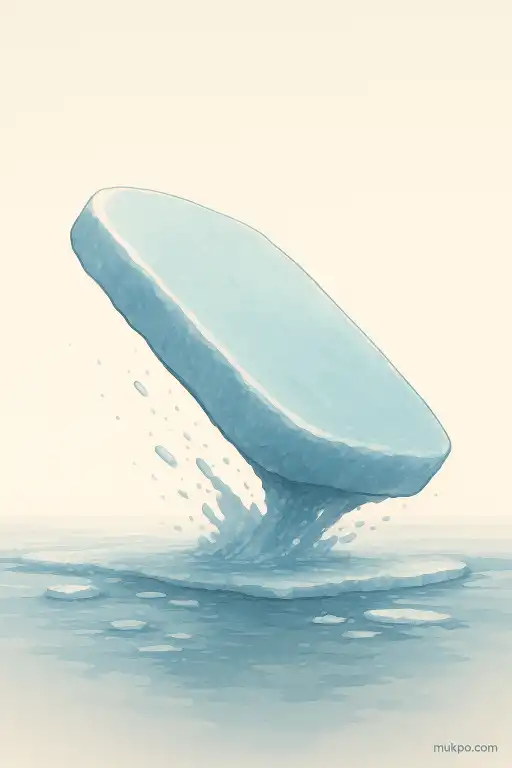
During thaw, meltwater and rising flow change the water level quickly. A slab that was resting low can find itself with current forcing water under it. If the downstream edge is pinned or pressed against something, water can’t escape as easily. Pressure increases under the plate. It’s the same basic idea as pushing up on the bottom of a board in a bathtub, except the river is doing it unevenly and continuously.
A detail people overlook is the thin gap under the slab. It doesn’t need to be a visible “cavity.” A few centimeters of clearance is enough for fast water to ram in, slow down, and raise pressure locally. Turbulence around obstacles can also create pulses, so the lifting force is not steady. That uneven forcing matters because it helps the slab start rotating instead of simply rising.
Why spinning happens before the flip
Rotation starts when the forces aren’t centered. Current rarely hits a slab perfectly evenly. One side gets more push, or the underside has roughness that catches flow. If one corner is lightly grounded or snagged, the slab can yaw around that point. Once it’s turning, it’s easier for water to keep getting under one side. The spin and the lift feed each other.
There’s also an angular-momentum effect that makes the motion feel abrupt. As the slab rotates and one edge starts to rise, the contact point can migrate. The pivot shifts from one snag to another, like a door whose hinge keeps jumping. Each hinge-jump changes the torque suddenly. That’s one reason a slab can go from lazy spinning to a sharp, almost springy tip-up in a second or two.
The “launch” is usually a release of stored bending and buoyancy
Ice bends a little before it breaks free. With a pinned edge, the slab can flex under its own buoyancy and the extra upward pressure from flowing water. That flex stores energy. If the pinning point finally fails—because ice fractures at the edge, a jam shifts, or a rock grip lets go—the slab can rebound. The rebound is the pop people notice.
Buoyancy adds to it. The moment the slab is no longer held down, the displaced water it was “owed” pushes it upward. If the slab is already tilted, that upward force has a sideways component too, so the motion can look like a kick out of the water rather than a clean rise. How high it goes is variable. It depends on slab size, thickness, how tight the pin was, and how fast water is still being driven underneath at the moment of release.
Where observers tend to see it, and why thaw timing matters
These flips show up near constrictions and rough boundaries: outside bends where ice rides up on the bank, shallow riffles, around bridge piers, and at the edges of ice jams. The Red River’s spring breakup is a classic setting because broad sheets can shear and then get trapped along shore ice. On the Yukon River, breakups can involve big, stiff pans moving fast, which makes the pin-and-release behavior more likely when they snag.
Thaw timing changes the balance. A slow warm-up can rot the ice so it loses stiffness and breaks instead of levering. A rapid rise in flow can keep slabs intact while adding strong under-ice pressure, especially if nighttime refreezing still toughens edges. That mix—coherent slabs, rising water, shifting jams—sets the stage for a piece of ice to spin, find a pivot, and then let go all at once.